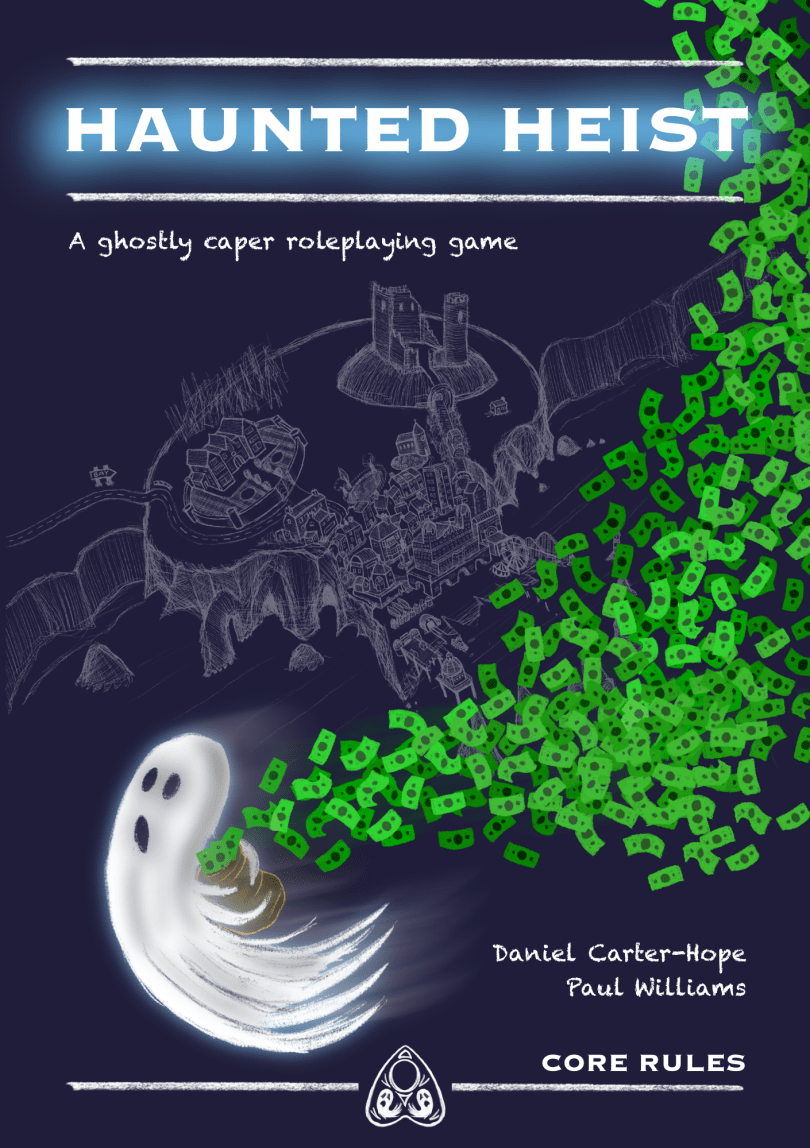
Haunted Heist is “A ghostly caper roleplaying game” by Red Mug Games.
It’s quite a novel idea in my opinion, it’s a fun concept that’s different from most TTRPG systems. So let’s see what’s in store.
The Concept
The GM is playing the role of a medium, that for whatever reason is in dire need of money. Lots of money, and quick – and so, they conjure up some criminal spirits a.k.a. players, and plan and execute a heist with their assistance. The big thing here is that the game is collaborative – The GM doesn’t just narrate or control NPCs, they actually take part in the heist with their own actions and decisions. Not that GMs don’t usually do that regardless, but… you get what I’m talking about – the GM is also a player by design. So the GM is very invested in the player’s success – because the GM will suffer the consequences of failure more than them.
As for the players, they each take a role of a ghost – “a criminal in life and a tormented spirit in death”, a fitting description for the miserable marauders that manifest. Each ghost has a Name, a Date of Death, an Anchor, and a Criminal Past. These have some effects on the mechanics, but are mostly flavor – however, the players also have Unfinished Business. They wouldn’t be ghosts otherwise, would they? This consists of 3 elements that the player comes up with themselves: Who, What, and Where, and has a stronger effect on the gameplay – but also, a ghost that recalls or fulfills all of their unfinished business can finally escape the afterlife and move on. More on that later.

As you can probably see, this system is heavily suited to one-shots without much of an overarching story or “campaign” – perfect for a halloween session, perhaps. Sure, you could do 2 or even 3 heists, but sooner or later the GM’s debt will be paid – not that this is a bad thing, not every game needs to have a long interconnected campaign. Still, I think it’s pretty easy to add that element: instead of a medium with a debt, the GM can be a member of some supernatural criminal syndicate, or even some kind of organization like the Foundation or the Global Occult Coalition from the SCP universe, shifting to a more spy-like genre easily. Just an idle thought, but something I wanted to mention – now let’s move on.
The Setting
The game takes place in a small coastal English town called Mortecambe Bay, the perfect location for ghostly shenanigans. Seaside places are ideal for spooky stories, and England has a very rich and violent history – you can have ghosts from the Roman Legions to Vikings, pirates, all the way to the modern age and everything in between (or even earlier).
There’s a lot of attractions (read: targets) in the Bay – from the old Grand Hotel to caverns filled with forgotten smuggler’s gold, and from Mallory Manor to the local fish and chips shop, there’s money to be made – though obviously, in some cases more than others. And even if we’re not talking about heist locations, there’s more that sells the atmosphere – the Lover’s Leap, a cliff with a self-explanatory morbid name, or the even more morbid Dead Man’s Fingers, a series of rocks protruding from the sea floor that have been the cause of innumerable shipwrecks, and more, each one giving plenty of inspiration for an untimely end and a bitter afterlife… and thus a prospective crewmember for the psychic Ocean’s however-many (technically as few as 1, with no upper limit).
Of course, you can use your own town instead of Mortecambe Bay, but I really appreciate that we’re given a primer with plenty of possibilities to start out with.
The Game
Now to the good part, the game itself. It uses d6 for everything, and is divided into 4 phases. In the Manifestation Phase, the players create their characters as mentioned earlier, and pick their Ghost Class. There are 3 classes – Haunter, with the ability to cause spooky sounds, apparitions, or glitches in machinery, Possessor, with the ability to compel the living to do something, probe their mind for info, or even outright fully possess them for a short duration, and Poltergeist, with the ability to levitate or throw stuff around, slam doors, blow lightbulbs, and generally cause the most chaos of the 3 – at least in a direct, physical sense.
Each ghost has a Spirit Level (SL) that they use to activate their abilities – it starts with a maximum of 6 (using a d6 to note it) and this maximum can increase if you find hints about your Unfinished Business. There’s also limited ways to recover SL – you can drain energy from a living person (with a chance of things going horribly wrong, of course), you can gain some SL from let’s call them critical successes, or you can spend all your SL and be resummoned by the GM to recover it (at a cost to the GM though).

When all the players have Manifested, it’s time for the Planning Phase. Here, the GM lays out the target, the score their crew is after, and what obstacles they might encounter. Then, along with the players, they come up with their convoluted plan to steal whatever priceless artifact or pile of money they’re going for, and how they’re going to neutralize or overcome the obstacles present. When everyone’s ready, the GM sets down the Seance Clock – this determines how many rounds they have until they lose connection to the summoned spirits and the heist fails – and mark their Psychic Stress: if this hits the max, the GM dies (and everyone obviously loses). You can choose the Seance Clock, depending on how many players there are and how easy or hard you want the heist to be – it’s suggested to start with 10, but after a couple of heists you can probably get a feel for how much you can stretch it.
Then, Heist Phase – it’s go time. Each turn, the players take one action, spending SL as appropriate, and rolling 2d6 to check their success. Most of the time, things are going to go alright – not great, not terrible – but, there’s a catch: for each partial success, the player rolls on the “Grave Consequences” table. Despite the name, there’s a decent chance for a neutral or even positive outcome – but there’s also the chance to mess up big time. Spirits do their thing, the GM takes Psychic Stress (not necessarily, but come on, there’s no way a round will go through without something going south), and then the round is over and the Seance Clock ticks down. And down, and down, a race against time with more obstacles popping up as players try their best.
I’m not going to go through every single mechanic involved (I mean, that’s for you to find out when you get the game) but I will point out a couple I found cool: First of all, if a player rolls badly enough, there’s a chance for them to kill someone accidentally. If they do… that person rises as a Vengeful Spirit, with their only goal being to stop their killer from achieving their objective. There are ways to deal with that, but it’s something you’ll have to work with when it happens. In addition to just being a cool mechanic, it also gives the player a VERY good reason to never intentionally kill someone. Second, every time a player makes an Ability Check and rolls their 2d6, the GM can focus their psychic powers and attempt to predict the outcome. If they succeed, they can choose a bonus, such as restoring SL to all ghosts, or rolling back the Seance Clock by 1 round, etc. It’s not mentioned if the GM needs to predict both rolls or just the total, but I guess it’s up to you. Probably a good idea to go with the harder option though if you have many players, otherwise you can just pick 7 every time and then things might be a bit too easy.
Finally, it’s done – your crew hit the motherlode, your time run out, or the GM had a heart attack from the Psychic Stress. Either way, it’s time for the Wrap-Up Phase – it’s over.
Overview
This is a game that’s obviously made to be a lighthearted, fun romp with spooky shenanigans. It’s quite open-ended, not really crunchy with its mechanics in the slightest – good for some, bad for others, but it knows what it wants to do. It’s also very open in terms of setting, giving you endless options to try. It’s generally short, built for one-shot sessions, and there’s no need for meticulous planning, although it does require quite a bit of improvisation.
Overall, I’d say Haunted Heist is a charming, accessible, and flexible game, and definitely worth a try.
 The Kind GM