
Splendor is a board game designed by Marc André and published by the Space Cowboys for 2 to 4 players, about getting rich during the Renaissance.
I first played Splendor very recently at my LGS, and I was immediately hooked. It’s probably one of the simplest and most straightforward board games I’ve ever played, and it’s very quick both to set up and play, so it’s absolutely perfect for casual players – but it still takes some thinking.
The Concept and The Box
Players are rich merchants in the Renaissance – and they want to get richer. Splendor is a card development game: you buy mines, ships, caravans, trading posts, artisans, etc etc, building up your prestige (a.k.a. Victory Points) until you win.
So what’s in the box? 3 things:
- 40 tokens that represent gems – Emeralds, Sapphires, Rubies, Diamonds, and Onyx (Onyxes?), 7 of each and helpfully colour-coded, and then also 5 Gold tokens.
- 90 Development cards split into 3 levels – 40 Level 1 cards, 30 Level 2, and 20 Level 3.
- 10 Noble tiles.
- 1 Rulebook (So 4 things, but you know… it’s the rulebook).
The tokens are made of plastic and are pretty chunky, which I like – besides being sturdy, it also gives them weight, so you really feel it when you buy a brand new galleon with some fat emeralds. It’s a small thing, but for me it counts!
The Rules and Mechanics
Let’s go over the rules real quick. You collect the aforementioned coloured gems, and then you use them to buy development cards. Most cards give you prestige – when you (well, not necessarily you specifically, any player, but I’m going to assume you’re the one ahead and winning) reach 15 prestige, everyone plays another round, and after that whoever has the most prestige is the winner. In case of a tie, the player with the least cards wins.
The development cards have only 3 things that matter: Cost, Bonus, and Prestige. We already talked about Prestige; the Cost is how many gems you need to pay for it, for example, 2 red, 2 blue, 1 white (I’ll call them by their colours instead of rubies, emeralds etc from now on), and finally the bonus gives you discounts on future cards. Each card has a single colour bonus – for example, buying a ruby mine gives you 1 red bonus. This means that if next turn you want to buy a card that costs 2 red, you only need to pay 1. These discounts/bonuses stack, until you can “buy” cards for completely free if you have enough of them.
I mentioned that the development cards are split into 3 levels – mechanically, there’s absolutely no difference, except that higher-level cards cost more and give more prestige. They still give just 1 bonus though, regardless of level. The bonus has 1 additional use, besides the discount: Getting nobles. Each noble has a specific requirement in terms of bonuses, mostly either 2 sets of 4 or 3 sets of 3 – so a noble might want 4 blue and 4 red bonuses for example, or 3 red, 3 white, and 3 green, et cetera. The moment a player has those bonuses, they grab the corresponding noble – and get 3 prestige.
Finally, let’s take a look at the setup and turns:
At the beginning of the game, you randomly place a number of noble times equal to the number of players +1. So for example, 3 players means 4 nobles. Then, for the 3 levels of development cards, you reveal 4 cards of each and place them on a grid, as you can see below.
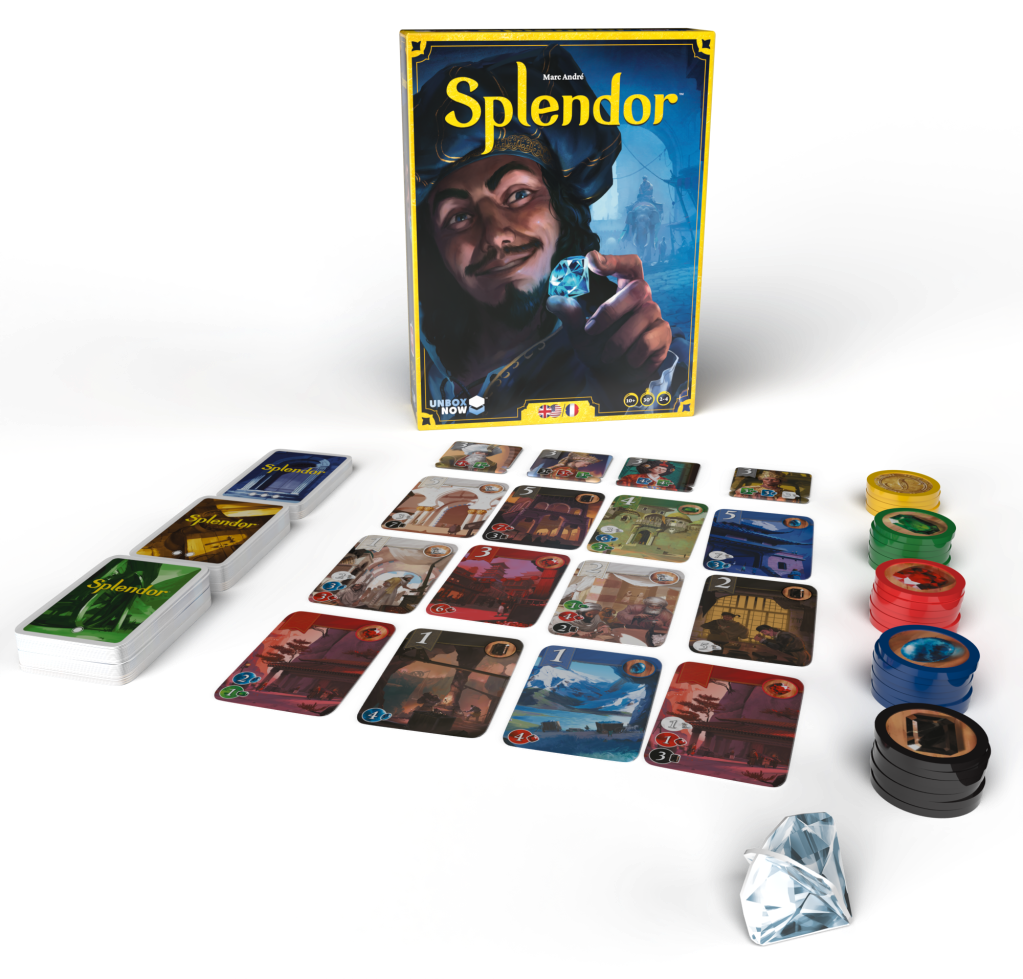
Each player can take a single action on their turn:
- Get 3 gems, each of a different colour (except gold).
- Get 2 gems of the same colour, only if there are at least 4 gems of that colour available (except gold).
- Reserve a card – either an open one from the board, or from the top of one of the decks – and get 1 gold token.
- Play a card, either from hand or an open one from the board.
If a card that’s on the board is taken, either because it’s played or reserved, you immediately open up a new one in its spot from the appropriate deck.
That’s all – pretty simple, right? There are only 2 more things I haven’t mentioned yet: Gold tokens can be used to pay for any colour, that’s why they’re a bit more difficult to get and you can only have up to 3 cards in hand, and 10 gem tokens total.
Playing the Game
Now that we’ve got the rules down, let’s talk about actually playing. First of all, as you saw, it’s ridiculously simple – even someone with no prior experience with board games can pick up the rules and play in 10 minutes- max. The games are also pretty short, so even if there’s some confusion at first, a couple of rounds will clear things up.
During the first rounds, things are going to be slow – people don’t have any discounts, so there’s mostly just gem collecting and level 1 cards being played. After a while though, the pace starts accelerating – cards get cheaper, and prestige starts accumulating as people play level 2 and 3 cards, then boom, suddenly someone gets 6 points in a single move and the game is over.
Now, I’ll admit I’m not a professional Splendor player, but generally, these are my observations:
First of all, Nobles are MASSIVELY important. Each one gives 3 points, which is already a decent chunk considering the 15-point threshold to trigger the end of the game, and combined with the fact that the card played to amass the total bonus for the noble can also be worth 3 or 4 points, someone can be halfway there and then, as I mentioned, boom – 15 prestige out of nowhere. Well, not out of nowhere – but we’ll get back to that. In addition to the fact that you gain points, equally important is that you deny them from your opponents – there is only a finite number of nobles so each one is precious.
Second, except in the very rare cases where someone draws a card from the top of one of the decks, you have full information about every other player. So it’s pretty easy to see from their gems if they’re aiming for a particular card, or from their bonuses if they’re aiming for a particular noble. In that case, you can “hate draft” their target – reserve their card before they have a chance to play it, play it yourself if you can, or race them to their noble. Or both – reserve the card they need to gather enough bonuses for the noble, although unless it’s early enough that they don’t have enough bonuses to compensate, it’s usually not worth it – there will be other cards on the board they’ll be able to play instead. Still, this might be a bit too antagonistic depending on the group – Chris plays a lot more of a chill game than I do, so I feel a bit mean doing that to him.
Finally – this is more of a personal playstyle, so I’m not sure if you should treat it as advice, but I try to both maximize and diversify my resources. What I mean by that: First, I try to either get 3 gems or play a card each turn. Playing a card is obvious, but why 3 gems instead of 2, if it meant I could play a specific card next turn? The main reason is that I don’t want to lock myself into a single option. Another player may pick my card, either because it just suits them as well, or because they want to deny me. Having a better spread of gems also gives me more options in general – a better card may open up until my next turn. It can also deter other players, confusing them about my targets and stopping them from blocking me. Second, it’s much better to have an (almost) even spread of bonuses for every colour. While there are cards with high costs of a single colour, and they generally give more prestige, in my opinion, they’re not worth it: You need enormous investment in both bonuses and gems, and for the same number of actions you can play 2 cards that give both more bonuses and more prestige. In addition, nobles are also to take into account: As I mentioned, they either need a bonus of 4 for 2 colours, or a bonus of 3 for 3 colours, so going for a bonus of 5 or 6 is counterproductive. One last thing that I’ve noticed, at least for me, is that I rarely play level 2 cards. Level 1 cards are obviously all you can play at the beginning, but I keep stacking them, until playing them is free – using them to get nobles, then immediately transitioning to level 3 cards once I have a critical mass of bonuses, allowing me to play cards every single turn, instead of wasting my action picking up gems. Still, you know what I’m about to say – IT DEPENDS. Every game works differently, and it’s good, otherwise picking an “optimal” strategy would just make it boring.
Final Thoughts
Splendor is a really fun game that’s become a bit of an obsession, as I try to play at least one round every time I go to the LGS. There’s also an expansion, The Silk Road, which adds several modules with new mechanics (that you can choose to use individually or in combination), and a Duel version for two players, but since I haven’t tried them I can’t really give an opinion. Overall, it might not be a super deeply strategic game, but it’s a ton of fun and really recommend giving it a try both for experienced and new boardgame players.
Join Our Mailing List
Do want…
- Extra content?
- Discounts?
- Updates about all our work?
This post contains affiliate links. By using them, you support the blog without any extra charge being applied to you.
 The Kind GM