
Wow, it’s been a while since we had one of those, hasn’t it?
Unearthed Arcana is back!
With 5e wrapping up, obviously there wasn’t much space for Unearthed Arcana for a while – though we did get several building up to the release of the 2024 edition (One DnD? Does anyone call it that?), there was a significant break, but now they’re back, as the new edition is spinning up.
This particular one came out in December 2024, so we’re a bit late, but better late than never! There’s also a YouTube video (available both through the link and below) from the official Dungeons & Dragons channel going over it. Now let’s get into it!
The Artificer
This is the new version of the Artificer, adjusted for the 2024 edition – though “new version” is perhaps a bit generous. It’s pretty much the Artificer from Tasha’s Cauldron of Everything, just with some adjustments and a couple of new features. I wouldn’t go so far as to call it disappointing, but it’s not revolutionary either.
Let’s take a look at the features we’re getting.
Magical Tinkering (Level 1)
As a Magic action while holding Tinker’s Tools, you can create an item from a given list that lasts 1 hour. You can do this a number of times equal to your Intelligence modifier.
The items available are mostly what you can count as adventuring gear, and most of them, I don’t think you’ll ever bother with. Jugs, torches, paper, crowbars, shovels, etc – sure there are situations that they can come in handy, but the real interest, in my opinio,n is in 2 things: oil (for extra fire damage), caltrops (to slow) and ball bearings (to get enemies prone). Still, once you get a couple of levels going, even these start to lose their appeal – you have more important stuff to do with your actions. But for a first-level feature, it’s good enough in my eyes – at the very least, it saves you some carrying weight and lets you solve various situations on the fly.
This is quite different from 5e, where this feature would let you apply a small magical effect, like producing light, to a tiny object. Honestly, I prefer the new version – it feels more thematic to the artificer and I’d say gives more options.
Spellcasting (Level 1)
The obligatory spell-casting feature, nothing much has changed here. Artificers are half casters, reaching up to level 5 spells, and you have a set number of prepared spells each day – no more bonus based on your INT, now you start at 2 and get on from there – though you do get some always prepared ones from your archetype.
As for their selection of spells, they mostly get support options – healing, control, buffs, etc – and not that much in terms of damage (with some exceptions, of course, which we’ll talk about later). Artificers get few cantrips though, starting at 2 and topping at just – they do get Guidance though, so in the absence of a cleric or druid, you can do that too. In exchange for that, however, you get the ability to switch out one cantrip every long rest – so technically you have access to all of them.
Finally, you can use Thieves’ Tools, Tinker’s Tools, or any type of artisan’s tools as a spell casting focus – not something that is usually noteworthy, but it does let you use some features more easily and reliably (the aforementioned Magical Tinkering for example, since it requires you to hold Tinker’s Tools).
Replicate Magic Item (Level 2)
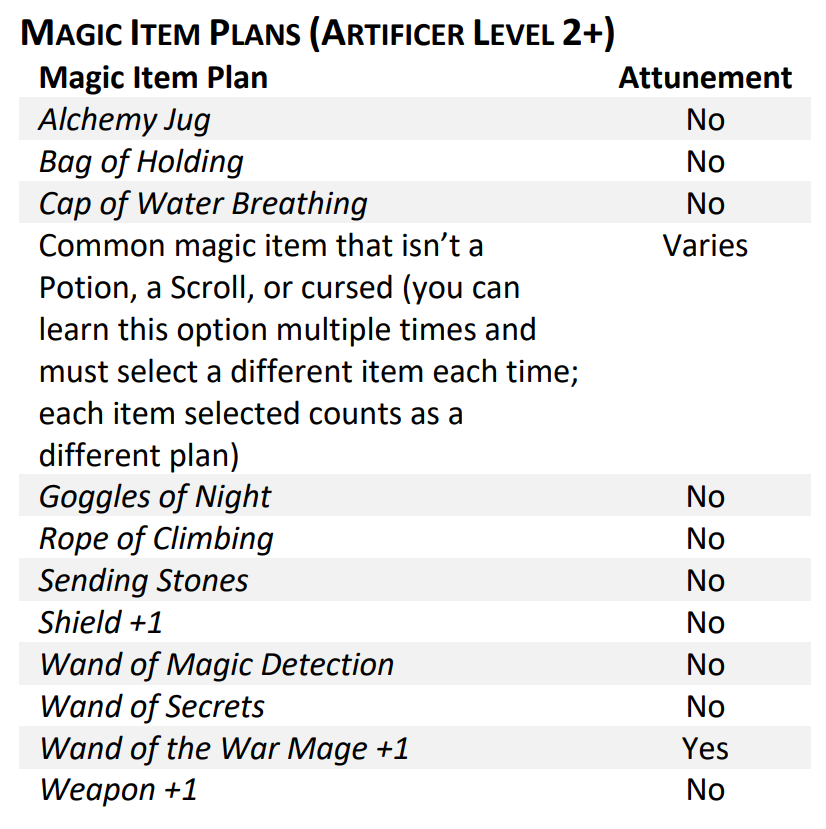
This is the big one, the signature feature that makes Artificers – what used to be called Infuse Item in 5e.. You can create Magic Items out of a specific list – starting with a maximum of 2 active at any time, and reaching a maximum of 6 at level 18. You create them at the end of a long rest, and you can make two at a time.
There’s some very nice stuff included, even at level 2. A Bag of Holding is always nice, but you’re probably going for a +1 Weapon, or even a +1 Shield – AC is a premium stat, and this early it can be a serious boost.
Artificer Subclass (Level 3)
We’ll talk about subclasses in detail later – for now, we’ll just say that we have the same old 4: Alchemist, Artillerist, Armorer, and Battle Smith. There are some differences compared to 5e, but a lot of stuff has also remained the same.
Right Tool For The Job (Level 3)
You can now also create artisan’s tools when using Magical Tinkering. Quite a niche application, really, but it does fit the theme, and while you probably won’t use it too often, since I expect most players to carry any tools they are proficient with, I suppose there are cases that this would come in handy. This is pretty much the same as it was in 5e, but now it takes an action instead of an hour.
Ability Score Improvement (Level 4)
Nothing much to say here – you know what this is. You also get an ASI (or a feat) at levels 8, 12 and 16.
Magic Item Tinker (Level 6)
You improve your Replicate Magic Item feature. You get additional plans for more advanced magic items, and you can also use a bonus action to drain the energy from a magic item you have created with Replicate Magic Item to gain a spell slot – level 1 for common item and level 2 for uncommon or rare – making the item vanish. You can only do this once per long rest.
This might seem like a limited feature – a level 2 spell slot, once per day? Wizards and Sorcerers can also recover slots much more efficiently! Well, first of all, remember that Artificers only get up to 5th-level spell slots, so it’s not something to scoff at – especially at level 6. Secondly, you can use this on magic items with charges, once they’ve been used up – for example, a Circlet of Blasting or a Wand of Magic Missiles.
Flash of Genius (Level 7)
When you or an ally you can see within 30 feet fails an ability check or saving throw, you can use your reaction to add your INT modifier to the roll. You can use this a number of times equal to your Intelligence modifier per long rest. This is the same as it was in 5e – nice and simple, but also quite powerful. You’re probably saving this for saving throws, and 5 times +5 bonus is nothing to scoff at – you’re going to save a lot of pain (and HP) with proper application.
Magic Item Adept (Level 10)
You can attune 4 magic items instead of 3, and you get additional plans for your Replicate Magic Item. Not much to say here – this gives you access to uncommon rings and wondrous items, and the extra attunement also comes in handy for a class all about magic items.
Spell-Storing Item (Level 11)
When you take a long rest, you can touch a weapon or an item you can use as a spellcasting focus (a.k.a. a tool, really) and store a spell in it. In 5e, this used to be a level 1 or 2 spell – now, it goes up to level 3, which is a massive increase in power. The spell needs to have a casting time of 1 action, and you don’t need to have it prepared – or use a spell slot!
When holding the item, a creature can use an action to produce the spell’s effect using YOUR spellcasting modifier – though they do need to concentrate on the effect if the spell requires it. This can be done a number of times equal to twice your Intelligence modifier, a minimum of twice. This particular wording (though it’s the same with 5e) means that you don’t CAST spells – so a barbarian can use this item no problem (though they still can’t concentrate while raging), up to 10 times.
Some level 3 spells you might be interested in include Haste and Fly – even with a 5-person party, having a full team hasted twice a day is ridiculous if you get the chance to set it up, although each person will have to concentrate on their own spell. In addition, Armorers get Lightning Bolt, Artillerists get Fireball, and Battle Smiths get Conjure Barrage – all of them massive AoE damage spells. 10 of them? For FREE? You know that someone’s going to get trigger-happy. Oh, and Alchemists get Mass Healing Word – so maybe you should have a second artificer in the party for when someone does get a bit careless with the Fireballs.
I have read some comments that you can use the item for Magic Item Tinker to drain for spell slots, but the way the rules are written that doesn’t work – Magic Item Tinker explicitly mentions the item must be from your Replicate Magic Item feature.
Magic Item Savant (Level 14)
Another upgrade to your Replicate Magic item – you can now create rare items, though you’re limited at 3 at any time. You also get another attunement slot – you can attune up to 5 items at once.
Magic Item Master (Level 16)
You can now attune up to 6 items. Not much to say here, except that this loses a tiny bit of value compared to 5e – due to a change in the level 20 feature.
Epic Boon (Level 19)
Nothing to say here, the standard epic boon that everyone gets at 19.
Soul of Artifice (Level 20)
This has 2 components. Cheat Death lets you destroy an uncommon or rare magic item from Replicate Magic Item when you are reduced to 0 HP, in order to instead set your HP to 20. In 5e, this also required you to use a reaction, and also put you down to 1HP instead – so this is a welcome little buff, although at level 20 I’m not sure that 19 HP is really that much of a difference, although it will probably save you if you’re swarmed by nasty little minions or are standing in fire or something.
I think this could easily have something a little extra as well – for example, ending any conditions on you, or giving even more HP if it’s a rare item instead of an uncommon one. Still, as I said, it’s an improvement over 5e.
The second part is a bit more controversial. Magical Guidance says that if you are attuned to at least 1 magic item, you can add 1d6 to any ability check, after you roll the d20, up to once per turn. This is in stark contrast to 5e, where you would get a +1 to all saving throws per attuned item – so a +6. Honestly, I think this was overdone a little: either make it 1d6 for both checks and saving throws, or if the saving throw bonus is too strong either way, keep the +6 to checks. Or even just halve it – so +3 max to saving throws, or half the number of attuned items rounded down.
Still, if you get to level 20, you’re probably just happy enough to have made it there – you probably have caverns full of legendary items to help you out.
Join Our Mailing List
Do want…
- Extra content?
- Discounts?
- Updates about all our work?
Artificer Subclasses
Now let’s take a look at the 4 sub classes available. As I said, they’re the same as 5e – Alchemist, Artillerist, Armorer, Battle Smith.
Alchemist
Tool Proficiency (Level 3)
You gain proficiency with Alchemist’s Supplies, and any potions you brew take half the time (using the new crafting rules). Seems a bit strange to reduce the time needed but not the cost, but that’s alright.
Alchemist’s Spells (Level 3)

You get some extra spells prepared for free, mostly healing and acid damage stuff. Nothing too exciting here. Alchemist is a mix between healer and damage dealer in terms of spells, and Alchemical Savant, the level 5 feature, pushes that further, but it’s not as good as a dedicated role for either. To be fair, it’s the best artificer subclass for healing, but I’d say the next ones are even better in general support, even the Artillerist has such options, and it’s supposed to be a pure damage dealer.
Experimental Elixir (Level 3)

When you finish a long rest, you create 2 magical elixirs, which last until your next long rest (or until you drink them, obviously). Drinking an elixir is a bonus action instead of a full one, which is pretty significant for obvious reasons – and you produce one extra elixir at levels 5, 9, and 15, reaching a maximum of 5 elixirs. Pretty good so far – now, for the bad news: you select the effect of these elixirs randomly. You roll a d6 for each, and the effect is shown on the table on the right – sure, at a 6 you can pick which you want, but that’s not something you rely on. In my opinion (and that of many others as well, from what I’ve seen), this is – in the risk of sounding harsh – stupid. Relying on chance for the main feature of your subclass is going to lead to a lot of frustration, and that’s probably the worst feeling you can get. In my opinion, you should just pick the effect you want and that’s that, or at least give you additional ways to have more control.
On that note, you can also create 1 additional elixir by spending a spell slot, and this time, you do get to pick the effect. But you get 1 elixir regardless of the level of the spell slot. I don’t expect this to see much use though, because here comes the second big problem with the elixirs: they don’t really scale as you level up. The healing one scales with your Intelligence, but that doesn’t really count. At level 10 let’s say, you really expect something more impactful than a 2d8 healing. I will admit that some of the effects are harder to scale, specifically Resilience and perhaps Boldness too, but the other 3 could easily get some number increases along the way.
I hope the elixirs get some fixes on their final release, because honestly, as it is (especially in combination with the other features), Alchemist looks to be the weakest archetype, and not something I’d pick up.
Alchemical Savant (Level 5)
When you cast a spell using your Alchemist’s Supplies as a spell casting focus, you can add your Intelligence modifier to one roll that restores hit points or deals acid, fire, poison, or necrotic damage. Quite a decent bonus to be sure, but I really see no reason to restrict the spellcasting focus – would it really be that much of a stretch to leave it completely open, or even just have it as any type of tool? Especially since you need to have Tinker’s Tools to use other artificer features like Magical Tinkering. This remains the same with 5e.
Restorative Reagents (Level 9)
When someone drinks one of your elixirs, they also gain Temporary HP equal to your Intelligence modifier plus your Artificer level. This is pretty good – it certainly helps your elixirs get a lot more useful. At level 9, you can also craft 4 of them, so with an INT of 20 that’s 14 THP each, or a grand total of 52. A respectable amount, though, depending on what you roll for your elixirs, you might not be able to spread them out the way you want to.
You can also cast Lesser Restoration a number of times equal to your Intelligence modifier per long rest. A nice thing to have for sure, though, unless you expect to get poisoned a lot, it remains niche. This part is the same as 5e, though the Temporary HP from Elixirs used to be 2d6+INT, so it’s gotten a bit of a buff.
Chemical Mastery (Level 15)
The penultimate Alchemist feature… gets some changes over 5e, but nothing too drastic.
First, you gain resistance to acid and necrotic damage. Gone is the immunity to the poisoned condition, though – was the artificer really that tanky, that they needed this nerf? Though perhaps it’s just an oversight, and it will return with the full release.
Then, a brand new aspect of the feature – when you deal acid, fire, necrotic, or poison damage to a target, you can deal an additional 2d8 force damage – only once per turn, so no AoE nuking. I like this – it gives some extra damage and fits with the theme.
Finally, you can cast Tasha’s Bubbling Cauldron (instead of greater Restoration or Heal) once per long rest without using a spell slot, preparing it, or using material components (aka a gilded ladle that costs 500g). I… am not sure about this. Oh, it absolutely fits the alchemist thematically, but I don’t know if I’d trade Heal for it. As for what the spell does – you summon a cauldron, and as a bonus action, you or an ally can reach into it and pull out a Common or Uncommon potion of your choice. The total number of potions is equal to your spellcasting modifier (INT in this case), and… potions that haven’t been used when you recast the spell disappear, so you can’t even use it for potion farming and selling. As for potions, you’ll probably use them for potions of healing (Greater are uncommon, which give 4d4+4) – maybe in some cases Potion of Resistance. Sure, on average you’ll probably get more healing from the potions than from the Heal spell (since you can also spread it around), but you’ll have to spend extra actions drinking them too.
Overall… mixed feelings. The entire subclass could have been much better.
Armorer
Tools of the Trade (Level 3)
Pretty standard, you gain proficiency with Smith’s Tools and Heavy armor. You can also craft armor in half the time.
Armorer Spells (Level 3)

Again, standard, you get extra prepared spells at levels 3,5,9,13 and 17. Mostly defensive stuff, but you do get Magic Missile, and also Lightning Bolt at level 9, so you have a good choice for your Spell-Storing Item as I mentioned earlier.
Arcane Armor (Level 3)
You can turn the armor you are wearing into Arcane Armor, gaining various bonuses. Nothing too impressive: it doesn’t have a Strength requirement, you can don and doff it with just an action, it can’t be removed against your will, and it can be used as a spellcasting focus. Overall, it just removes a few headaches that you might run into and lets you wear a big, heavy suit of armor and bash stuff in peace.
Armor Model (Level 3)
We’re finally getting to the good stuff. This is the main feature of this archetype – in some ways, staying pretty much the same as 5e, while there’s also a whole new model available.
I’m going to mostly rush through Guardian and Inflitrator – they’ve remained the same, but not everyone has Tasha’s Cauldron of Everything, so they merit at least a little mention.
Something to keep in mind is that all armors have their own special attacks, and you can use Intelligence instead of Strength or Dexterity for the weapon attacks, which stops you from splitting your attention between 3 different ability scores.
The Guardian armor is a front-line disruptor, equipped with Thunder Gauntlets. You have a melee attack that deals 1d8 thunder damage, and enemies hit by it have disadvantage against creatures other than yourself. In addition, when you are bloodied, you can use a bonus action to gain Temporary Hit Points equal to your artificer level. This used to be a limited use, and though the new version requires you to be on a dangerous threshold, it’s better in my opinion. The style is obvious – get up close and personal, start swinging, and make a mess. Enemies will have to target you if they don’t want disadvantage, and every turn you gain a ton of HP, they have to chew through.
The only issues are that you still have a d8 hit die, so you’re not as tanky as you might want, and you’ll need some good mobility as well – getting slowed down or having enemies stay at range can cripple your effectiveness. Still, that’s where your spells come in – Fly, Haste, Blink, Freedom of Movement, even Longstrider and Jump can help, as well as the Armorer’s Greater Invisibility.
Up next is the Infiltrator. You have a ranged attack (range 90/300, which isn’t that bad) that deals 1d6 lightning, so lower than the Guardian’s, and once per turn, you can also deal another 1d6 to an enemy you have hit. Your speed also increases by 5 feet, and you have advantage on Stealth checks – though if your armor gives disadvantage, it cancels out as normal. Honestly, I think it wouldn’t be that much of a stretch to ignore that armor penalty as well – you’re stomping around in power armor regardless, let us indulge in the fantasy. It could even be part of the Arcane Armor feature.
Overall, you have much less of a distinct playstyle than Guardian – you’re more of a damage dealer, but the Infiltrator could do with some more impactful options, something I felt for 5e as well – and which continues to apply as it’s the same features now.
Finally, we have the Dreadnought, the new option. This is also a frontline armor, though not made for tanking – it disrupts enemy positions. First, you get a 1d10 bludgeoning attack with reach, the highest damage among the models. When you hit an enemy with it, you can also push or pull it up to 10 feet, without any strength saving throws or such. This is pretty good for some battlefield control, though it requires good coordination with your allies. You can use it offensively, pull enemies in or reposition them on top of ground effects, for example, or get them in range or in view of others for attacks. You can also use it defensively – if your backline is engaged in melee, you can get the enemy further away and spare them an opportunity attack. Still, I think the Guardian is more effective in that role.
Finally, as a bonus action, you can change your size to Large (a limited number is f times, equal to your INT modifier). On its own, it’s not much, though it gets a nice upgrade later (much later), and you can probably combine it with other effects to take better advantage of it.
Overall, it’s ok, I’d say – I’m not awed by it, though I can see the appeal of a big stompy armor. I’m glad it’s added, though – more options are always welcome.
Something to keep in mind, though, is that you don’t have to commit to one type of armor forever; when you take a short or long rest, you can change it.
Extra Attack (Level 5)
The standard extra attack that fighting-type subclasses get. A much-needed feature that really helps – some armors more than others (by that I mean Guardian of course, though Dreadnought also appreciates this).
Armor Replication (Level 9)
You learn an additional plan for your Replicate Magic Item feature, though it has to be for an Armor item. You can also create an additional Armor item with that feature. Essentially, you get one free use of Replicate Magic Item for your armor. I don’t know how useful this truly is – at this level, I think you’re settled for magic items. I’d prefer a suite of upgrades for your armor models. (Check what 5e did here)
Perfected Armor (Level 15)
This is where your big upgrades come in for your armors. Dreadnought gets 2d6 damage, you can get your size to Huge if you want instead of Large, your reach increases by 10 more feet, and you get a flying speed equal to your speed. A very nice set of upgrades, though, of course, the permanent flying speed is the most important one.
Guardians increase their damage to 1d10, and can force creatures that end their turn within 30 feet to make a STR saving throw or be pulled up to 25 feet. If they end up next to you, you can also make a melee attack against them. A very powerful ability making Guardians even more disruptive – but they pay for it with the lowest damage, and the fact that it’s a limited use reaction.
As for infiltrators, they increase their damage to 2d6, and hitting a creature gives them disadvantage on attack rolls against you. A big upgrade for the Infiltrator that lets you be a bit safer, but also incentivises you to spread out your attacks.
I mentioned in the previous feature that I’d like it to include some upgrades – I don’t mean these ones should go to level 9, but I do think some more damage scaling and some minor upgrades would help a lot more. I also think that both Guardian and Infiltrator could have some more things to do. Maybe a limited-use ability for Infiltrator – extra damage or attacks, or something stealth-related; and Guardian could do with something more defensive, too. Honestly, I think Infiltrator is also better for the flying speed.
Overall, the Armorer remains a decent choice with a pretty nice theme, but I think there’s some imbalance in the design of the armor models that might leave some people disappointed.
Artillerist
The artillerist also remains almost the same, with only some minor adjustments and nothing new compared to 5e.
Tool Proficiency (Level 3)
You get proficiency with Woodcarver’s tools, and you can craft wands in half the time. Neeext
Artillerist Spells (Level 3)

You get your extra spells. Lots of blasting and burning, predictably. Thunderwave, Scorching Ray, Fireball, Ice Storm, et cetera. NEXT!
Eldritch Cannon (Level 3)
Now we’re talking. As an action, you can create an eldritch cannon that lasts 1 hour. I’d it expires (or gets destroyed), you can use a spell slot to make a new one – you only get a free one once per long rest. Oh, and of course, you can only have one cannon active at a time.
You can activate it as a bonus action, and choose what it does: Flamethrower deals 2d8 fore damage is a 15 foot cone (DEX saving throw, half on a save), Force Ballista makes a ranged attack that deals 2d8 force damage in a 120 foot range and pushes the target 5 feet, and Protector gives creatures of your choice within 10 feet 1d8+INT temporary hit points.
The big change here, however, is that you don’t have to pick one type of cannon when you summon it – now, you just get an eldritch cannon, and every time you can pick any action you want, getting some excellent flexibility. You get close-range AoE, you get long-range damage, and you get a TON of THP – though that means bunching up to get within 10 feet, and that comes with dangers of its own. Also, for 3rd level, you get a ton of damage – 2d8, on a bonus action, and still keeping your normal action open is nothing to scoff at.
The cannon is also decently durable – it has 18 AC, and hit points equal to 5 times your artificer level. You can also heal it by casting Mending for 2d8 HP, so you can keep it going for a while – though it’s pretty slow, as you can only move it 15 feet per turn.
Arcane Firearm (Level 5)
At the end of a long rest, you can turn a Rod, Staff, or Wand into an arcane firearm, meaning you can use it as a spell casting focus, and casting an artificer spell through it makes you deal an additional 1d8 damage with it. I am unsure if this includes cantrips (this needs some research for 2024)
Explosive Cannon (Level 9)
Your cannon’s damage, both for Flamethrower and Force Ballista, increases by 1d8. Protector stays the same, though I think that’s fine. Also, when your cannon dies, you can make it explode; all creatures within 20 feet of it make a DEX saving throw or take 3d10 force damage (half on a save). This is a feature I feel… not hesitant, or apprehensive about, I’m just not sure how often you’re using it. On one hand, you want to keep your cannon close, to make sure you can use Protector – as well as obviously keep it alive as long as possible, which means if it does die, you DON’T want to trigger it as you’re the one eating the damage. On the other hand, you can also send it forward to use Flamethrower and support the front line with Protector – but, again, there’s a risk of heavy friendly fire, and its slow speed makes it clunky for that. Overall, I can definitely see the use case for it, and I think it definitely fits the theme – I appreciate the option, and I think it can lead to some nice, memorable moments.
Fortified Position (Level 15)
A pretty impactful feature here. First, you can have 2 cannons at once. You can create both with the same action, but not the same spell slot – I feel I have to disagree with this. Maybe 1st level spell slots create 1 cannon, and 2nd level slots and up create 2 – I understand the hesitation to give artificers the ability to spam cannons, but I think spell slots are a reasonable investment to get them back, and it will also let people be a bit more aggressive with them – for example being a bit more willing to let them blow up. Regardless, a second cannon is a serious increase in firepower. In addition to that, you and your allies get half cover (meaning +2 AC) when within 10 feet of your cannons. I am curious if that includes the cannons themselves, though I don’t see why not – having them next to each other gives them 20 total AC.
Overall, Artillerists look pretty good – very minor changes, but the extra flexibility of your cannons being free to use any action is an amazing improvement.
Battle Smith
Battle Smiths have even fewer changes, just an adjustment to the Steel Defended stats.
Tool Proficiency (Level 3)
You get proficiency with Smith’s Tools, and you craft weapons in half the time.
Battle Smith Spells (Level 3)

Mostly defensive spells here – Shield, Warding Bond, Aura of Vitality, etc. Warding Bond in particular is an intriguing one, if you can sustain it – you can probably even put it on your Steel Defender, if you feel it’s worth it (and get it to wear the ring the spell requires), though admittedly it’s role is to protect you, instead of the other way around.
Steel Defender (Level 3)
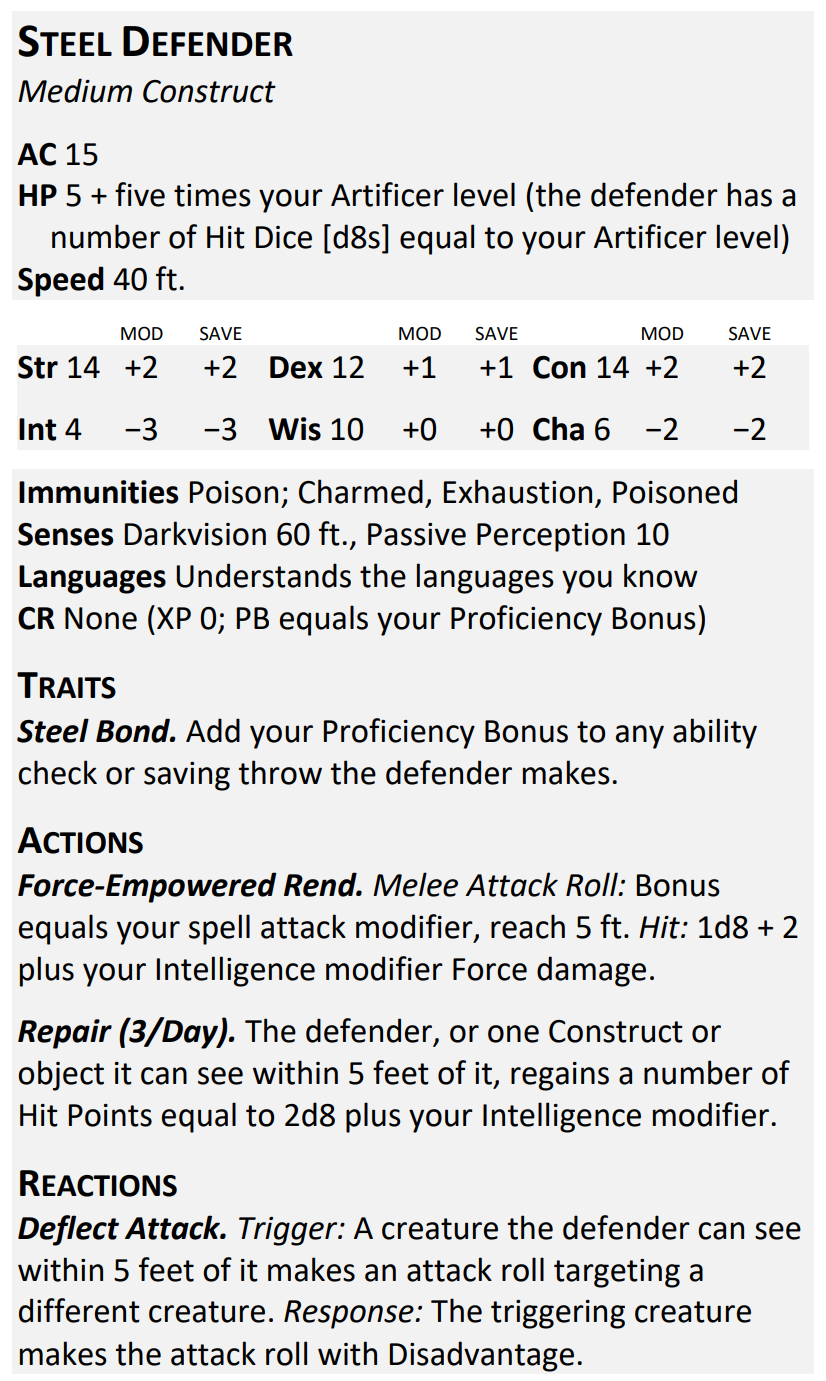
And speaking of the Steel Defender, here it is. You can make one once per long rest, or, if it has died within the last hour, touch it and use an action to bring it back after 1 minute. It can move and use reactions on its own, but you must use your bonus action to order it to do stuff other than Dodge – pretty standard stuff.
As for its stat block, the only difference is a bit more HP (a flat 5), and 2 extra damage on Force-Empowered Rend. Still, I’d say that it makes it quite a bit more formidable in the lower levels, so it’s a nice buff overall.
Extra Attack (Level 5)
You get an extra attack (no, really?). Honestly, I think you could also give the Steel Defender this as well – it’s not like it’s an unstoppable death dealer or something, and it doesn’t get damage scaling beyond your INT either.
Arcane Jolt (Level 9)
When you or your defender hit an enemy with a magic weapon, you can choose to either deal an extra 2d6 force damage or heal a creature or object within 30 feet for 2d6. Obviously, healing is a lot more valuable, so I expect most people to use the second ability. You can only use it a number of times equal to your INT modifier, but only once per turn.
I know I said just earlier that the Defender doesn’t have damage scaling, and I stand by it – limited use doesn’t count.
Improved Defender (Level 15)
The final set of upgrades. Steel Defender gets 2 extra AC, up to 17, using the Deflect Attack option makes the target take 1d4+INT force damage, and Arcane Jolt damage and healing increases to 4d6.
Overall, nothing spectacular – I feel that the Steel Defended ends up pretty underwhelming the higher the level. I also find it pretty weird that the DEFENDER needs level 15 to get 17 AC, while the Artillerist’s Eldritch Cannon starts at 18 AC – and has comparable HP too. I think Battle Smith needs more defense, more utility, and more disruption to compete with the other archetypes – I’d say it’s almost as weak as the Alchemist, who also has a very simple fix, but getting the Battle Smith up to par would be a bit more complex.
Final Thoughts
I will echo my thoughts from the beginning. This UA Artificer is pretty much the artificer from 5e with minimum adjustments to work in the 2024 version, along with some minor additional freedom of choice (Cannons, for example, and the new Dreadnought). Still, I’m not really excited for this – partially because it’s been out for several months now of course, partially because I don’t expect the goal was to do so but instead to see how the Artificer works in the new edition and hopefully improve it, and partially because i genuinely do think it could have been much better – sure, some of the things I said along the post are personal preferences, but I think some are also complaints I’ve seen widely repeated with simple solutions.
Join Our Mailing List
Do want…
- Extra content?
- Discounts?
- Updates about all our work?
 The Kind GM