A new Unearthed Arcana was released this week, containing updates and revisions to horror-themed subclasses from 5e as well as a couple of new ones.
I was actually about to post a different UA analysis for one of the older ones we’ve got in our backlog, but this takes precedence. As usual, you can also watch the related YouTube video from the official Dungeons & Dragons account.
Let’s get into it – we’ve got 8 subclasses to go through.
Artificer – Reanimator
Doctor Frankenstein and his Creature, now in artificer flavour. The subclass revolves around your pet undead.
Reanimator Spells (Level 3)
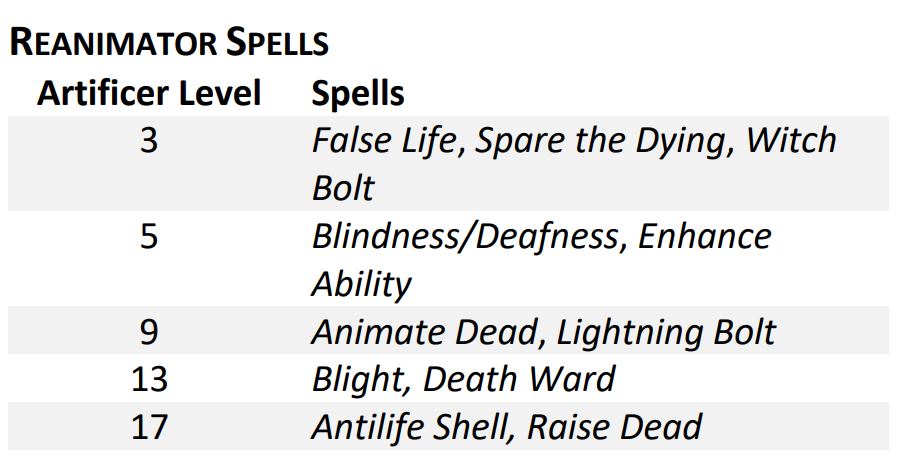
The usual extra spells, mostly necromancer stuff and some lightning damage. Pretty good in terms of flavour, and you also get an extra cantrip – Spare the Dying. More on that specific one on the next feature, but overall it’s alright – you also get Lightning Bolt for your Spell Storing Item from the base Artificer.
Jolt to Life (Level 3)
When you cast Spare the Dying (which I will remind – if a creature is at 0 Hit Points, it is now Stable, with a range of 15 feet increasing further as you level up), the creature now gains 1 HP – so they’re up and ready. In addition, all creatures in a 10-foot emanation make a DEX saving throw or take 1d4+half your Artificer level lightning damage, half on a success. You can do this a number of times equal to your Intelligence modifier per long rest.
A pretty good little feature, certainly makes Spare the Dying a lot more usable (especially since it takes a whole action) – just be careful about friendly fire, as it’s all creatures, not just enemies. I also like that it’s limited, otherwise, hit points would stop being a consideration as long as the artificer stays alive. I do want to note a minor wording issue, though – the text states that the cantrip “sends a jolt of electricity through the target, reviving it,” but that’s just flavour text: the creature can’t already be dead, just at 0 hit points. You can’t actually revive someone with a cantrip.
Reanimated Companion (Level 3)

The core of the class… and for me, a disappointment. I’m always hesitant about subclasses that rely on summons, companions, et cetera – and in this case, artificer already has the Battle Smith with its Steel Defender. If you remember the last UA Analysis, I was critical of it then, and I feel the Reanimated Companion is worse than the Steel Defender.
At first glance, you might think that it’s a heavy, disruptive unit – get in, tank things, use Dreadful Swipe (sure it’s low damage, but no Opportunity Attacks is decent) and when overwhelmed, it dies and deals a bunch of area damage. So similar to the Steel Defender, no? Well, yes, and by that I mean no. It has less HP (d6 instead of d8 Hit Dice) and less AC (and less damage) than the Defender, it has worse saving throws (because Steel Defender also gets your proficiency), it is slower by 10 feet, and it lacks the built-in healing of Repair. Admittedly, it has much higher potential for healing through Lightning Absorption, but it requires you to spend additional resources, because unless your entire campaign takes place in the elemental plane of lightning or something, I won’t count on enemies providing heals. Perhaps I’m being too harsh; it has additional resistances on top of the Lightning Absorption, and you don’t have to specifically target it – getting it in the middle of a Lightning Bolt, or even a Spare the Dying enhanced with Jolt to Life is pretty good, but… no, I still don’t like it. As for the Death Burst… it’s a big pile of meh, and that’s if it doesn’t blast your own allies as well – I’ve seen some discussions that you can use the Steel Defender as a mount, but I don’t expect many people would do the same with this guy (and not only because it’s Small).
You make one Reanimated Companion for free per long rest, and if it dies, you need to expend a spell slot (no level requirements, so level 1 works) to make another one. Only one can be up at any time. Also, I forgot to mention – standard companion rules, you use your bonus action to command it or it just uses Dodge; if you’re incapacitated, it acts on its own.
Strange Modifications (Level 5)
When you make a Reanimated Companion, you choose one of the following bonuses to grant it.
- Arcane Conduit: You can cast spells through your Companion. Once per turn, when dealing damage with an Artificer spell from the Necromancy or Evocation schools and your Companion is within 120 feet of you, you add your INT modifier to a damage roll.
- Ferocity: When you command it to use Dreadful Swipe, it can do it twice.
Honestly, why choose? Why not both? Or, at least, make it so that at level 5 you choose, but at a later level you get both. Arcane Conduit is nice – it extends your range by quite a bit, though you still use your own senses (you still have to see your target, etc), and the damage is alright. Ferocity is also good, it lets you “tag” an additional target – helpful if someone is surrounded. The funny thing about it though ,is that it only happens when you command it – if you’re incapacitated, and the Reanimated Companion acts on its own, it still gets only one attack, at least that’s how I read it.
Improved Reanimation (Level 9)
More upgrades to your creature. Again, you choose one of the following when you make it:
- Bloated: The thing can now be Medium or Large, its Dreadful Swipe can push 10 feet, and you add your INT modifier to Death Burst damage.
- Gaunt: It gains a Speed and Climbing Speed of 45, it can climb without needing checks, and at the beginning of their turns, creatures of your choice within 10 feet of it make WIS saving throws or are frightened.
- Moist: It gains a swim speed equal to its speed (30), and whenever it is hit by an attack within 10 feet of it, the attacker takes acid damage equal to your INT modifier.
Each descriptor is more disgusting than the last. You mostly care about one thing from each, though: push from Bloated, frighten from Gaunt, and the damage from Moist (eugh). I guess all are equally useful in niche situations – generally, I’m leaning towards Gaunt most times. I still think you could have something stronger, though. Maybe a +5 speed bonus, regardless, and Bloated also gives extra HP?
Promethean Reanimation (Level 15)
The capstone feature for this archetype, you get 3 abilities.
- Facilitated Revival: the cost of material components for Revivify and Raise Dead is halved. Just make it free…
- Improved Companion: Death Burst now deals 4d6 and ignores necrotic resistance. Alright, sure, I guess.
- Life Transfer: Now this is a bit more interesting, finally. When you take damage, you can use your reaction to make your companion drop to 0 HP immediately (triggering its new and improved Death Burst! Wow), and you gain a number of HP equal to your Artificer level. Well, I guess it’s a decent healing ability for the cost of a 1st-level spell (what you’ll need to pay to re-summon your creature).
Overall, I’m… not exactly impressed. In terms of flavour, very nice; I approve, love the vibe, and all that. In terms of mechanics, though, I was reading feature after feature and lots of time, all I would think is “who cares?”. For a subclass entirely revolving around your companion, it sure doesn’t look very strong. Again, compare it to the battle Smith, or even the Artillerist – they get more interesting (and interactive!) stuff to work with.
Bard – College of Spirits
A revised version of a subclass from Van Richten’s Guide to Ravenloft.
Channeler (Level 3)
You know the Guidance cantrip, and it has a range of 60 feet. You also gain proficiency with Playing Cards and can use them as a spellcasting focus, along with candles and ink pens. Guidance is always great to have, especially at range – as for the second part, yeah, nice flavour but whatever. This is pretty much a combination of the two 5e features.
Spirits from Beyond (Level 3)
Random effects, everyone’s favourites. You can spend a Bardic Inspiration and roll for a random effect, then choose a creature within 30 feet of you that is affected. You’ve got some positive effects, some negative, and thankfully, you choose your target after you roll, though you have to use it immediately. In 5e, you could hold on to it for however long it took until your short rest, though you also had to expend an action to use it. Overall, I’m not fond of randomness – it was a major complaint about the Alchemist Artificer, and one of the reasons I almost never play Wild Magic Sorcerers, but you might enjoy that more.
Empowered Channelling (Level 6)
Once per turn, when you cast a Bard spell that deals damage or heals, you can roll a d6 and add that to the damage or heal. Same as 5e (except it was part of Spiritual Focus, a level 3 feature) – still pretty good.
You also know the Spiritual Guardians spell and can cast it for free once per long rest. When you cast it (in general, not just for free), you can also choose to give allies inside it half-cover – you can do this once per short rest. Pretty good defensive tool, though I think the 5e feature that lets you temporarily learn spells from other classes was a lot more fun, even if it could do with some tweaking.
Mystical Connection (Level 14)
You roll twice for your Spirits from Beyond feature, and can choose which of the two results you want. I didn’t really expect anything different here, though I’d like to see something more on top of this – maybe some free rolls without using Bardic Inspiration if you only roll once instead of twice? It also loses an aspect of the 5e feature – if you rolled the same number twice, you could choose the effect regardless of the rolls. A rare event, sure, but it would feel really good to have without even being powerful – just a tiny bit of extra quality of life.
Overall – it’s alright, not too many differences from 5e but not really moving towards the right direction either in my opinion.
Cleric – Grave Domain
A returning archetype from Xanathar’s Guide to Everything. Not to be confused with the Death Domain.
Circle of Mortality (Level 3)
When you heal a creature at 0 HP, you no longer need to roll dice but instead use full rolls for the healing amount. So, for example, instead of rolling 2d4, you now heal 8 – but only for creatures at 0 HP! Ironically, they don’t mix well with Reanimator artificers and their Spare the Dying. Same as 5e – though there’s not an extra part as well: you deal an extra 1d4 necrotic damage to bloodied creatures (once per turn, so no AoE).
A decent feature for starting out – I’m glad about the addition of extra damage, because otherwise it would be a very niche and rare healing ability. As fun as it would be to heal for a lot like that, I don’t think many people like to drop to 0.
Grave Domain Spells (level 3)

Your extra, always prepared spells. No False Life, Death Ward or Antilife Shell though – seems a bit weird to me as they seem to fit very nicely with the theme of the subclass, but alright.
Path to the Grave (Level 3)
As a bonus action, you can use your Channel Divinity to curse a creature within 30 feet. It has disadvantage on attack rolls and saving throws until the start of your next turn, or you can stop the effect to deal an extra 1d8 necrotic or radiant damage when it is hit by an attack roll. A change from 5e, where it just gave vulnerability to the next attack that hit it, but I prefer this one – disadvantage on everything like that is hard to pass up, and I think you’d usually prefer to keep it rather than deal the extra damage.
Sentinel at Death’s Door (Level 6)
When you or a bloodied creature within 30 feet of you gets hit, you can use your reaction to reduce the damage taken by half. You can use this a number of times equal to your WIS modifier. Big upgrade from 5e in my opinion – it used to “neutralise” critical hits into normal ones, so now you can use it a lot more often (and perhaps reduce more damage too, so win-win).
Divine Reaper (Level 17)
When you cast a 5th-level or lower Necromancy spell that targets a single creature, or a Grave Domain spell, you can expend one of your uses of Channel Divinity to target a second creature. Sounds pretty good on paper, but you don’t really have that many uses for it – Blight, Vampiric Touch, Inflict Wounds – and maybe Revivify if you’re really unlucky and you have 2 people dead.
However, you also get another ability here – when an enemy dies within 60 feet of you, you or a creature you can see within 60 feet gains HP equal to three times your cleric level. A slightly worse version of the Heal spell, but you can use this once per short rest – also note it requires a creature to die, not just drop to 0 HP, though this isn’t usually an issue for most parties… Not many go for non-lethal hits, and alternatively, you can also carry around a bunch of small animals to kill outside of combat. This is similar to 5e, but stronger and with longer range.
Overall, the Grave Cleric remains a niche option. Even with the extra buffs this edition, I’d probably pick a different domain that gives you more reliable features.
Ranger – Hollow Warden
A new archetype for the ranger about turning into a spooky, gross plant monster.

Hollow Warden Spells (Level 3)
Your obligatory extra prepared spells. They look pretty good at first glance, nothing too bad – except they’re almost all useless. Sounds harsh? Well, not really – most of them require concentration, and that’s reserved always, at every single combat, for Hunter’s Mark. It’s not that bad, you’ll say – Hunter’s Mark is a nice spell, sure, but you can occasionally use other spells too! Well, you’ll see…
Wrath of the Wild (Level 3)
When you cast Hunter’s Mark, you transform and gain the following benefits while the spell lasts: You gain a bonus to AC equal to your WIS modifier, and creatures that start their turn within 10 feet of you make a WIS saving throw. If they fail, they can either take an action or a bonus action on their turn, not both.
This is why you never really use any other concentration spells. A 2-3 AC increase at the very least, and a massive impact on the action economy? You do need to be careful, though, as you can lose concentration to Hunter’s Mark and thus lose the transformation as well – but hey, you get a bunch of free casts of Hunter’s Mark as a ranger regardless, so go nuts.
Hungering Might (Level 7)
You add your WIS modifier to CON saving throws. Including Concentration checks, look at that – that’s much easier to keep Hunter’s Mark going now. Though CON saving throws are pretty common in general, so this is a big bonus. Also, once per turn while in Wrath of the Wild and bloodied, you can regain 1d10 HP when you hit a creature with an attack roll.
Rot and Violence (Level 11)
When transformed with Wrath of the Wild (again…), you gain some extra bonuses. When a creature fails its saving throw against your aura, it also takes necrotic, poison, or psychic damage equal to your Ranger level that ignores resistance. In addition, when you hit a creature with a weapon attack, you can activate the Sap or Slow mastery properties.
Look, I like it when the core aspect of a subclass gets upgraded as you level up, but it can’t be the only thing the subclass does. Also, another instance of damage ignoring resistances.
Ancient Endurance (Level 15)
For the capstone feature, another upgrade to your Wrath of the Wild. If you fall to 0 HP while transformed, you can spend a 4th+ level spell slot and set your HP to 5 times the spell slot’s level. You’re also immune to Exhaustion.
Immunity to exhaustion is interesting, and I’m sure people can find some fun things to exploit – but as for the first part of the feature, I’m also starting to get sick of “if you fall to 0 HP, you instead…” stuff. It feels like every single subclass has either that or a Fly speed (or both), and I’m starting to lose track of what’s what – everything starts to blur together.
Overall, I think I’ve made my feelings clear – it’s nice to have a transformation type thing that’s central to how your subclass plays out, but it’s bound to get tiring if it’s all you do.
Rogue – Phantom
Returning from Tasha’s Cauldron of Everything
Wails from the Grave (Level 3)
When you deal your Sneak Attack damage, you can target a second creature within 30 feet and roll half your sneak attack dice (rounded up) to deal necrotic damage to it. You can use this a number of times equal to your Dexterity modifier (instead of your Proficiency bonus in 5e). Still a decent damage bonus, and as the levels start picking up and your sneak attack dice increase, that’s a decent way to one-shot weaker enemies, or disrupt concentration.
Whispers of the Dead (Level 3)
When you finish a short or long rest, you choose one tool or skill proficiency to gain (until you choose again, obviously). Not that rogues are starved for proficiencies, that’s just another step further. No changes from 5e though.
Tokens of the Departed (Level 9)
When you finish a long rest, you gain 2 Soul Trinkets, increasing at levels 13 and 17 to 3 and 4, respectively. You can use them in the following ways:
- Death’s Knell: When you deal sneak attack damage, you can spend a trinket to use Wails of the Grave without expending a use of it.
- Life Essence: While you have at least one Soul Trinket, you have advantage on Death saving throws and CON saving throws.
- Spirit Query: You can spend a trinket to cast Augury without requiring material components.
In addition, you gain a Soul Trinket by using a reaction when a creature within 30 feet of you dies (not drops to 0 HP).
In 5e, this was a 9th-level feature, and you didn’t get trinkets at a long rest, so now it’s a lot more reliable. In general, I like features that give additional resources and ways to spend them, though I expect you always keep one for the saving throws, and the rest you’re mostly spending for the damage. The trinkets last until your next long rest, but have no upper limit – at least I don’t see one the way it’s written.
Voice of Death (Level 9)
You can cast Speak with Dead without using a spell slot once per short rest. This is an ability you had through Soul Trinkets in 5e, now as a separate feature – it’s alright, but it feels more like something to shove at level 9now that there’s a gap.
Ghost Walk (Level 13)
As a bonus action, you enter a spectral form for 10 minutes once per long rest, or by spending a Soul Trinket.
You gain a flight speed of 10 feet and can hover, attack rolls against you have disadvantage, and you can move through occupied spaces as if it were difficult terrain.
Exactly the same as 5e – you’re mostly doing this for the disadvantage, though phasing through stuff is also a good mobility option.
Death’s Friend (Level 17)
When you use Wails from the Grave, you also deal the necrotic damage to the original target. In addition, if you roll initiative and have no Soul Trinkets, you gain one. Similar to 5e, the damage is the same, but it used to instead give you Soul Trinkets at a long rest, something that’s now redundant.
Overall, I’d say the more reliable gain of Soul Trinkets is a good step – I like this subclass and its theme, though I generally prefer other rogue archetypes.
Sorcerer – Shadow Sorcery
Returning from Xanathar’s Guide to Everything – now, with 100% less dog.
Eyes of the Dark (Level 3)
You have 120 feet of Darkvision, 10 feet of Blindsight, and you can see through magical darkness. The last part is new, and really makes sense to be honest, no need to keep this as a Warlock Invocation only, especially for a subclass called “Shadow Sorcery”. So now you can use the old reliable Darkness on yourself and start blasting from full cover.
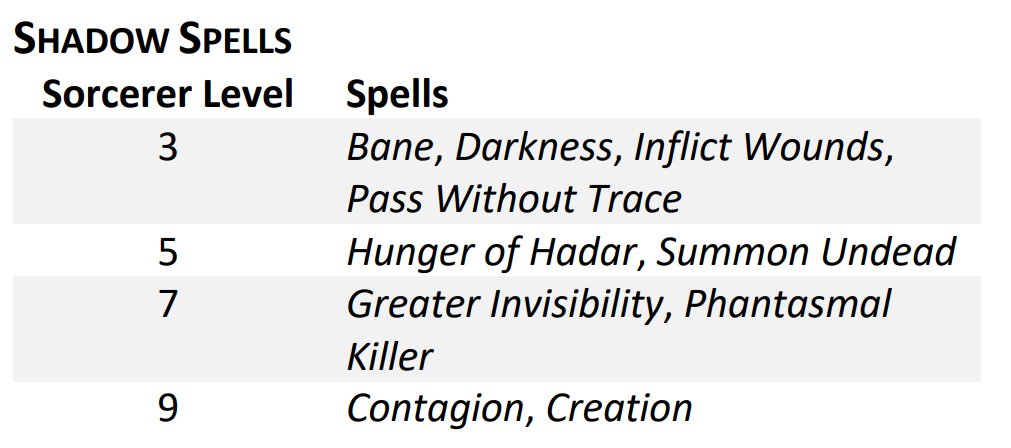
Shadow Spells (Level 3)
You get your extra prepared spells. What’s this? It’s Darkness! The other spells are also pretty nice and fit the theme. Except maybe Contagion, but it’s still fine.
Spirits of Ill Omen (Level 6)
Bye bye, Hounds of Ill Omen. You were a good dog. You can now cast Summon Undead once per long rest for free, and you don’t need material components for it in general. When you cast it, you can also choose to make it last just 1 minute, but it no longer requires concentration.
It’s alright, but I’ll be honest – I prefer the Hounds, and I’m not even fond of dogs; I’m a cat person. It was certainly more fun.
Shadow Walk (Level 14)
When in dim light or darkness, you can use a bonus action to teleport up to 120 feet, as long as your target is also in dim light or darkness. Same as 5e, though you can now use your own Darkness spell as well since you can see through it.
Umbral Form (Level 18)
As a bonus action, you enter a shadowy form for 1 minute. You can do this once per long rest, or if you spend 6 sorcery points.
You can move through occupied spaces as though they were difficult terrain, you have resistance to all damage except force and radiant, and if you fall to 0 HP, you roll a CHA saving throw equal to 5+half the damage taken. If you succeed, your HP instead becomes equal to 3 times your Sorcerer level.
Mostly same as 5e, except you get 1 free use before needing to spend sorcery points (nice, I approve) and… the “when you fall to 0 HP…”
Sigh.
Oh well. Overall, not too bad on its own, perhaps even an improvement over 5e, but nothing too good either.
Warlock – Hexblade Patron
Ah, the Hexblade. A controversial subclass, and now… still quite controversial, although perhaps for different reasons. But this version has pretty much nothing to do with how it used to be.
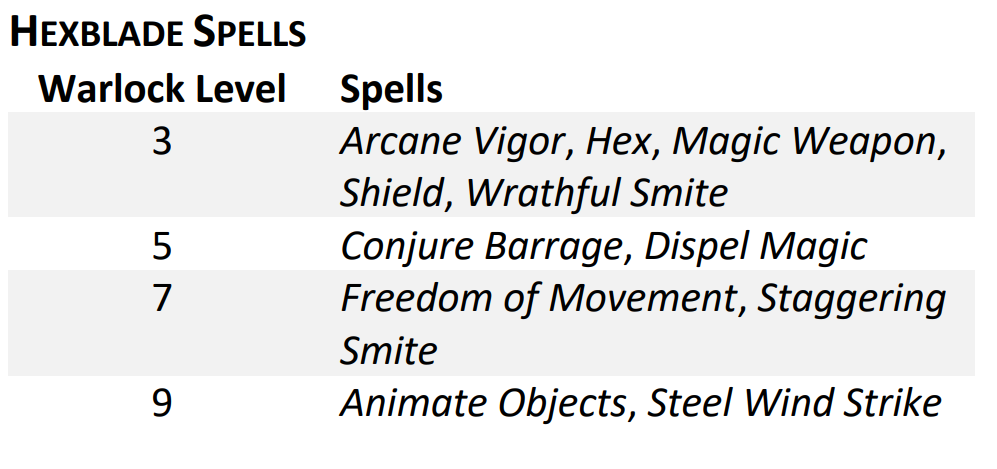
Hexblade Spells (Level 3)
Yes, yes, you get your extra prepared spells. Some changes from 5e – now you have Magic Weapon, Shield, Freedom of Movement and more – you lose Blink though, Cone of Cold, Blur… In general, you get more “martial” spells, if that makes sense. You also get Hex as permanently prepared – because, just like the ranger we saw with Hunter’s Mark, the entire subclass revolves around it. So don’t count on concentration either, that’s locked down.
Hexblade Manifest (Level 3)
You can cast Hex a number of times equal to your CHA modifier without using a spell slot per long rest. Necessary, really, considering the way Warlocks get spell slots. You also get “Hexblade Maneuvers” – when you hit a creature affected by Hex with an attack roll, you can choose:
- Draining Slash: the target makes a CON saving throw – on a fail, they can’t make opportunity attacks and their speed is halved.
- Harrowing Blade: the target makes a WIS saving throw. On a fail, the next time they make an attack roll against a target other than you, they take necrotic damage equal to your CHA modifier.
- Stymying Mark: the target has disadvantage on the next saving throw it makes before the start of your next turn.
Pretty strong stuff, and I can see all 3 options being used – though Harrowing Blade is perhaps not as up to par as the other two.
Life Stealer (Level 6)
When a target cursed by Hex drops to 0 HP, you regain 1d8+your CHA modifier HP. Also, once per turn, when you miss an attack roll against a target with Hex, you can deal necrotic damage equal to your CHA modifier.
More Hex focus, as I mentioned. A decent feature on its own, though perhaps the life gain could be toned down a bit – perhaps make it temporary HP instead?
Armor of Hexes (Level 10)
When you take damage from a creature affected by your Hex, you can use your reaction to reduce it by 2d8+your CHA modifier. You can do this a number of times equal to your CHA modifier per long rest.
This is mostly enough to block most damage – an average of 14 is certainly a decent chunk, especially at level 10, where things are still somewhat reasonable.
Masterful Hex (Level 14)
You crit on a 19 against creatures affected by Hex, when you use a Hexblade Maneuver you can choose a creature within 30 feet and deal 1d6 necrotic damage to it (no save), and taking damage doesn’t break your concentration for Hex.
Now it’s time for the Hexblade rant. First of all… there’s certainly a lot of hex, but where’s the blade!? Everywhere you look, it mentions attack rolls, not weapon attack rolls. You can just use Eldritch Blast no problem. No more medium armor, shield, and martial weapon proficiency like 5e, so goodbye bladelocks. Now, to be fair, 5e hexblades were insanely frontloaded, and available at level 1 as well, so dipping just a single level into it was very good. But I’m not sure this is any better. It might be better as a whole, but it has lost a ton of flavour, and reliant entirely on a single spell. And speaking of flavour, no more Shadowfell – now your patron is a cursed blade… that never really does anything because YOU DON’T NEED TO USE A WEAPON!
Anyway. Let’s not get carried away.
Warlock – Undead Patron
Another subclass originally from Van Richten’s Guide to Ravenloft, and our second Warlock of the day.
Form of Dread (Level 3)
As a bonus action, you transform for 1 minute. You gain Temporary HP equal to 1d10+your Warlock level, immunity to being frightened, and once per turn, you can frighten a creature you hit with an attack if it fails a WIS saving throw. You can do this transformation a number of times equal to your CHA modifier per long rest. Exactly the same as 5e (though you get it at level 3 instead of 1 now), not bad.
Undead Spells (Level 3)
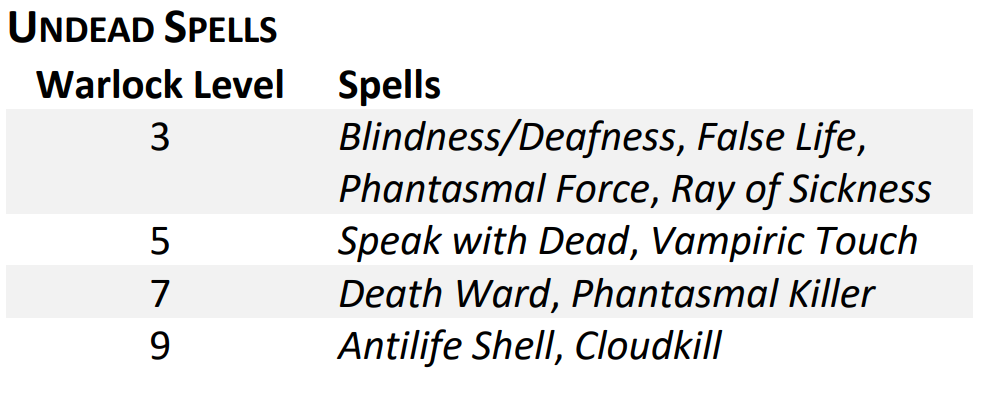
The extra archetype spells. A couple of changes from 5e, no more Phantom Steed and Greater Invisibility, but you get Ray of Sickness, Vampiric Touch and Phantasmal Killer now.
Grave Touched (Level 6)
Your spells and attacks that deal necrotic damage ignore resistance, and when in Form of Dread, you can change other damage types to necrotic. A small change from 5,e where Form of Dread gave extra necrotic damage, and you lacked the resistance ignore altogether – and this is yet another feature that ignores resistance. Getting a bit too common for my taste.
In addition, you don’t get Exhaustion from malnutrition, dehydration, and suffocation, and don’t need to sleep, and magic can’t put you to sleep. Same as 5e, though a bit reworded, you mostly care about the sleep part.
Necrotic Husk (Level 10)
Same as 5e again (mostly). You have resistance to necrotic damage or immunity while in the Form of Dread. If you fall to 0 HP, you can instead choose to gain 1 Exhaustion level, and set your HP to 10 times your Charisma modifier. Each creature of your choice within 30 feet makes a CON saving throw and takes 2d10+your Warlock level necrotic damage on a failed save or half as much on a successful one. You can do this once per short rest.
The changes from 5e are that you now gain a lot more HP (it used to be just 1), and you can do this a lot more often, every short rest as opposed to every 1d4 long rests. A nice change in my opinion, as you still can’t spam it thoughtlessly due to Exhaustion.
Superior Dread (Level 14)
Your Form of Dread improves. While in it, you gain a flying speed equal to your speed and can hover, once per turn you can regain HP equal to your CHA modifier when you deal necrotic damage, and you ignore components (except material components that have a cost) when you cast Necromancy or Conjuration warlock spells.
In 5e, this used to be the ability to detach your spirit from your body and fly around, separate from your Form of Dread. I think now it’s much clearer and easier to use – technically ,you lose some utility, but I prefer this version.
Overall, not bad – not many changes but it’s a good revision and return.
Final Thoughts
Some good changes this time, though again, overall I expected more. With every UA, I can’t help but feel there are obvious issues that can be resolved relatively easily – though I also feel there is a trend of design decisions I can’t help but disagree with, like some subclasses revolving entirely around the use of a single spell (like Hexblade and Hollow Warden).
Join Our Mailing List
Do want…
- Extra content?
- Discounts?
- Updates about all our work?
 The Kind GM