The latest Unearthed Arcana is out, containing 9 new subclasses centered around magic.
Most of the subclasses are revised versions – Arcana Domain for the Cleric, Arcane Archer for the Fighter, four Wizard subclasses, and even the Hexblade Warlock make a return, while we also get 2 new ones: the Tattooed Warrior for the Monk, and the Ancestral Sorcery for the Sorcerer. As usual, you can watch the related YouTube video from the official Dungeons & Dragons account.
Cleric – Arcana Domain
This is an old one, first appearing in the Sword Coast Adventurer’s Guide for 5e all the way back in 2015 – and never again, until now. As such, I’m not really going to do much in terms of comparison – I’m going to treat this as a mostly new subclass.
Arcana Domain Spells (Level 3)
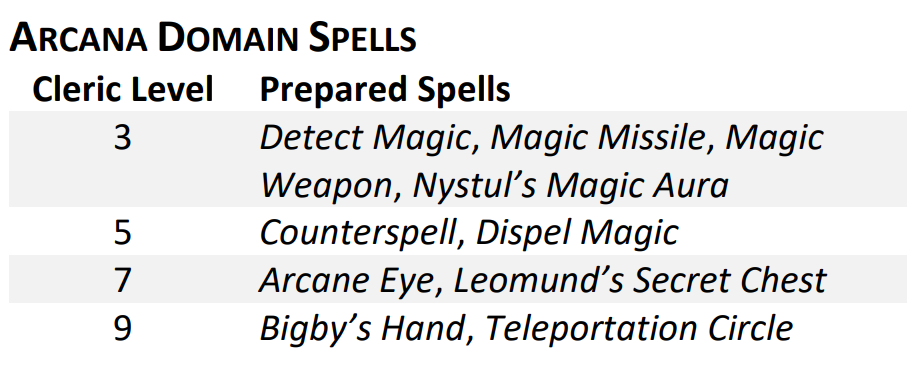
Your always-prepared spells, mostly wizard flavoring as you would expect. Most are the same as before, but you do get Counterspell now which is pretty big.
Arcane Initiate (Level 3)
You gain proficiency and Expertise in Arcana. You also learn two Wizard cantrips, and you can change one of them every time you get a Cleric level. Pretty nice introductory feature – and wizards have a ton of fantastic cantrips. You can get the ol’ reliable Fire Bolt if you want damage and aren’t satisfied with Sacred Flame, or you can get more utility with Mage Hand or Minor Illusion – or Mind Sliver for a mix of both.
Modify Magic (Level 3)
When you cast a spell, you can use your Channel Divinity to enhance it. It either gives one target 2d8+your Cleric level Temporary HP, or, if it forces a saving throw, one target gets a 1d6 penalty to it. I’ve said this over and over, but once more won’t hurt – reducing enemy saving throws is always an amazing ability to have (cough cough Mind Sliver), especially since the term I’ve heard a lot about several spells in DnD is “Save or Suck”, which honestly is pretty fitting.
Dispelling Recovery (Level 6)
When you cast a spell (using a spell slot) that recovers HP, you can also cast Dispel Magic on the same target as a bonus action and without expending a spell slot. You can do this a number of times equal to your WIS modifier per long rest. Somewhat niche, but I like it a lot – if someone’s in trouble, say they are caught in one of the aforementioned Save or Suck spells (Hold Person, Blindness/Deafness, Bestow Curse, etc), you can spend a 1st level slot for Cure Wounds and get a free Dispel Magic on top of it. Though keep in mind (I assume, at least) that you cast it at its lowest level – so when facing spells cast at high level slots, it might not be as effective.
Arcane Mastery (Level 17)
Man, what a capstone – this is a great one. You choose one Wizard spell from levels 6,7,8, and 9, and you have that always prepared. When you gain a Cleric level, you can replace one of those. So Clerics now have access to Wish (which means also access to any other spell below 9th level), Time Stop, Foresight, et cetera – making them an even greater spellcasting powerhouse.
Overall, I like this – certainly not weak, and I wouldn’t call it overpowered either.
Fighter – Arcane Archer
Returning from Xanathar’s Guide to Everything, the Arcane Archer doesn’t seem to have many changes. I remember playing it a while ago and I had fun with it – I always like the ranged fighters, so I’m looking forward to this.
Arcane Archer Lore (Level 3)
You learn either the Druidcraft or Prestidigitation cantrips, and you gain proficiency in Arcana and Nature. I don’t really see the ties to nature – I know the “lore” says this began as an elven discipline, and I suppose it is implied those elves lived in forests? But that makes it more like a Ranger archetype. Just a personal nitpick I suppose.
Arcane Shot (Level 3)
The centerpiece of the subclass, these are essentially similar to Maneuvers. You learn 2 Arcane Shot options at level 3, then one more at levels 7, 10, 15, and 18 – and you can also swap one option at those levels (though I think it could be able to change every time you level up too). You can use your option once per turn after you hit your target with a ranged attack with a weapon with the Ammunition property (so crossbows, and even slings, blowguns and actual guns count) as long as the option doesn’t involve an attack roll. You can use this a number of times equal to your INT modifier per short or long rest, and you also get an Arcane Shot die that you use for most of them that starts out as a d6.
Most options deal additional damage and impose a condition on the target – Restrained, Blinded, Charmed, etc. In my opinion one of the strongest options here is Enfeebling Shot; 2 dice of extra damage, the target is poisoned if they fail their saving throw for one turn, and if they hit while poisoned the reduce their damage by one Arcane Shot die roll. Alternatively, Banishing Shot completely takes a creature out of the fight for a whole turn.
Curving Shot (Level 7)
If you miss with a ranged attack roll with an Ammunition weapon, you can use a Bonus Action to make another attack with the same weapon to a different target. Not bad – it’s certainly a feature that’s going to see a lot of use, and that’s a lot of potential damage; and you rarely fight a single individual on their own, so you’ll probably have that secondary target available.
Ever Ready Shot (Level 7)
When you roll initiative and you don’t have any Arcane Shots left, you get one. Honestly this is pretty nice, as they are tied to your INT modifier and you might not have it that high, so getting some extras to play around with is a decent bonus.
Improved Shots (Level 10)
Your Arcane Shot Die increases to d8. Yeah, I don’t have much to say here, except perhaps that this could have even come a bit earlier even.
Powerful Shots (Level 15)
Your Arcane Shot Die increases to d10. Yup.
Masterful Shots (Level 18)
Your Arcane Shot Die increases to d12. That’s all. Those 3 features honestly feel pretty underwhelming – yes, you also get your extra Arcane Shot options, but they could still have something more – even just a tiny bit of conditional/niche bonuses to make them more interesting. As is, they barely feel like features.
Overall… again, not bad, but certainly not as good as I was hoping for.
Monk – Tattooed Warrior
Now we’re getting into the new stuff. Not quite arcane, but magic nonetheless – it essentially makes you a spellcaster, using Focus Points instead of spell slots.
Magic Tattoos (Level 3)
This is the “primer” feature, essentially just saying “You get Magic Tattoos, look at your other features for details”. The only extra piece of information is that when you finish a long rest, you can change one tattoo to another of the same list (or same level, essentially).
Beast Tattoos (Level 3)
You first set of tattoos, these all give a cantrip and a secondary bonus. Some give a level 1 spell for 1 Focus Point, while others enhance some of your class features. The two that stand out to me are Crane, which gives you Guidance (already a great cantrip to have in the party) and gives you advanatge on your rest of your Flurry of Blows if you miss one of them, and Spider, which gives you Mending (not really that interesting on its own) and gives creatures you hit with Flurry of Blows disadvantage on their next attack roll. There are others with more niche benefits (Bat gives you Blindsense, for example) but these two are the most reliable and widely useful in my opinion.
Celestial Tattoo (Level 6)
Your second set of tattoos just gives you a level 2 spell for 2 Focus Points. You can choose between Find Traps, Misty Step, Invisibility, or Lesser Restoration. Invisibility is probably the strongest, with Misty Step after, but there’s not much else to talk about here.
Nature Tattoo (Level 11)
Another set of similar tattoos. As a magic action, you can spend 3 Focus Points and gain resistance to one type of damage and advantage to one saving throw for 1 minute. The pairs are Acid damage and CON saving throw, Lightning damage and DEX saving throw, Fire damage and STR saving throw, and Cold damage and WIS saving throw. A pretty good feature that’s flexible – but it also needs setup. This is the feature that benefits most from switching tattoos, especially if you know what you’re going to face, but it also takes an action to apply – which you can spend punching people in the face. A simple and strong defensive measure though, which I like on a Monk.
Monster Tattoo (Level 17)
When i first read this, I immediately though of a monk with a tattoo of the Monster energy drink logo on them. Let’s all try to forget this image and move on. A bit more variety here; Beholder gives you 10 feet of flying and Counterspell for 3 Focus, Blink Dog lets you cast Blink for 3 Focus when you use Patient Defense (if you spend the Focus for it), Displacer Beast gives you Mirror Image for 2 Focus when you spend Focus on Flurry of Blows or Step of the Wind, and Guardian Naga gives you twice your Monk level in HP when you drop to 0 HP once per long rest. Out of all of these, I think I lean more towards Displacer Beast – Mirror Image is a fantastic defensive tool and you can easily spam it every time it runs out. I don’t think Blink is much use when you already used Disengage and Dodge with Patient Defense, and I’m always looking at the “cheat death” kind of features like Guardian Naga as a good last line of defense, but not something I’d pick over the other options. Beholder is interesting though, and I can see myself picking it now and then, especially if facing a large amount of spellcasters.
Overall, a nice concept – but I think it a bit undertuned. I think that at higher levels especially, you could unlock extra tattoo “slots” – Maybe at level 6 you get an extra Beast tattoo, at 11 an extra Celestial, and at 17 an extra Nature?
Sorcerer – Ancestral Sorcery
The source of your powers is an exceptionally powerful ancestor that somehow a fragment of their personality guides you. An interesting premise; let’s see how it works though.
Ancestor’s Lore (Level 3)
You gain proficiency to one of Arcana, History, Investigation, Nature, or Religion. More importantly, when you make an Intelligence check, you add your CHA modifier. It’s a nice bonus, though Sorcerers aren’t really thought of as skill-stackers.
Ancestral Spells (Level 3)

A bunch of nice stuff- Command, Protection from Good and Evil, Spirit Guardians, Legend Lore are all great.
Visage of the Ancestor (Level 3)
While your Innate Sorcery feature is active, you have advantage on Influence actions. Most of the time you want to save your Innate Sorcery uses for combat, but this can work great if you’re playing a diplomatic sort of campaign.
Superior Spell Disruption (Level 6)
You always have Counterspell and Dispel Magic prepared. Once per long rest, while using Innate Sorcery, you can cast one of them without expending a spell slot. For Counterspell, the target has disadvantage on the saving throw, and for Dispel Magic, you have advantage on the check. A free, more reliable Counterspell? Sign me up. Still, a bit restricted – once per long rest, and while in Innate Sorcery. I think you could have one of the two – once per long rest, OR once per Innate Sorcery, and it would still be alright.
Ancestral Majesty (Level 14)
While using Innate Sorcery, you have a 5-foot aura that causes fear or prone. I’m starting to see a theme here focusing around Innate Sorcery – and while i can see how it fits thematically, I’m not sure I like it. Regardless, this feature looks meh to me – 5 feet only, with a saving throw attached. I suppose it’s a good tool, but generally you don’t want a lot of people next to you. But, you also get a second feature at 14:
Steady Spellcaster (Level 14)
Taking damage doesn’t break concentration. Now that’s a good one – let’s you feel a lot more safe and reliable with your big concentration spells (and saves you having to get War Caster too!).
Ancestor’s Ward (Level 18)
While using Innate Sorcery, you have advantage in saving throws against spells, and once per use you can turn a failed saving throw into a successful one. Wow this is good – you’re using Arcane Sorcery pretty much every big fight, so this is a huge defensive bonus. This, combined with unbreakable concentration, means you can do your stuff mostly uninterrupted.
Overall, I am a bit hesitant due to the complete focus on Innate Sorcery, but it’s a core feature of the class (and not like some other subclasses we saw in previous UAs that focus entirely on a single spell like Hexblade and Hollow Warden)
Warlock – Hexblade Patron
And speaking of Hexblade – what a coincidence! Seems like it’s gotten a bit of an overhaul.
Hexblade Spells (Level 3)
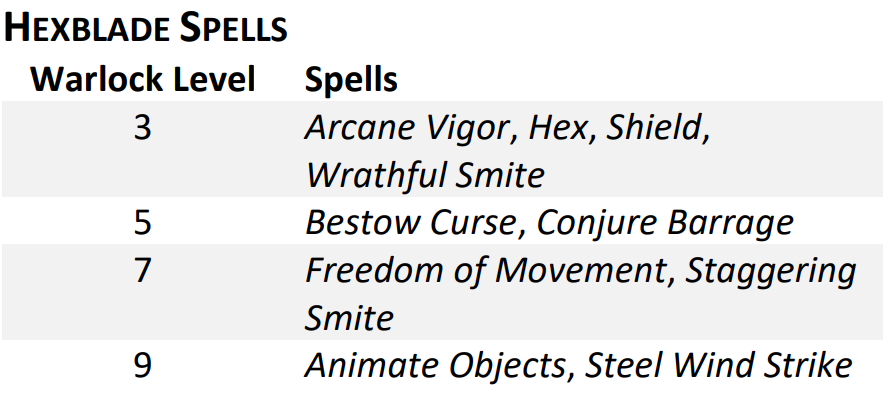
Not really any particular changes here from the precious version – Dispel Magic has been swapped with Bestow Curse though, which I like.
Hexblade’s Curse (Level 3)
It’s back. As a bonus action, you can curse a creature within 30 feet of you for 1 minute. you can also do this as part of a spell that targets that creature – so you get it for free instead of a Bonus Action. You can do this a number of times equal to your CHA modifier per long rest, and there are 2 parts to it: When the creature drops to 0 HP, you regain 1d8+CHA hit points, and while you aren’t wearing armor or holding a shield, you get +2 to your AC while within 10 feet of your target.
The healing is pretty good to have, especially in the early levels, but I don’t like the “no armor or shield” for the AC bonus. How are you supposed to fight in melee without armor or shield? You’re pretty much obligated to get Mage Armor, or multiclass for Unarmored Defense or something. I do like the combined casting though – when used as part of another spell, it inherits both its range and duration, so it’s a bit more flexible.
Unyielding Will (Level 3)
Once per turn, when you succeed on a concentration saving throw, you can deal 2d6 necrotic damage to any number of creatures within 10 feet of you. In addition, once per long rest, you can choose to succeed on a failed concentration saving throw, and gain 1d10+your Warlock level Temporary HP. The second part is obviously more important than the first – We we just talking about it with Steady Spellcaster. Still, it might be a good idea to get War Caster regardless (or Eldritch Mind), and keep the auto-success for dire circumstances. The first part is also nice though – You’re often in the thick of it, so you can expect lots of creatures around you and plenty of concentration checks.
Malign Brutality (Level 6)
3 separate bonuses.
- Harrowing Hex: After you cast a level 1+ spell that costs an action, you can make a weapon attack as a bonus action. Always good to have extra attacks (though remember Warlocks can get Extra Attack with the Thirsting Blade invocation).
- Hindering Curse: When you hit the target of your Hexblade’s Curse with an attack roll they get disadvantage on their next saving throw. Another excellent feature.
- Inescapable Hex: When the target ends their turn 30 feet or more away from you, you can move up to your Speed towards them. This is another decent addition for a simple reason: You can keep your +2 AC much more easily. Though you might also get mauled by opportunity attacks on the way, so keep that in mind.
Armor of Hexes (Level 10)
When you take damage from your Hexblade Curse target, you can use a reaction to reduce it by an amount equal to your Warlock level. No restriction on uses, so this will save you a ton of HP – and it also makes it easier to keep concentration, since you take reduced damage.
Masterful Hex (Level 14)
Even more bonuses.
- Accursed Critical: You crit on a 19 against your Hexblade Curse target. Alright, but i don’t really rely on criticals much.
- Explosive Hex: When you damage your target, you can deal 3d6 necrotic, psychic or radiant damage to any number of creatures within 30 feet of them, and their speed is reduced by 10 feet. You can only use this once per long rest, but you can also spend a spell slot to regain a use. The damage isn’t that much (unless we’re talking about a horde of fodder) but it’s automatic, no save, and the AoE is HUGE The speed reduction is also pretty important, this can cripple a lot of enemies.
- Hex Restoration: You get back one use of Hexblade Curse when you take a short rest or use Magical Cunning. Getting it a bit late in the capstone feature, but still a very welcome addition.
Overall – I like the changes from the previous version, and I think they’re moving in the right direction, but it still needs some more work. Particularly the base Hexblade’s Curse.
Wizard – Conjurer
Let’s get started on the Wizards.
Benign Transposition (Level 3)
This used to be a level 6 feature. It’s pretty much the same as it was in 5e – teleport 30 feet, or swap places with a willing creature in the same range. Once per long rest – but now you can expend a 2+ level slot to use it again. A pale imitation of the Psi Warper from the Psion, but that’s a bit of a special case. Anyway – I like teleports, so this is alright. Essentially a Misty Step… but worse, since it takes a full action.
Conjuration Savant (Level 3)
You add 2 Conjuration Wizard spells to your spellbook (they must be up to level 2). Every time you level up, you add one more (if it’s a level that you have slots for). Note that you don’t have them prepared – Wizards follow their own spell preparation rules with a flat amount determined by level. This is pretty much the new “Savant” feature for most wizard subclasses that revolve around a spell school.
Distant Transposition (Level 6)
Your Benign Transportation increases to 60 feet, and you can use it every short rest. It’s alright, but I think it should also be a bonus action now (more on that later)
Durable Summons (Level 6)
This also used to be a later feature, at level 14 and gave a flat 30 Temporary HP to creatures you summoned with a conjuration spell. Now it gives equal to twice your Wizard level instead. Makes sense, since it’s available earlier, and has a slightly higher cap. This can certainly be very annoying to your enemies if you summon a bunch of little guys, each with a ton of extra HP.
Focused Conjuration (Level 10)
Taking damage can’t break your concentration for Conjuration spells. Excellent – now you can be certain that all your summoned creatures are going to stick around.
Quick Transposition (Level 14)
For a capstone, a bit disappointing. Benign Transposition is now a Bonus Action – very good, but as i said, I think this should be earlier. You can also use it as a reaction when being targeted by an attack, but only to switch places with another creature, which is the new target of the attack. Not bad for a squishy wizard who usually has minions to take his place, but I think you could have something extra here for using Benign Transposition on your summons. Maybe extra uses at the very least?
Overall, certainly an improvement over the 5e Conjurer I think, but it could do with a smidgen more.
Wizard – Enchanter
A few more changes than the Conjurer, Hypnotic Gaze and Instinctive Charm are both replaced.
Enchanting Talker (Level 3)
When you make a CHA check, you add your INT modifier. You also get proficiency to one of Deception, Intimidation, or Persuasion. This is kind of the inverse of the Sorcerer’s Ancestor’s Lore – but more useful in my opinion. If you don’t have a “face” for the party, now the Wizard can take that role.
Enchantment Savant (Level 3)
The standard “Savant” feature, for Enchantment spells. Let’s move on, not much to say here.
Vexing Movement (Level 3)
When you cast an Enchantment spell with a spell slot and an action, you can take a bonus action to both Disengage and Dodge. You can do this a number of times equal to your INT modifier. A bit weird, but alright I guess. You’re probably just using this for the Dodge.
Reflecting Charm (Level 6)
Once per long rest (or with a level 2+ spell slot) you can use your reaction when hit by a creature within 30 feet of you. You reduce the damage taken by half, and force the creature to make a WIS saving throw or take half your Wizard level + your INT modifier psychic damage. This replaces Instinctive Charm, which instead made the creature attack another target instead – and in my opinion, a much better fit thematically for an Enchanter. I much prefer the old version.
Split Enchantment (Level 10)
This stays roughly the same – but with a bit of updated wording that makes it a bit better. When you cast an enchantment spell that can be upcasted to target more creatures, increase the spell’s effective level by 1. Very very nice.
Bolstering Belief (Level 14)
You always have Power Word Fortify prepared and can cast it once per long rest for free. When you do, every creature affected by it has advantage on saving throws against being frightened or charmed. It’s… pretty good, yeah, but why is this an Enchanter feature? Yeah, Alter Memories was a bit of a janky, niche feature, but it fit the theme.
Overall, disappointing. Most of the features aren’t even about enchanting. Bring back Instinctive Charm, and I don’t know what you can do for level 14, but Bolstering Belief is not it. If you want a free spell cast though, Mass Suggestion is right there!
Wizard – Necromancer
Quite a few changes here as well – every single feature is changed, though a lot of the old features are just slightly changed and repurposed into new ones.
Necromancy Savant (Level 3)
We know what this is by now, moving on.
Necromancy Spellbook (level 3)
A mix of Grim Harvest and Inured to Death, with some changes. You gain resistance to necrotic damage, and when you cast a Necromancy spell using a spell slot, you or a creature within 30 feet of you gain Temporary HP equal to the level of the spell + your INT modifier. A much better change from the original Grim Harvest: You no longer need to kill, it’s now Temporary HP instead of healing, and you can target others as well, making it a lot more versatile.
Grave Power (Level 6)
You get 2 more benefits.
- Grave Resilience: When you use Arcane Recovery, your reduce your Exhaustion level by 1. This is one of those features that’s very niche, but very strong when it hits just right. It also fits nicely with the Necromancer i think.
- Overwhelming Necrosis: Damage from your wizard spells and features ignores necrotic resistance. Pretty nice. Since it doesn’t bypass immunity, I like it.
Undead Thralls (Level 6)
You always have Summon Undead prepared and can cast it once per long rest for free. When you do so, you can siphon half of the summoned creature’s HP to yourself. Pretty good if you’re desperate for healing, but overall not that significant – I think you’re just using the free cast without the extra ability most of the time.
Undead Secrets (Level 10)
When you take a long rest, you can use a level 4+ spell slot to protect yourself from death. If you drop to 0 HP, your HP instead becomes equal to 10 times the spell slot expended. So pretty much a better Death Ward – except it doesn’t protect your from instant death stuff, which I think it should. In addition, after taking damage, if you are bloodied, you can use a reaction to teleport up to 60 feet and deal 2d10 necrotic damage to each creature within 10 feet of the space you left. Not sure how the teleport fits with necromancy – I think this could instead give Temporary HP, or maybe reduce the damage taken, or something. Still pretty nice though – if only it protected against instant death, it would be perfect.
Death’s Master (Level 14)
Well, if nothing else, I learned a new word today: “Abstruse: difficult to understand, obscure”. I’m not sure if whoever wrote this was intending it to be a joke, but either way, it got me. Anyway, you get 2 bonuses:
- Bolster Undead: As a bonus action, you can give Temporary HP to any number of undead you have summoned within 60 feet of you equal to your Wizard level. Each undead can benefit from this once every 24 hours. So you can reuse it, as long as you keep summoning new undead. I like the Conjurer’s Durable Summons and this is sort of a lesser version, but still very nice (plus, you can’t give the necromancer something better than the conjurer on this).
- Harvest Power: When you use Grim Harvest, the target that gains the Temporary HP also gains advantage to either attack rolls or the next saving throw until the end of their next turn. A very nice bit of support – throw this on your frontline fighters/barbarians/what have you, and enjoy.
Overall, I like the new Necromancer a lot – not sure I’d play one, since involving summons and such makes the flow of the game a lot more complicated, but I’m tempted.
Wizard – Transmuter
And we’re here, to the last subclass of this UA. Transmuter used to be pretty weak, but let’s see if they’ve gotten any buffs.
Transmutation Savant (Level 3)
Savant, you know it, 2 spells, blah blah, moving on.
Transmuter’s Stone (Level 3)
This is now available at level 3 instead of 6, but is otherwise pretty much unchanged. When you finish a long rest, you create a Transmuter’s stone that lasts until you do so again. Whoever has this stone has one of the following benefits (you choose when you create it, and can change using a spell slot):
- 60 feet of Darkvision
- 10 feet of speed
- Proficiency to CON saving throws
- Resistance to Acid, Cold, Fire, Lightning, Poison, or Thunder damage.
Much better now that you get it early, and a bit more versatile since you can now change the bonus during the day (though I don’t expect you to do so often).
Wondrous Enchantment (Level 3)
You always have Enhance Ability prepared, you can cast it once for free, and when you cast it (at any time, not just for free) the targets have advantage on saving throws of the chosen ability. This is fantastic in the early levels, though later on you want your concentration for better stuff.
Split Transmutation (Level 6)
Similar to Split Enchantment – when you cast a Transmutation spell that has additional targets when you upcast it, it counts as being 1 level higher. The example given her is Fly – and while it’s a fantastic spell, I’m not sure what else you can use with this feature – not Haste, not Polymorph, not Disintegrate, not Stoneksin, or even Enlarge/Reduce. What’s left? Spider Climb? Also Jump and Longstrider, I guess. So this is pretty much “target an additional creature with Fly”. Still, I’ll take that. You can use this a number of times equal to your INT modifier, but those are more than enough I feel.
Potent Stone (Level 10)
You can choose a second option for your Transmuter’s Stone, or choose two different types of resistance. Yes, this is lovely. Though quite weak for level 10 – maybe you could also (or instead) make a second stone? Or have new, stronger options, or improve the 4 existing ones.
Master Transmuter (Level 14)
I can’t believe it, they actually made this WEAKER than 5e. No more major transformation – alright, fine, even though it would have been fun in my opinion. Restore Life is the same – you use the Transmuter’s Stone to cast Raise Dead for free. Restore Youth is also the same, you use the stone to reduce someone’s apparent age by 3d10 years (meaning they don’t actually get to live longer). Finally, Panacea is gutted. It used to be: Restore all HP, and remove all curses, poisons, and diseases from a creature. Now it’s just regain a number of HP equal to twice your Wizard level, and end a curse.
It looked pretty good at the start for the Transmuter there, but Potent Stone is disappointing and Master Transmuter feels horrible when you know what Panacea used to be. I think it needs a lot more work, and it also needs some features like the old Minor Alchemy and Major Transformation – you know, things that actually transmute objects to different things.
Final Thoughts
Some good, some bad. The only subclass I can say I fully like is the Cleric – all the rest look like they’re heading towards the right direction, but just stumble at some point and miss their mark. Hexblade, Enchanter, Transmuter especially – they really need some extra attention.
Join Our Mailing List
Do want…
- Extra content?
- Discounts?
- Updates about all our work?
 The Kind GM