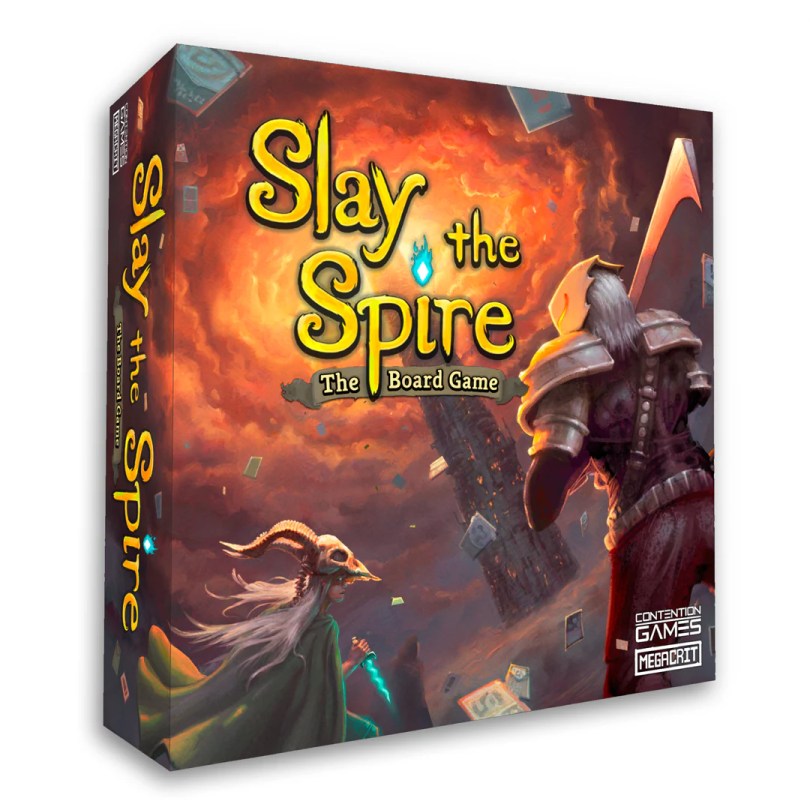
Slay the Spire: The Board Game is a cooperative deckbuilding adventure, based on the Slay the Spire videogame and created and published by Contention Games.
I’ve been a huge fan of Slay the Spire, so the moment I saw the Kickstarter for this back in 2022 I was instantly hooked. It took me a while to finally get my hands on the game (just this year, in fact), but it was well worth the wait – but let’s not get ahead of ourselves. Let’s take things one at a time.
The Concept
Slay the Spire doesn’t really have a detailed, explained lore, but there is a story nonetheless – at least if you’ve played the videogame. There’s not much explained in the board game, and, truthfully, it doesn’t really matter: the basics are, there are 4 characters that try to ascend the Spire, a towering monument filled with monsters and adversaries and many other strange characters – again and again and again. Whether they die or succeed, they eventually are brought back and given a blessing by Neow, a whale (?) god (?), and off they go killing once more. Well, until they finally manage to kill the Heart of the Spire, but that’s a bit of a spoiler and comes a while after regardless.
This is a cooperative game; all players work together, each picking a different character and fighting their battles collectively. One player dying means that everyone loses – so there’s significant incentive in covering each other and making sure everyone stays safe. Each character also has their own deck, and while the general mechanics are the same for everyone, they all have their specific focus where they excel. However, very importantly, you can also play this solo – and without any additional or altered rules, it’s the exact same game.
As for the actual gameplay – we’ll get into more detail later, but the general gist is that you start with a simple and relatively weak deck of cards and at the bottom of the Spire. You have several paths you can follow, moving from room to room – always upwards – fighting enemies and encountering random events, and adding and upgrading your cards along the way. There are 3 Acts, and at the end of each, a very powerful Boss awaits you – with equally powerful rewards. If you beat the Boss of the 3rd Act, you win the game.
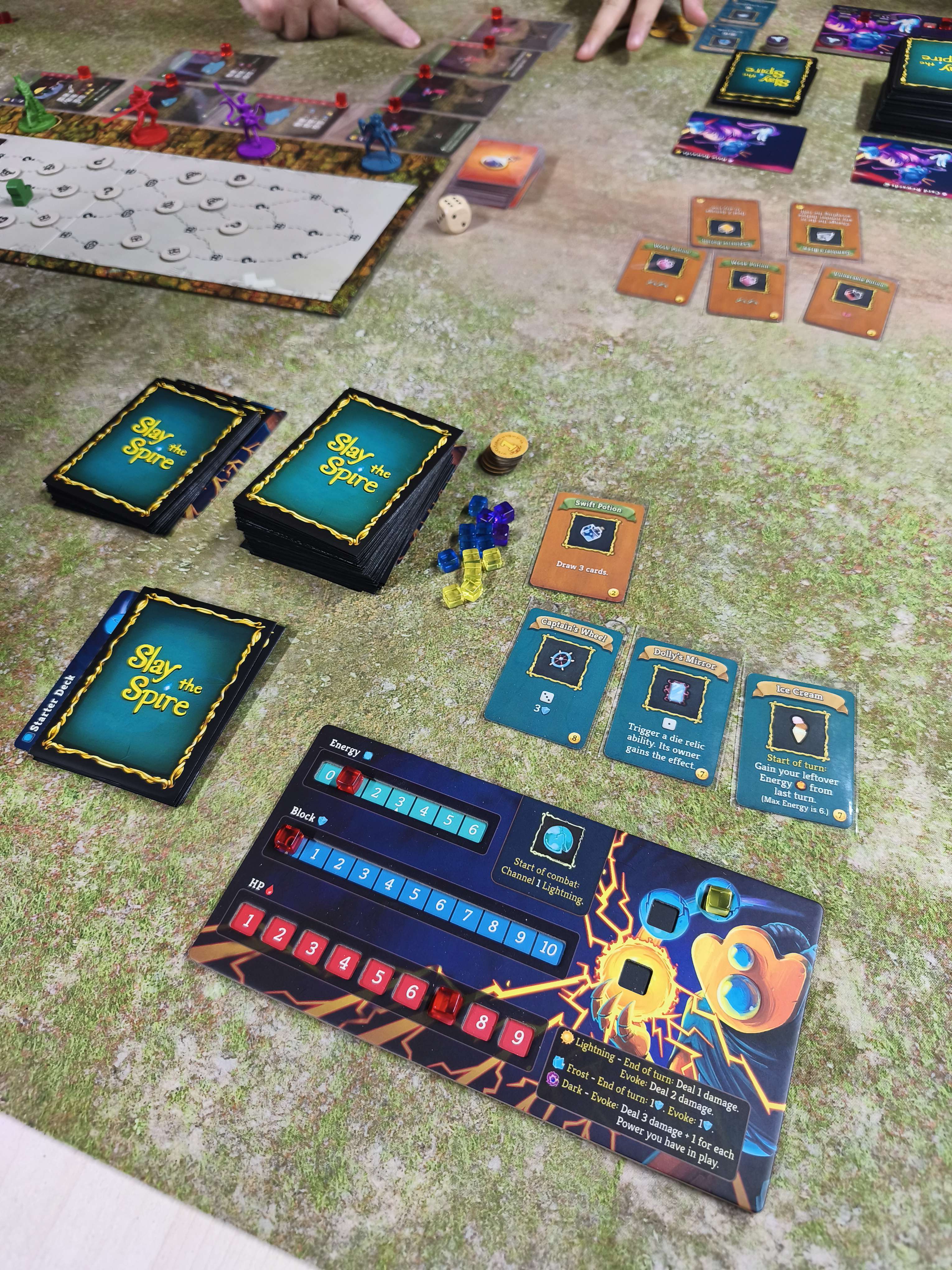
The box states that each act takes 60 to 90 minutes – for solo players, that sounds about right, but expect some longer sessions if you have 4 people, especially if they are new to the game or if you also count setup and cleanup.
The Box
With that introduction out of the way, let’s take a look at the box – and it’s a BIG one. You have:
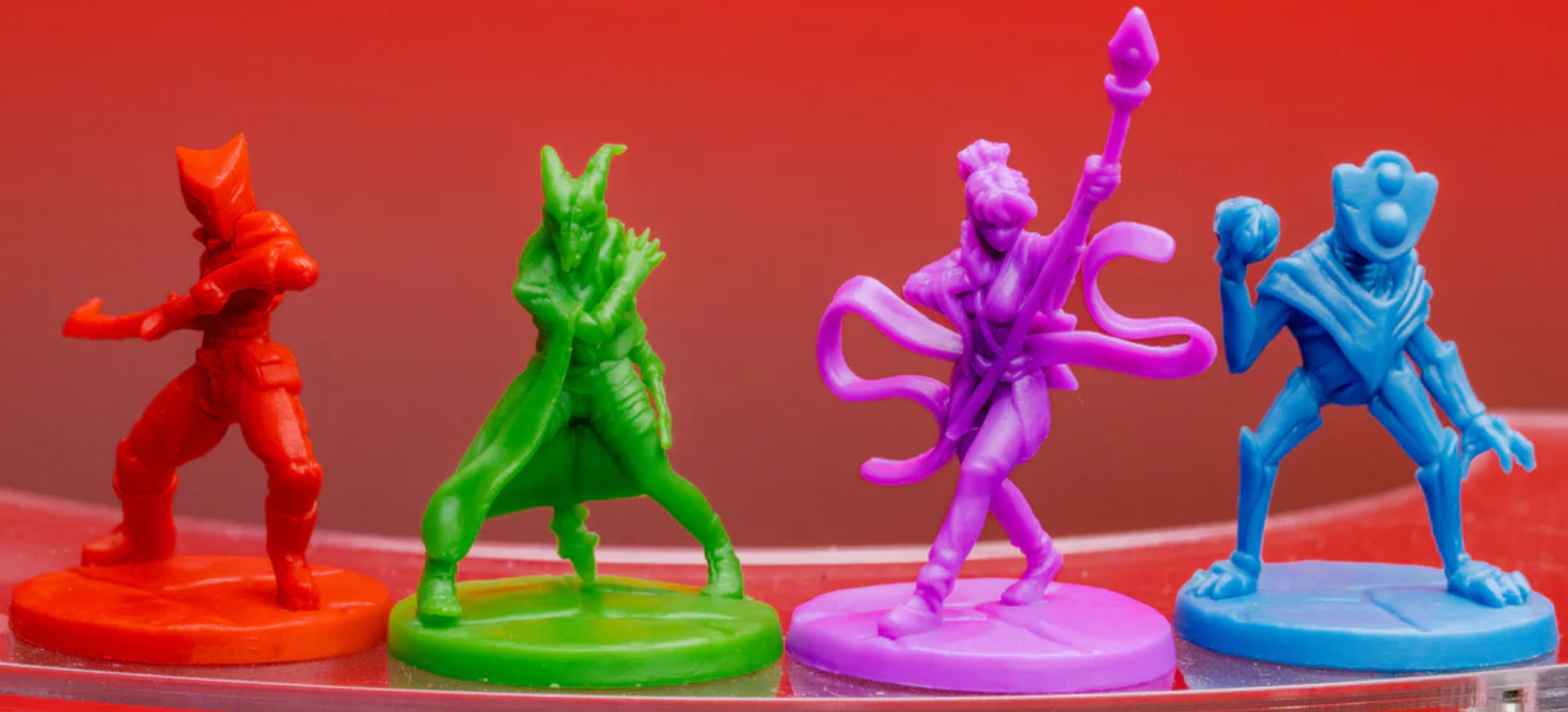
- 4 plastic minifigures, one for each character. They are all one flat color, with each character having a different one – red for the Ironclad, green for the Silent, blue for the Defect and purple for the Watcher. I don’t mind the flat color; I think it’s a good decision to make them easy to recognize, even though they all have very distinctive shapes; especially for newer players, and doubly so because there’s a lot of stuff being set up on the table, so seeing where your character is with just a glance is a big bonus.
- 4 player boards, again one for each character. These track the character’s Energy, Block, and HP, as well as any additional mechanics (Orbs for the Defect and Stances for the Watcher). They also have some extra indications for character-specific mechanics, like how Orbs or Poison works, as well as the character’s starting Relic.
- 2 map boards, double-sided. One board has 2 versions of Act 1, while the second has Acts 2 and 3.
- 1 merchant board, for setting up his wares when you run into him.
- 50 plastic cubes – most are red, for general uses, but you also have special ones to track the Defect’s orbs.
- 1 d6 die.
- 1 Boot pip to trach your progress along the Spire.
- About 115 tokens – these include Gold, various Rooms for the spire, and indicators for Strength, Vulnerable, Weak, Poison, Shiv, Miracles, and Block.

- About 450 sleeves, more than enough for all the cards that need them. However, I will note here that while the sleeves are alright, they’re not great – they have a tendency for the back layer with the art to peel. However, I think they’ll last you for a while – the extras can replenish any… attrition, though I can understand some dissatisfaction; once you run out of extras, replacing them with something stronger is going to be a bit pricey with so many cards.
- And speaking of cards – there are about 730 of them. Not all of them need sleeves – but they can certainly use them, though you’ll have to get transparent ones as well as some smaller ones. These include 112 small cards – 29 poitions, 58 relics, 20 boss relics, 4 Prismatic Shard indicators, and a special solo relic. Then you have 13 curses, 10 Daze cards, 36 Slime/Burn cards, 20 Neow’s Blessing cards, 19 Colorless cards, about 85 cards for each character, and finally separate cards for Encounters, Summons, Elites, and Events for each of the 3 acts. And you also have some extra stuff like alternative Elites and Encounters for higher Ascendancies, but we’ll get into that later.
- Larger cards for each of the Bosses, and their alternate versions for higher Ascensions.
- A special tracker for boss HP.
- A Rulebook, Storage guide, and Upgrades & Items Reference.
Anyway, as you can see, there’s a lot here. The good thing is that it’s easy to organize inside the box – a plastic insert has neatly divided slots for all the cards and figurines, and a smaller, second plastic tray fits on top for the boards – as well as a little box for all the tokens. And as I mentioned, there’s even a storage guide to help you!
The Rules and Mechanics
Before we delve into the details of the mechanics, let’s talk about the videogame first. As an adaptation into a physical board game, there is always the question – was it a “faithful” adaptation? And if so, is that a good thing? I mean, you can reasonably make a very close adaptation of any game, but that doesn’t mean it’s a good idea to do so. Well in this case, I’m glad to report that the answer is yes, and yes. It is a near 1-to-1 adaptation – StS already had the advantage that it’s based on cards, and cards existed in the physical world long before computers were a thing. The feel of the game and the identity of each of the characters is preserved, and though obviously several changes were made – especially for the Relics – I was very impressed with how close the board game actually is to the original one. The characters are of course the same; the art is straight out of the videogame; and so are the cards, enemies, events, relics, etc.

Now, here’s the thing; I’ve played a lot of Slay the Spire. Like, a LOT. I know every card, every relic, every event, and every rule. So I can look at something in the board game, and immediately make a connection, and thus understand how it’s supposed to work. The Rulebook works perfectly fine for me – I haven’t gotten a case where something was ambiguous, once I found the appropriate rule for it. However, I’m not sure if that’s the case for everyone – I’ve seen some comments online that people who haven’t had any prior experience with the original StS would appreciate more details and clarification on the rules.
If you want to read the rules yourself, you can find the Rulebook online.
Beginning & The Spire

So, you’re starting a new game. After each player picks their character, they get that character’s starting deck; then they set aside card rewards and rare rewards for later. Then, you set up the map; lay down the board for Act 1, shuffle the room tokens, and randomly put them on the corresponding slots before turning them right-side up. This changes up your runs every time, so there’s no “optimal” route you can learn. Roll a die to randomly choose the Act Boss, or pick one yourself, and place their card on the top of the Act map. Finally, each player gets a Neow’s Blessing – these are cards you get once at the beginning of the game and give you a small reward, usually some gold and an extra choice between 3 options – some giving strong boosts but with their own downsides. Place the Boot on the bottom room, and you’re ready to start.
Alternatively, if you want to maybe do a quick run, you can start from later acts as well – there are additional rules for how to do it, quickly setting up with some extra rewards to get right into it. This also works if you’ve reached let’s say Act 2 or 3 solo, and you want to bring in a second (or third, or fourth) player for the rest of the game – they can join you with an upgraded character instead of having to scrap the game and start from scratch.
Moving on though – the very first room is a special battle, with weaker enemies than usual – in the Act 1 cards, you will find them in the Encounter deck with the special “1st Encounter!” card back. When you defeat them, pick up the boot and – collectively – pick the next room you visit. You can only visit rooms that are connected with a path, and the type of room is shown by the icon – the question marks are Event rooms (you draw a card from the Event deck and choose one of the options presented), the campfires give you the option to either Rest to recover HP or upgrade a card, the money bags are Merchants where you can spend your Gold for cards, relics, and potions, and the enemy icons with the large horns are Elites – much stronger enemies that reward you with relics.
Combat

Now, once you’ve stepped in a room with an Encounter, combat begins. Each player places their character figure in one of the 4 slots on the board – the circles you can see on the right side. Then, for each player, draw a card from the Encounter deck and place them in a row. Some enemies have Summons; they are indicated on the bottom of their card, and you search for them in the Summons card and place them next. Put some cubes to track their HP, and you’re ready to fight. Page 10 of the Rulebook has some very simple and nice diagrams of how exactly this works.
Now we get to the fun part. At the beginning of each turn, every player draws 5 cards and gains 3 energy. Then, you (all, collectively) roll the die once, and only once – the resulting number indicates if some relics are activated, and in some cases, what actions the enemies will take. After that, you’re free to start playing cards. There’s no specific player order – any player can play any card at any time during the player turn, and it is in fact encouraged to communicate with each other to plan how to “weave” actions with each other for maximum efficiency. Generally, in the games I’ve played with others, we’ve all played with our cards open – though part of it was because I was the one most familiar with the rules so I would help others.
Each card you play has a cost in Energy, and has an effect. It can draw you more cards, or deal damage to an enemy, or give you block, etc etc. Each enemy only attacks the player on their row (though some enemies have actions that can affect everyone), but players can all attack any enemy they want regardless of row. This lets you plan your turns better – for example, focusing down the most dangerous enemies together, or clearing out one row to let the player there deal damage and not bother with blocking. This sort of planning is the main sort of interaction with other players. There are some cards that let you do more active stuff, like exchanging places with a player in another row, or giving another player Block, but they’re few and far between. I didn’t find myself using them a lot regardless.
When the players decide their turn is done, it’s time for the enemies – they do their actions (either as decided by the die or by their sequence of actions), moving from top to bottom and from left to right, then it’s the player’s turn again.
Finally, once you defeat all the enemies, it’s time for rewards! Each player gets the corresponding rewards from the enemy in their row, usually some gold and the addition of a card to their deck (drawing 3 cards from the Card Rewards deck and choosing one – or none, you’re not obligated to add to your deck), sometimes a potion. However, the good stuff comes from facing an Elite; and that’s relics. Relics are often what makes a build shine; they’re quite significant upgrades to your power, especially if you hit the right ones. Act Bosses also give Boss Relics, which are much more powerful.

Ending the Game
As I mentioned, you lose if any player dies, and you win once you defeat the Act 3 Boss. However, you can also pause at the end of any Act and save your game for later, which is a fantastic feature, especially if you play with multiple people and can’t finish an entire run (which can easily take 4-5 hours, maybe more). Once you defeat an Act Boss, you can pack up the board and all the enemies, then store all your gold in specially marked plastic bags, store your relics and potions using dividers for each character; and store your cards normally, just using the “starter deck” divider for your current deck. If you’ve finished for good though, you reset everything back the way it was – you don’t get to keep stuff from previous runs.
I will say here however – it’s a lot of work. Not just putting everything back in the box, but also laying it out too. Especially after a couple of hours of playing, it’s honestly more tiring gathering everything back up – it usually takes me like 10 minutes at least to stuff all the tokens in the box, put the cards back in order, et cetera.
Progression

Slay the Spire also includes a progression system between runs. While you don’t keep stuff between runs, as I mentioned, you do unlock new things over time. In the Rulebook, one of the pages has some markers for unlocking new cards – every time you defeat a Boss, you check one box for the corresponding character. When you reach certain breakpoints, you open up some sealed packs and add the new cards to their card rewards. In addition, win enough games, and you unlock colorless cards as well, and the final final boss in Act 4!
But that’s not all – once you’ve gotten familiar with the game, it’s time to make things harder. There are 13 Ascension levels, each one getting progressively more difficult by adding extra modifiers to your runs – making enemies more dangerous, reducing your starting HP, and so on, with the final level making you fight 2 Bosses at the end of the game back to back, pushing your deckbuilding abilities to the limit. I haven’t played around with the Ascensions yet, but I really suggest getting comfortable with the base game before delving into them – play a few rounds solo and with friends, get to know the cards and mechanics, and slowly make your way up. And don’t feel obligated in making your life more difficult – play at the level you enjoy! Personally, besides maybe trying to finish all Ascensions at least once, I’d probably play at around level 5-6. Challenging enough to make sure you don’t steamroll the game, but not hellishly hard to make you hyper-optimize and stress out over it.
But if you want more reasons to play around, there are also Achievements and other modifiers for your runs. Most achievements are easy to get, like finishing a run with each character, or reaching maximum poison or block or strength, but there are some that make you try a bit harder, like winning a game without any relics, or creating an infinite loop (much, much harder here compared to the videogame!). As for the modifiers, there’s 6 positive and 6 negative ones, so you can either roll for them or just pick and choose – I definitely suggest at least one run with Prismatic Shard, which lets you pick card rewards from any character’s deck, so you can make some crazy chimera decks.
Deckbuilding
Now for some extra notes on deckbuilding. As I mentioned, each character has some “archetypes”, or stuff they are good at – stuff that their pool of cards push them to do. You can always make a “pile of good stuff” deck, but at higher ascensions this probably won’t work – not without getting lucky with relics anyway. Thus, you must focus on synergies.
Let’s start with the Ironclad. He’s probably the easiest to play (and thus the best option for new players). He heals at the end of each combat, so you can be more aggressive – or perhaps make more mistakes and not get punished – and he has both good damage and good defense. A good all-rounder – some might call him boring, but with a bit of luck when it comes to cards he can build some very fun combos.
The Silent is next. She’s very defense-oriented – lots of cards that block and weaken, and Poison also rewards a more defensive playstyle where you win by attrition, blocking all the damage and waiting the enemies out. She also has the most supportive cards – giving block to other players, switching positions with them, giving them more card draw and energy. If you’re an experienced player playing with others who aren’t as much, I suggest building the Silent is a supportive role.
The Defect is another all-rounder like the Ironclad, but definitely a lot more involved. It keeps track of Orbs, which activate at the end of the turn to deal damage or give block, but you can also “evoke” them for stronger effects. It takes a bit to get used to its mechanics, but it’s perhaps my favorite character because of just how interactive and versatile it is.
Finally, we have the Watcher – and she has damage. With the right deck, she can obliterate every single enemy in the game without breaking a sweat – but in my experience, she struggles in Act 1, especially solo as you don’t have an extra player to cover you. Unfortunately (or perhaps fortunately) gone are the days of just dealing practically infinite damage or having an infinite look halfway through Act 1 and trivializing the game, like the Watcher is notorious for having in the videogame – this time, you must pay close attention to what you’re doing. Still, her Stance mechanic is quite powerful, though similar to the Defect it takes some getting used to for newer players – especially because building a deck suited for it is harder than just spamming orbs.
Finally, a general deckbuilding hint is – don’t bloat your deck too much. If you get 3 duds in one of your card rewards, remember that you’re not obligated to take one – skip them and move on. Though I will note that, at least personally, I’m not as picky in the board game as I am in the videogame – sure, you still want to remove the basic Strikes and Defends, but I usually find myself picking up a card reward at least 90% of the time, even late into Act 3. I think a big part of it is that your options are also a lot fewer, in a sense – the pool of cards is limited, there are only a handful of duplicates, so you can’t really build a broken, super-combo deck. In addition, many effects (especially relics) that were central to some decks in the video game, or could trigger repeatedly, now happen only once per turn. No more Corruption+Dead Branch, no more Spinning Top, no more getting 100 energy and then Multi-Cast evoking a lightning orb with the Defect. So if you’re coming into this with several hundred hours in Slay the Spire and your first instinct is to concentrate your deck to a tiny handful of combo cards – you’re probably going to fail, at least at first.
Final Thoughts
I don’t think there’s much to say here. I love Slay the Spire – I’ve played it solo a lot, and I’ve played it with others as well (though I often act as a kind of GM, hovering over the table and doing all the administration to keep things running, as well as explaining the rules and cards). I will say that it can be a bit pricey – 100 euros (plus shipping) is nothing to scoff at, but then again, most board games of this size are probably going to run you at around that price. If you like the video game, you’re going to like this too; and even if you’ve never played it, I think the board game stands on its own as a ton of fun.
Join Our Mailing List
Do want…
- Extra content?
- Discounts?
- Updates about all our work?
 The Kind GM