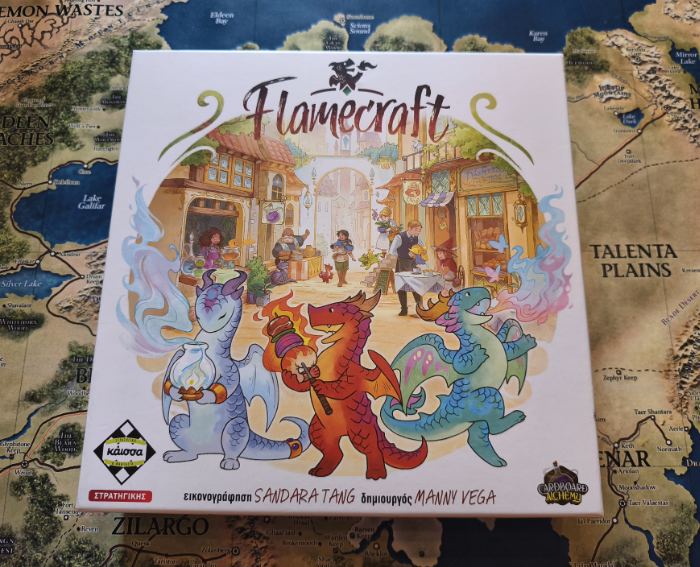
Did anyone say cute dragons?
Flamecraft is a worker placement and city-building game. It’s also one of the cutest board games out there. It is a game for 1-5 players of ages 10+, allowing you to play solo or with friends and family.
The box
What do you get with the regular version of the game?
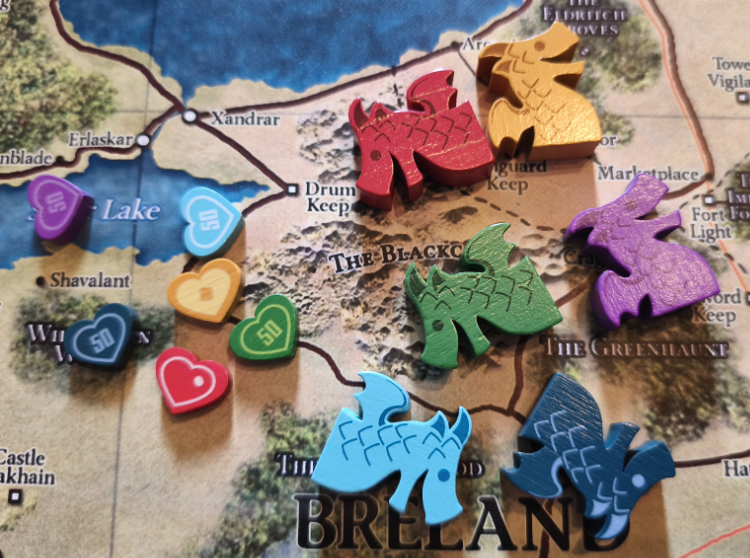
- 6 wooden player tokens – dragon-shaped
- 6 wooden reputation markers – heart-shaped
- the town map – which is a neoprene playmat
- 8 player aids – these show you what you can do during your turn
- 34 shop cards – 6 are the starter ones, and the rest are ones you open randomly
- 42 artisan dragon cards
- 36 fancy dragon cards
- 36 enchantment cards
- 7 companion dragon cards
- 24 coin tokens
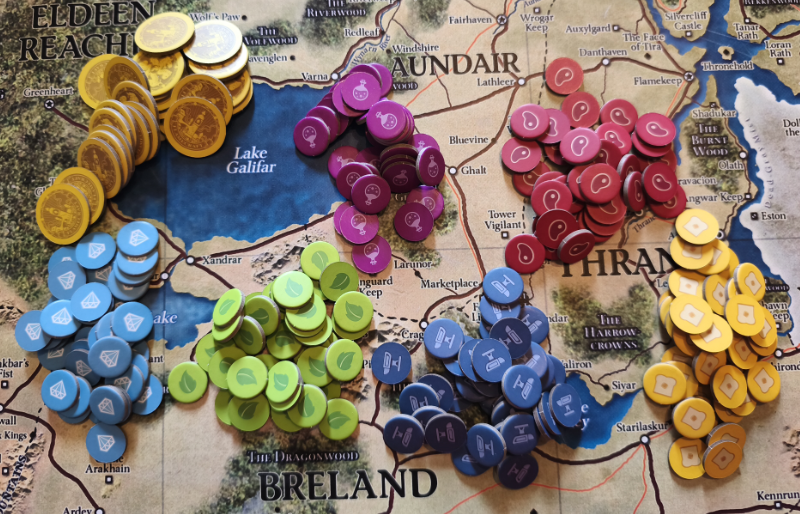
- 210 goods tokens
- a 20-page rulebook
That’s not bad for a game of its size, if you ask me. Personally, I was really pleased by the town map. Boards are usually made out of cardboard, but this one is a neoprene playmat, which makes it a bit more durable to creasing and liquids.
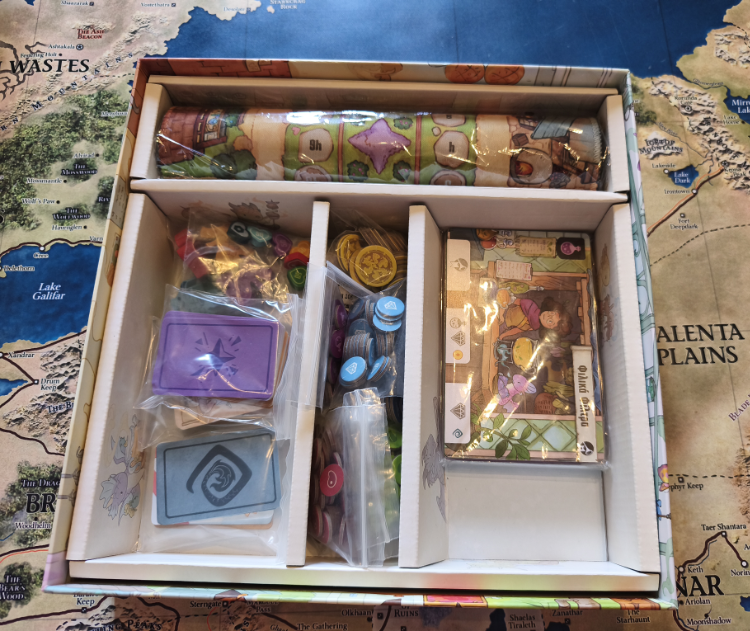
The cardboard of the various components is also quite good, but as always, I make sure to sleeve everything. The size of the cards is a bit on the smaller side, with the majority of them being 44×67. Actually, there are no “regular” sized cards in the game, with the only other card being the huge 88.9 x 139.7 shop cards. Still, you won’t break your bank, since you will need less than 200 sleeves for everything. The box is also large enough that it will easily fit everything, even if you sleeve the cards (Looking at you, Sushi Go, you traitor).
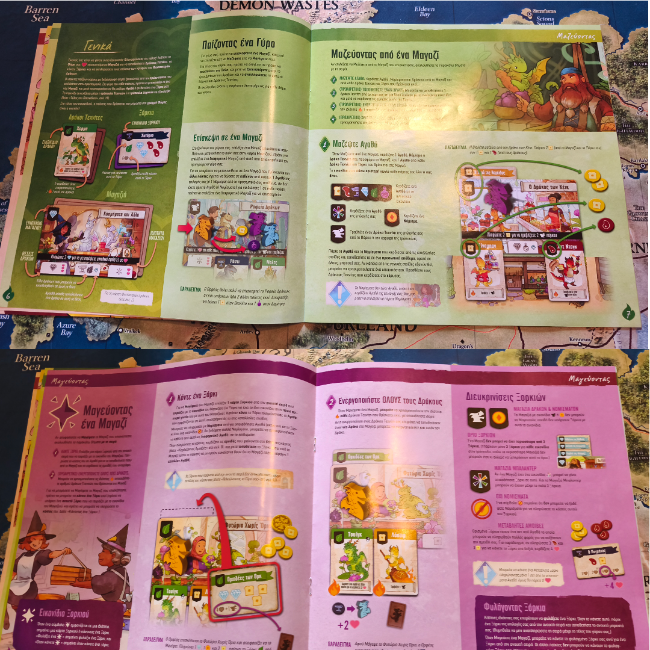
The rulebook is also something worth mentioning due to its colour coding. Each section has a distinct page colour, making it easier to navigate.
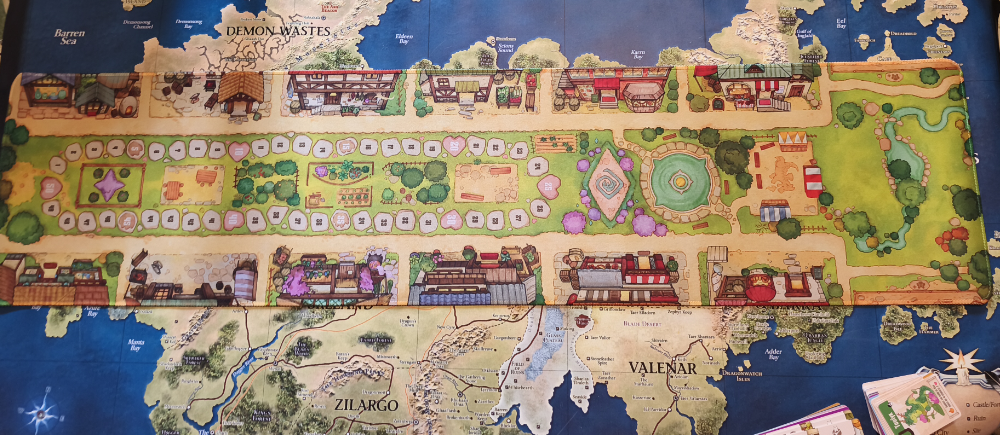
Art
The art was, for me, the game changer. The art of cute dragons is what drew me to the game. Though the gameplay is what made me stay, I give at least 40% credit to the cute dragons. Seriously, those dragons are adorable. The choice to go for a combination of a sketchbook vibe with pastel colours is excellent, giving it a more relaxed feeling.
Card Types
There are 5 different types of cards in the game. Let me go through them.
Shops
This is where you place your artisan dragons, cast your enchantments, or activate abilities. Each shop has a type. There is one type for each resource (bread, meat, iron, crystal, plant and potion). These usually give you resources based on what type of store it is and how many dragons are working there. There are also special ones, which I would categorise as wildcard, coin, and dragon. This is more of a categorisation based on the symbol on the top left of the shop card, because the abilities of special shops vary a lot.
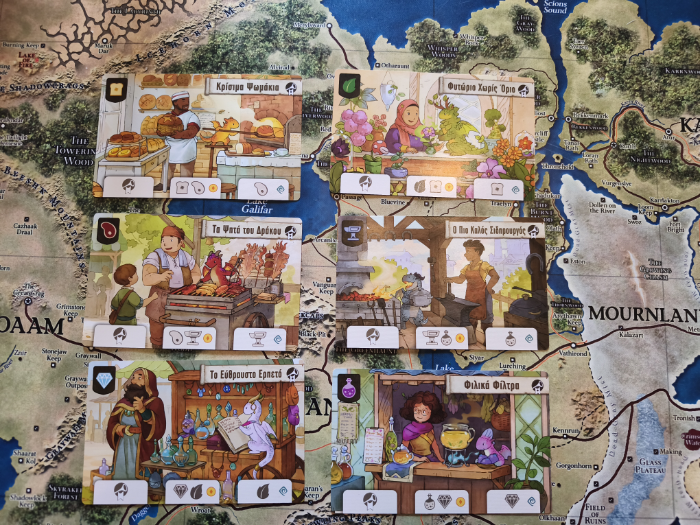
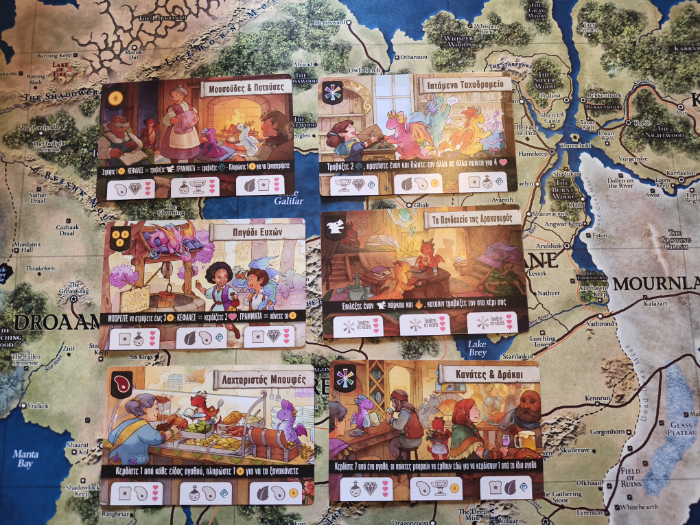
The game starts with 6 basic shops open, one for each resource type. Each shop has 3 slots for dragon artisans. Placing a dragon in a slot has a requirement and a benefit. The requirement is that the dragon type must match the type of the slot. The benefit can be drawing cards, gaining reputation or gold. Once a shop gets full, a new shop opens at random. Due to this, each game is different because you won’t draw the same shops in the same order.
Artisan Dragons
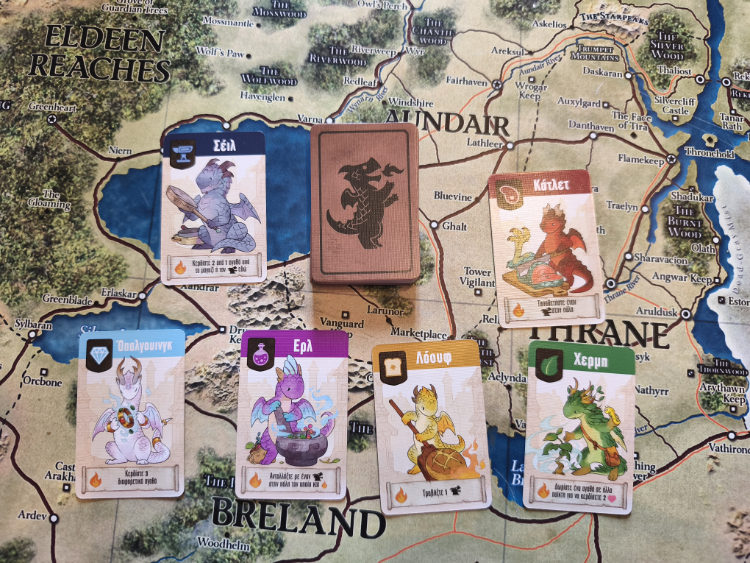
These cute little dragons get placed in shops. Each dragon has a type (same as the basic resources). Also, each dragon type has an ability. Six abilities may not sound like a lot, but they are more than enough. More on how to use these abilities is in the Gameplay section. You can have only 6 artisan dragons in your hand.
Fancy Dragons
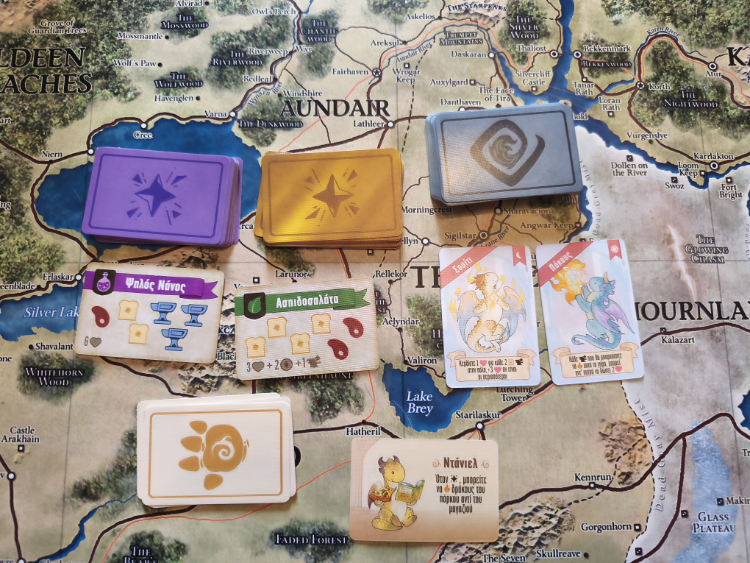
Fancy dragons come in two types, sun and moon. Both give you something when their conditions are met. The difference is that sun dragons should be used during the game, while the boosts of the moon dragons are counted at the end of the game. You start with 1 fancy dragon. There is no standard way of getting more of them. You need to visit a shop that allows you to draw additional ones (if it is in play) or cast an enchantment that lets you draw one. If you get to draw a bunch of fancy dragons and satisfy their conditions, you will usually get 5 reputation per fancy dragon.
Enchantments
Enchantments are spells you cast on the shops, improving them and also gaining something for yourself. Like with artisan dragons, they have symbols matching the resource types. That symbol also signifies which shops you can cast the enchantment in. The rest of the card has two important parts. The first part is a series of resource symbols. This is the cost. Some cards are simple, and you can pay just what’s mentioned. Others allow you to pay multiple iterations of those symbols, which increase the potency of the spell. The other part of the card you need to care about is the benefits. These are visible on the bottom left part, and are usually reputation, but you may also get coins, artisan dragons, or even fancy dragons.
Companion Dragons
These are optional. At the start of the game, you can pick one companion dragon at random, and they give you a once-per-game ability. Some of them may give you a bonus at the start of the game, as well. They feel a bit like fancy dragons, but with no activation requirement.
Not cards, but important
Resources and coins are tokens, but I am including them here. Resource tokens are very simple because they represent just one resource type. You can have a total of only 7 of them. Coins are a bit of a multitool and not bound by a limit. You can use them as a resource when casting a spell. They can also be spent in shops to activate some abilities. They also count as extra reputation at the end of the game.
Gameplay
The goal is to gain the most reputation among the players. You gain reputation by placing artisan dragons, casting enchantments, and satisfying the conditions of fancy dragons.
The setup is quite simple. You set the board by placing the 6 basic shops anywhere on the map. Then each shop gets a starting artisan dragon matching their type. These dragons are easy to find because the cardback is different from the rest of the artisan dragons, and because they have a small trumpet symbol on them. On the Park area of the board, you place the first 5 artisan dragons from the deck face up. Then you place the first 5 enchantment spells on the board face up. Each player gets 3 artisan dragons. They also get 2 fancy dragons, but they have to choose and keep only one. That’s basically the whole setup. There are a few variations based on the number of players, the enchantments you choose (there are 2 different decks), and whether you are using companion dragons or not.
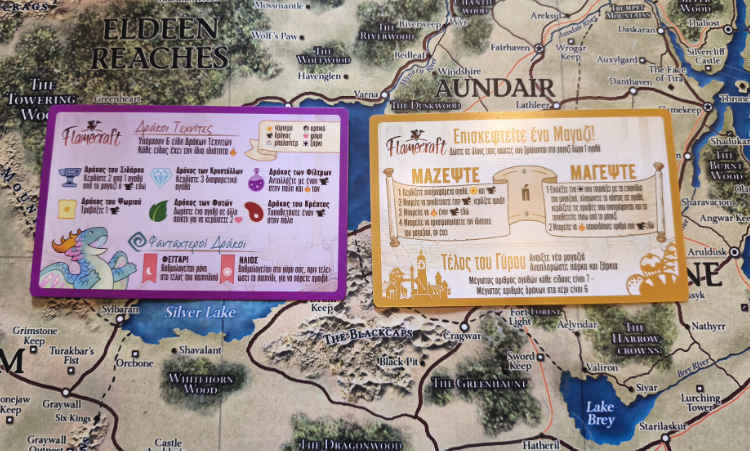
Setup is simple. But how’s the actual play of the game? Equally simple. Each round, you visit a shop. You usually visit a shop unoccupied by another player, but if you really need to visit an occupied shop, you may do so by bribing the other player with a resource. Oh, and you need to do this for every player already in the shop, so you’d better really need that shop. Then you get two options: gather or enchant. This is your main choice each round, which takes you down a different action path.
Gathering
This option has 4 steps, 3 of which are optional but must be followed in order. The first step is to gain resources from the shop you visit. What do you get each time? Simple. You gain one thing that shares the same symbol as the top left part of the shop. That can be standard resources, a coin, or a dragon. The wildcard symbol means you get any standard resource you like. This is just from the shop itself. You also do the same for every dragon and enchantment in the shop. So, for example, if you visit a shop with a bread symbol that has one enchantment on it (it’s a bread enchantment because these need to match, more below), a bread dragon, and a diamond dragon, you get 3 bread and a diamond.
Once you are done gathering resources, you get to choose if you will place a dragon in the shop. As I mentioned above, each shop has 3 slots for dragons. The starter shops have their first slot filled, but the rest start with 3 slots open. To place a dragon, their symbol must match the symbol on the slot. Once placed, you gain the benefits marked on the slot, usually reputation, coins, or dragons.
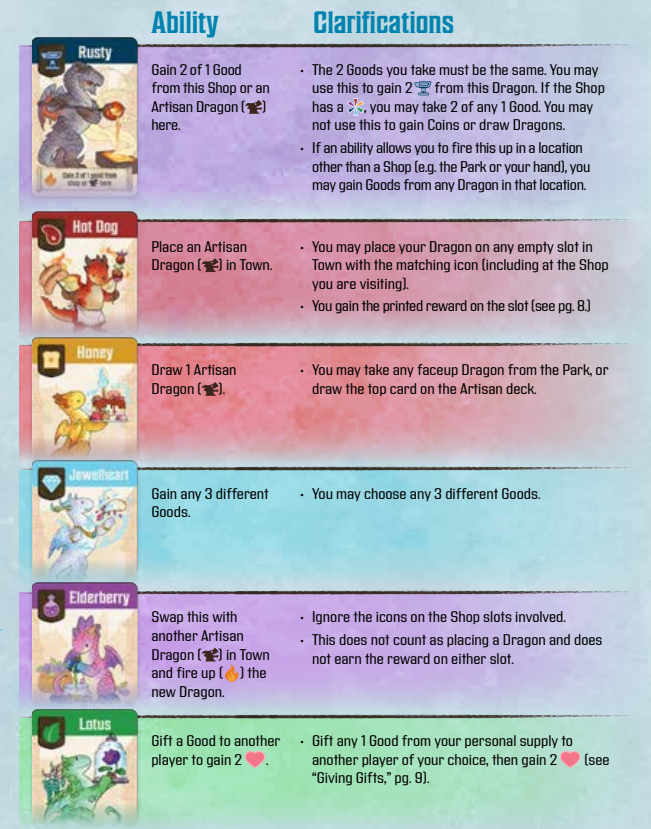
Moving to the next step, you may choose if you want to activate a dragon in the shop. If you do, you follow the instructions on the dragon. Each symbol, not dragon, has a different ability. So all anvil dragons do the same thing. While the abilities are quite simple, the more dragons are in play, the more cool things you can do, especially when you get to activate multiple ones (mostly when enchanting).
The final step is activating the shop ability, if there is one and if you want to. The basic shops do not have any abilities, so you will see one only when the first shop is filled. From my experience, these are the most confusing rule texts of the game and the ones we have had to check the rulebook for the most of the time. But don’t be alarmed by this statement because these are the most confusing rules in the context of a really simple game.
If you have chosen to gather this round, this is where you stop. You’ve done a lot and need to pass to the next player. By the way, most of your turns will probably be the gathering option, since in order to enchant, you need resources.
Enchanting
Okay, so you have eyed a good enchantment card on the board, you have the resources, and it’s your turn. You move to the shop you want to enchant, and you’ve made sure the enchantment symbol matches the symbol of the shop. Now what?
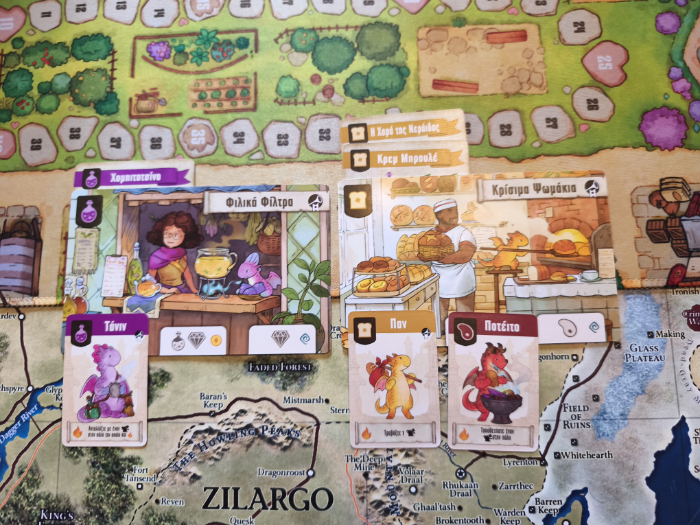
You cast the enchantment. So, you pay the cost and gain the benefit. Then you put the card on the top left part of the shop, to signify it has been enchanted. And now here’s the best part. You can activate as many of the artisan dragons in the shop as you want. Depending on the dragons, you can do a chain of activation. This is something I find really fun and try to do, whether the dragons I activate benefit me the most or not.
And that’s the enchanting part. While this option doesn’t have multiple steps, it can take longer than gathering. By the way, make sure you count the number of enchantments per shop. You can cast only 3 per shop, so make sure where you go when you want to cast.
End of turn checks
Regardless of what you choose to do in your turn, at the end of it, you need to check for 3 things.
When a shop fills, you put a shop card in a slot on the board faced down. At the end of the turn, you flip it face up. Then you need to reduce your cards and resources to their limit. So you need to put artisan dragon cards from your hand to the bottom of your deck until you are down to 6. Then you need to return resources to their piles until you have 7 resources.
Finally, you refresh the enchantments and park. There must always be 5 enchantments and 5 artisan dragons on the board. And that’s also a trigger for the game to end. Which brings us to…
End of game
When either of the enchantment or artisan dragon decks becomes empty, everyone gets a final turn. This includes the one triggering the game to end. Then you add any extra sources of reputation to your total. These can be coins and fancy dragons. If you are the one with the most reputation, congratulations!
Strategy
I am sure any of the other two wonderful authors on this website would give you actual strategies here. However, you are stuck with me and my weird philosophy on board game strategies. But I will try and mention a few things that I consider tips.
It’s easy to figure out which enchantment each player wants to cast. Your resources are limited, so you need to gather with an enchantment in mind. The resources of each player are visible at all times. Put 2 and 2 together…
Enchantments that scale are best when cast at their highest possible scale. That’s obvious. However, if you want to stop someone from casting an enchantment, you can just cast that for 0 benefit. Of course, that’s easier for scaling enchantments because the rest have a static cost, which can be too high to cover.
Your initial fancy dragon may define your focus during the game. Some fancy dragons care about having the most artisan dragons of a specific type in play. This gives you a direction. Drawing one like that during the game, however, may be harder to satisfy. Drawing fancy dragons has no bad effect, though.
Drawing artisan dragons, however, is trickier. These are an end-of-game trigger, so you need to be careful. You don’t want to trigger the end when you are behind in reputation.
Your approach in each game changes a lot, based on your fancy dragons and the shops that open. You will not play the same game twice, so you cannot sit at the table with a specific strategy in mind.
And now let me tell you about my strategy. I keep the fancy dragon I find cuter. I play the artisan dragons I find cuter. I cast the enchantments that intrigue me the most, either due to their name or cost combination. I try to do stuff that looks fun, either activating cool shop abilities or activating a bunch of dragons during an enchantment. Is this a winning strategy? Reputation-wise? Probably not. Have I won with this strategy? I sure have. Do I have fun each and every time I play Flamecraft? Oh, you bet.
Final Thoughts
Flamecraft checks a lot of marks for me. It’s not too expensive, but the quality is great. I can play solo. It’s really simple to explain and play, but it has depth if you want to go into mathematical approaches. And its art is exquisite. I mostly recommend this to players who want to have a relaxed evening. It won’t disappoint you.
And until next time, have fun!
Join Our Mailing List
Do want…
- Extra content?
- Discounts?
- Updates about all our work?
This post contains affiliate links. By using them, you support the blog without any extra charge being applied to you.
 The Kind GM