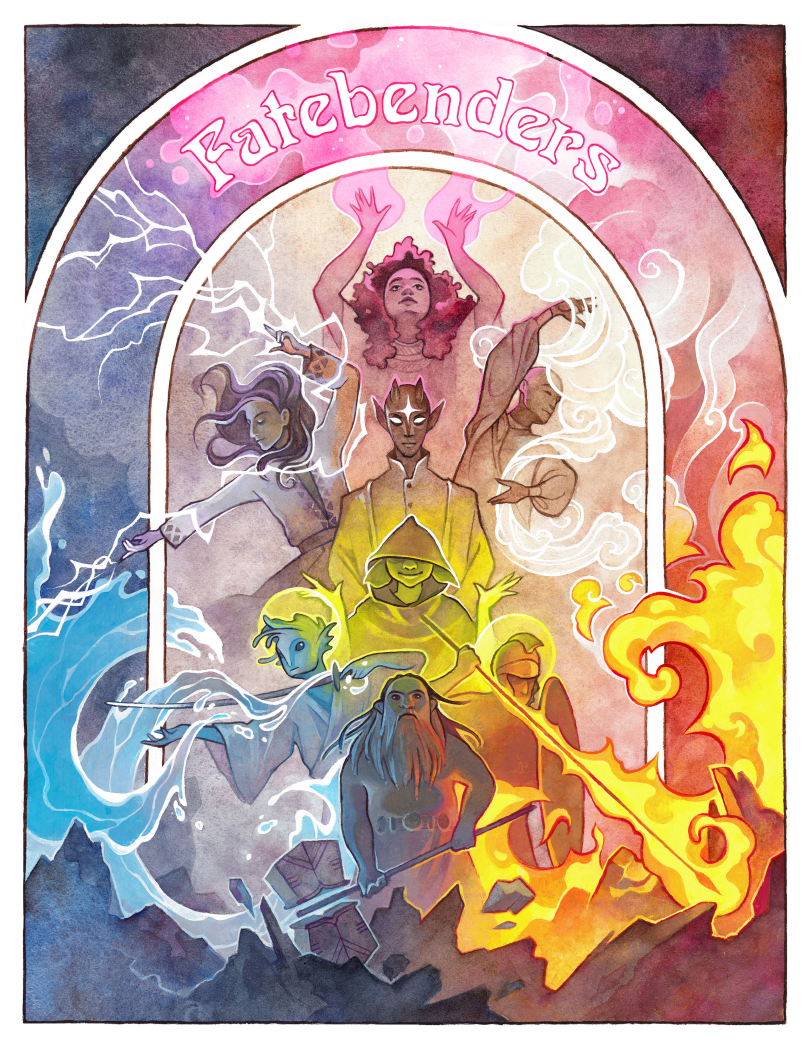
Fatebenders RPG is a Public Domain system by Robert Peetsalu, focused on sandbox urban fantasy.
Disclaimer: We were provided with a free digital copy of this product.
The Setting
There is no preset setting for Fatebenders. You are encouraged to create your own – though the system is mostly designed for small-scale events, not world-shattering apocalypses. In particular, Fatebenders most commonly takes place in a city; divided into Districts (Castle, Lower City, Docks, Market, Workshops, Barracks, Temple, Entertainment, Academy, and Upper City – depending on the size and type of the settlement, it may or may not have some of these), with each District having its own Faction – for example, the Workshops District has the various Guilds, the Docks have Smugglers, the Castle has the ruler (an aristocrat perhaps, or even the royal family), et cetera.
There is magic in Fatebenders, though it is not the all-powerful system you might be used to in DnD; there are 6 “elements”, each with minor effects that we’ll get into later in the mechanics, but there’s no specific in-world explanation for it; that’s up to you – same goes for gods, they might exist or not, and they might have an active role or just observe. As for technology, you could go from bronze age to medieval-ish/pre-gunpowder times.
There is a procedural generator linked in the pdf for creating kingdoms and cities – though, as it usually goes with such tools, it’s better used to supplement your ideas rather than create from scratch. I do appreciate the extra work that went into it however; it’s like an easier to use roll table that you might find in other RPGs, and you can use it for worldbuilding in general, not just for your Fatebenders sessions. There is also a generator for NPCs as well. In general, I really do like having more automated tools for RPGs – so these are both great additions in my opinion.
The Mechanics
Right, let’s get to the mechanics. This is a d20 system, and only d20 – you won’t need any other type of dice. Any modifiers are either flat, or rerolls.
Character Creation
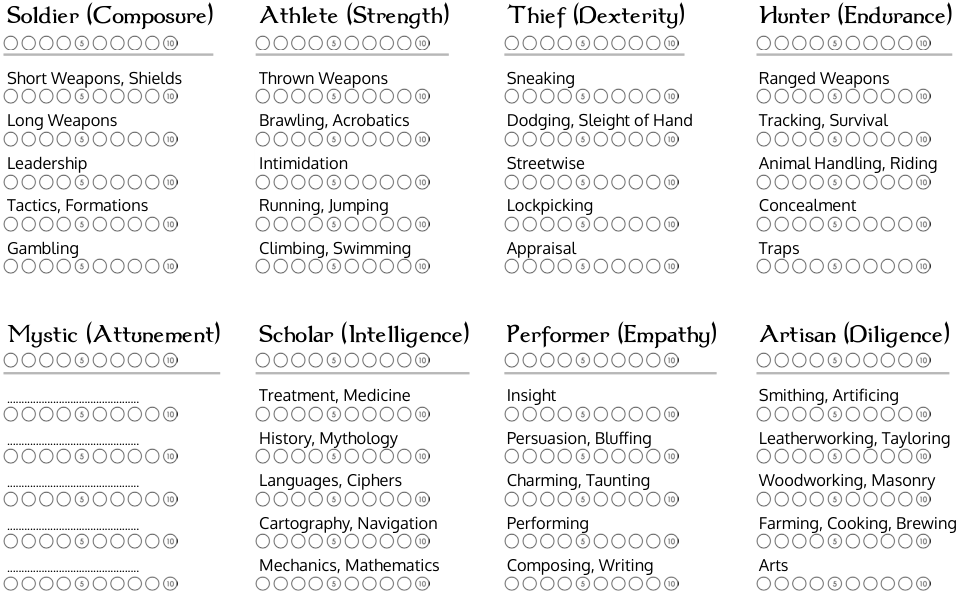
There are no classes; the characters put points into 8 different professions, with each profession representing an attribute and affecting a number of skills. These are:
- Soldier (Composure): Mostly dealing with combat and weapon skills.
- Athlete (Strength): Running, jumping – most kinds of movement really, as well as brawling and throwing.
- Thief (Dexterity): Sneaking, lickpicking, dodging – the classic rogue things.
- Hunter (Endurance): Ranged weapons, tracking, traps, et cetera
- Mystic (Attunement): No set skills, but this is where the magic (literally) happens – we’ll get to that soon
- Scholar (Intelligence): All the academic stuff; medicine, history, navigation.
- Performer (Empathy): Most social skills are here.
- Artisan (Diligence): And finally we have the various artisan skills like smithing or cooking.
You can see an overview of them on the image below as well, with all the skills.
Having points in a profession doesn’t mean your character is actually employed in it or practices it; it just means they have knowledge or skills adjacent to what such a profession might need. You can have as many points in as many professions as you want (well, as long as you’ve got points to spend). How do you get points? Well, that’s your XP – every session, or when your character completes one of their Goals, you get 1 XP – each level of a profession needs that much XP to raise. So yo get from level 2 to level 3, you need 3 XP – similar to Open Legend’s system, if you’re familiar with that.
However, you can’t put points in skills. These get 1 point every time you roll a critical failure in a skill check. As for skill checks, they’re pretty straightforward – you roll your d20, you add your profession bonus, then your skill bonus if you’ve got it, and if the result is above a target, you succeed. You can get advantage and disadvantage on your rolls, and they mostly stack – multiple advantages give you more dice to roll, 1 disadvantage cancels out 1 advantage, but you can only roll 1 extra dice for pure disadvantage.
A big part of Fatebenders is your character’s personality and bonds – the players are supposed to work together, for a (relatively) common goal. Going against your Bonds or Goal can have consequences in your rolls; and of course, as I mentioned, fulfilling your Goal grants you XP.
Combat
Combat is pretty simple for the most part. Your attack rolls work the same are your skill checks – because they are skill checks. Each weapon has a particular type, and uses a profession – Ranged Weapons use Hunter, Short and Long Weapons use Soldier, and Brawling (unarmed) uses Athlete. If an attack hits, there’s no damage roll; Fatebenders uses a Wound system. Each character (not just players, but most NPCs as well) have 3 Wounds. Getting hit adds a wound – get all 3 Wounds and you start rolling Death checks. Healing from wounds is also not that easy – left on their own, 1 wound takes 1 month to heal – but you can reduce it using Treatment checks. You can also avoid getting a wound if you are wearing armor; depending on your armor, you have 1, 2, or 3 Armor points. You can choose, instead of taking 1 Wound, to instead break 1 Armor point.
That’s if you get hit; how do you avoid getting hit alltogeher? Well, when you are attacked, it’s in fact an opposed check – you choose your method of defending: Dodge (using the Dodging skill), Shield Block (using your Shield equipment and your Shield skill), or Parry (using your Unarmed, Short Weapons, or Long Weapons skill). You don’t roll a dice for this – instead, you essentially choose which of the 3 will act as your AC, in DnD terms.
Overall, as you can see, combat will tend to be short and dangerous; most NPCs will choose to retreat if possible after a couple of wounds, or even 1, and the players will also have to be careful – since a single wound could potentially take you out of commission for up to a month, or at least keep you from being at your best.
Magic
In this case, Magic is specifically “Elemental Attunement”. There are 8 elements: Wind, Earth, Fire, Water, Lightning, Illusion, Mind, and Body. To attune to one of these elements, you must have a point in the Mystic profession – each point lets you attune to another element. When you do, you note that element as a skill under the Mystic – that’s why the skills were left blank.
Each element has a number of Abilities. These are the “spells” of the system; most have 3, but Body and Mind have 4. They are quite open-ended, and not particularly awe-inspiring – not in the sense that they are boring, but there’s not an equivalent of, let’s say, Time Stop or Wish; mostly small-level effects, which in my opinion helps keep the game grounded, especially since it’s more about personal stakes and interactions than conquering the world.
For example, Fire has the Ability “Burn” – you breahe or create fire. It’s up to you how or what you target (though expanding the area of effect makes the resulting Ability check harder), so everyone has their own personal style of how to use it. (Again, I am somewhat reminded of Open Legend’s system – though I’m sure that lots of rules-lite or classless systems use something similar). The Ability check I mentioned doesn’t mean you miss the ability if you fail – but it does mean you get a point of Fatigue. Get your 3rd Fatigue, and you get a Wound – and another Wound for every subsequent Fatigue as well. There are other ways to get Fatigue too – overexerting yourself or environmental hazards, but for Mystics this is a big source of danger.
Overview
There’s still more things to cover, but I thing I gave you a decent idea of how the system works. It’s not particularly crunchy, focused more on the roleplaying, but there’s still enough here to form a very solid but light system. For example, NPCs don’t have their own profession scores etc – you just assign them a “level”, and they get that much bonus to all their checks – skills, attacks, dodge/block, etc. There’s no initiative or turn order – players go first as a bunch, choosing how they will distribute their actions, then the NPCs all together as well. It’s a well-designed and, again, lightweight system that you can figure out in just a couple of hours max, and can run it anytime as long as you’ve got a story in mind.
Final Thoughts
Fatebenders RPG is a great system that I wholeheartedly suggest you at least take a look at – the pdf version is free on DrivethruRPG, and there’s also a hardcover edition if you prefer physical versions.
 The Kind GM