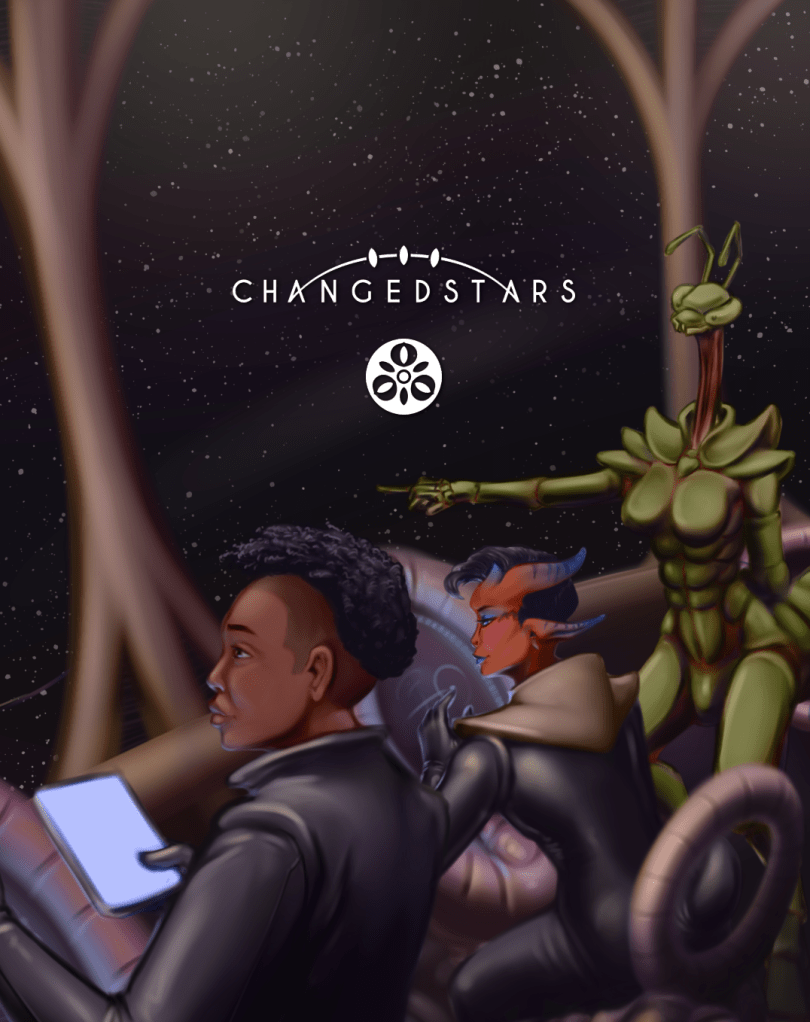
Changed Stars is a sci-fi TTRPG by DieselShot set in the 26th century, in an era of relative peace after a brutal interstellar war.
Disclaimer: We were provided with a free digital copy of this product.
Setting
Let’s start with the world Changed Stars takes place in. While certainly a largely optimistic setting, there are parts that (to me, at least) read as very dystopian – both in the past history and the current times. Whether that’s the author’s intent, merely a byproduct of needing some amount of conflict in an RPG, or just my own inferences, I don’t know, but it makes for a quite intriguing world.
A very short summary of the relevant history: Humans developed space travel, and almost immediately got busy destroying everything, establishing an “Empire of Man” that aspires to be Warhammer’s Imperium, and gleefully enslaving and genociding every alien they could find, declaring Manifest Destiny over the galaxy. Well, they bit off more than they could chew, and got 3v1’d, eventually losing the war against the alien alliance between the insectoid Murai, the humanoid Thren, and the… well, I don’t know how to describe them, but they’re the Viir, former subjects of the Empire. When the war ended, The Great Transition took place, and now the major power in the Orion Arm is The Trinity, a union between the Thren, Murai, and a new Human political entity called the Artemisian Commune. While the core worlds of the Trinity are secure and stable, there is a large area of space known as the Frontier, which remains fractured and independent; this is where most of the Empire remnants are holding out, either biding their time to return or having turned to piracy and mercenary activities. And of course, there are other alien species as well with their own ambitions.
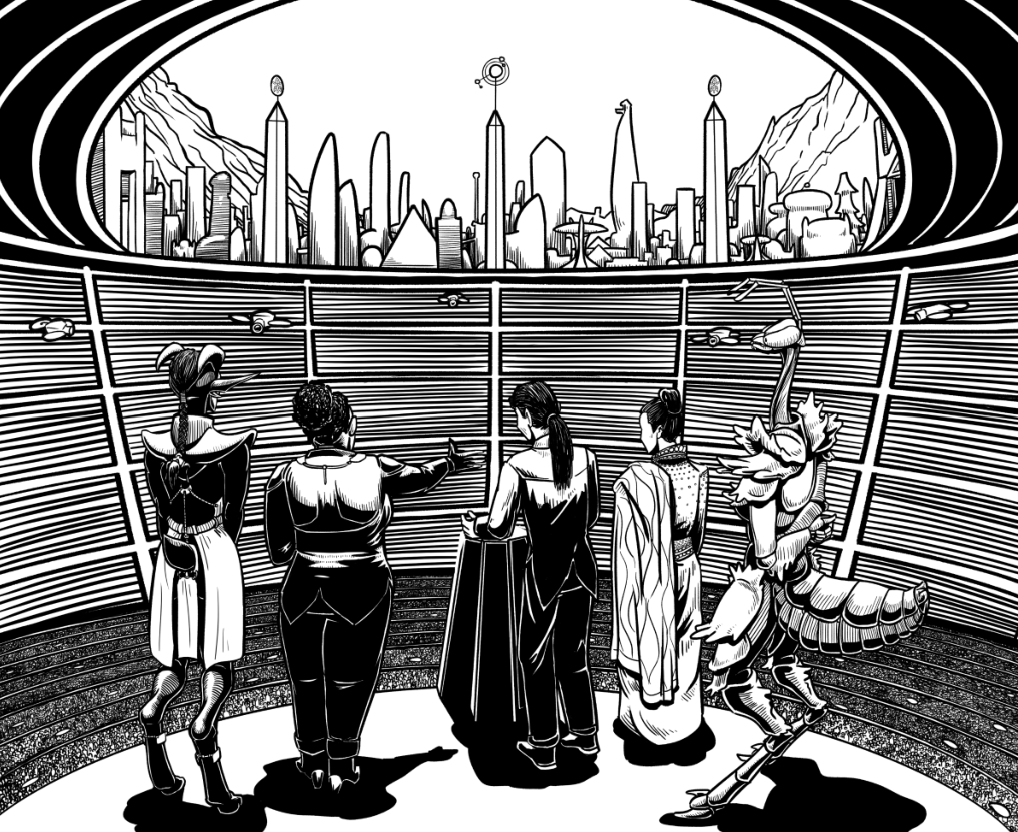
While the Trinity is largely presented as “the good guys”, with every need of its citizens mostly met – fully automated luxury space gay communism, if we’re feeling cheeky – there are lots of aspects that you can explore that might cause conflict. With just 50 years having passed from the end of the war, there are lots of grudges all around; not everyone agrees with how the Trinity functions, or even if it should exist, so there’s pleny of separatist movements, as well as potential for cultural clashes in general. For example, the Murai are, as I mentioned, insectoids – ruled by Queens, with 90% of their population being “mindless drones”, essentially being controlled via pheromones. The queens are absolute monarchs – deities, even – with a built-in, biological leash on their lesser subjects; but there’s not just Murai living on their worlds now. How do they handle other species that can choose not to obey the queen’s orders?
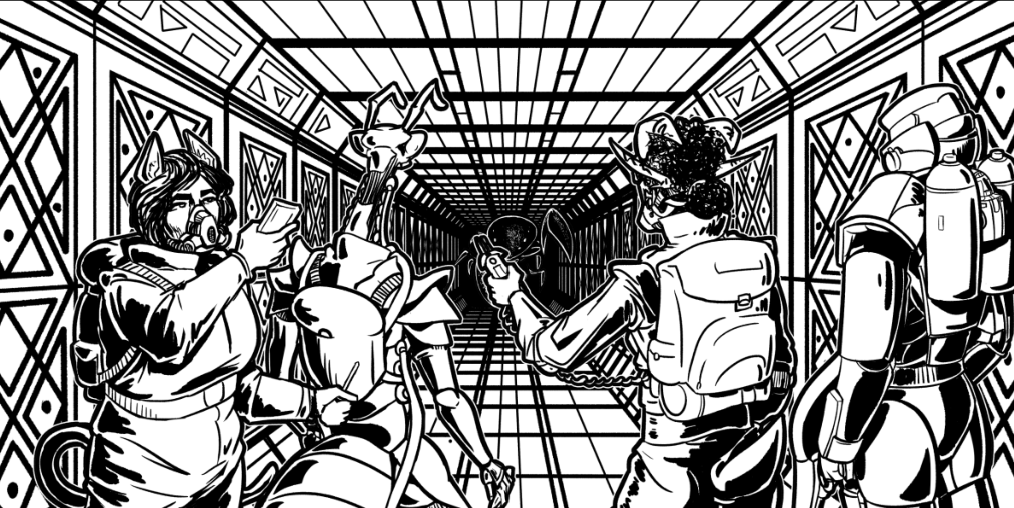
As for the humans, the Empire was essentially fully conquered, and the Thran and Murai sought to fundamentally change Humanity – how exactly did they achieve this? Humans essentially went from “incarnation of evil” to “Star Trek Federation” in a very short time – how heavy-handed was their interference? Though perhaps that’s just fixed by stretching the timescale a little bit. However, the current “administrator” of the humans is an AI, appointed as “Indefinite Coordinator” – something uncomfortably close to “supreme leader for life” with “life” being forever, which also causes tensions within human societies. In this, I am somewhat reminded of Asimov’s The Evitable Conflict – a synthetic being so computationally powerful that it can solve all of humanity’s issues, but takes away almost all agency – not even in a “malicious” way, but simply because it “knows better”. And what are the implications of this AI being repurposed from the Empire’s strategic command & control network? How can anyone be sure of its innermost thoughts? Finally, while lots of Thren are opposed to the inclusion of humanity in the Trinity (fair enough, admittedly) I couldn’t help but notice that human space forms a nice big buffer between the Thren and Murai and other, more aggressive species like the Rast and Nouseguay – so perhaps there were other considerations to their inclusion besides the kindness of their hearts. Maybe at this point I’m merely doing my own additive worldbuilding, but I think there are lots of things you could explore in this setting while keeping the overall optimistic tone.
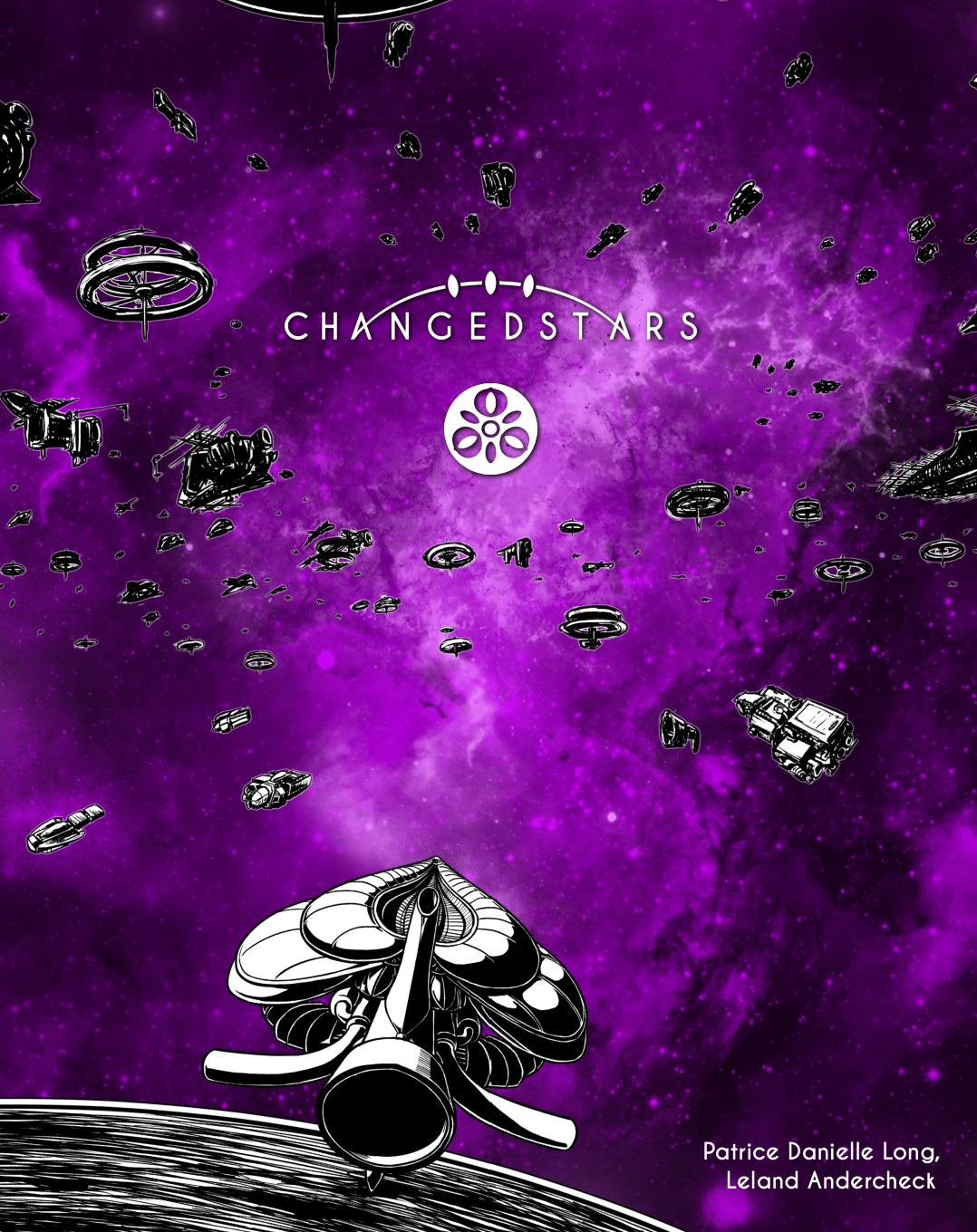
As you see, there’s a ton of lore to play with – and I haven’t even mentioned the ancient species that passed through the galaxy millennia ago who were somehow capable of stellar engineering. However, something that’s kind of unfortunate is that a lot of the action happens in the Frontier – unexplored, fractured, whatever you want to call it, but far from the centers of power and the vast majority of the lore, unless you want to play some form of clandestine/political campaign, though with the story I went over before, there’s certainly plenty of things to do in “civilized” space as well. Another issue is that, as this is designed as a sandbox setting and there are a ton of things to do, it would benefit from some additional instructions on how to start. There is some of that in the GM’s Guide chapter (or DreamWeaver’s Guide, for this system), but I’ll talk about that later. Still, overall, I really enjoyed the lore – I’ll reiterate, there’s a LOT of it, and I can tell that the authors have a lot of passion for this setting; and while I don’t think I need to say this and it’s evident from all of the previous text, I will go ahead and state the setting is very much political, and explicitly so, the authors even having a list of inspirations in the introduction.
System
Now let’s get to the crunchy parts, the system and its mechanics. Let’s start with character creation. There are 4 attributes, each with 3 skills; overall, pretty straightforward and streamlined:
- Cognition, with the skills Scrutiny, Medicine, and Systems
- Alacrity, with the skills Operate, Maneuver, and Ballistics
- Resilience, with the skills Melee, Mechanics, and Endurance
- Empathy, with the skills Insight, Communicate, and Resolve
Each Attribute starts with a score of 2, and when you begin, you can allocate 5 points to attributes, to a maximum of 5. You also get 10 points to allocate to Skills, though they have a cap of 3 at character creation (at least, if you don’t begin with a more experienced character). What does this mean, though? Well, Changed Stars is a d6 system – for every check, you roll a number of d6 equal to the sum of the relevant skill and attribute. So if you have 3 points in Congition, and 2 in Medicine, you roll 5 dice for a Medicine check. If one of them rolls a 6, it’s a success; additional successes (called Twists) can be used to augment the results of your action further.
Moving on, you pick your species – Human, Thren, et cetera. Each species has Talents and Quirks, which are unique features, as well as setting some secondary stats: Health, Stamina, and Move. Move is your speed and any special movement options like climbing or swimming, while Stamina and Health are both hitpoint pools. Stamina is depleted first and recovers quickly, while Health represents more serious wounds. Finally, after species, you pick an Archetype. There are 12 premade archetypes, but you can also create your own. Archetypes give you Tag Attributes (usually 1 but can be 2), which can be raised to a maximum of 6 instead of 5, Focus Skills (2 or 4, depending on your other picks), which get +1, Talents (1 or 2 perks or features), and finally an Edge Break. Before we talk about Edge, let’s go over the Talents really quick: There are 17 Talent Trees, each with a theme: Soldier, Command, Mechanic, Harmony, etc. Each tree has 2 tiers, usually with 3-4 talents in each tier – to get a talent from tier 2, you must have a talent from that tree’s tier 1 – and there’s also a pool of generic talents that don’t belong to any tree and count as tier 1. You buy talents (and skill points) with XP – and you can buy talents from any skill tree, so this is a classless system (and I guess technically without levels either, though you could count XP as levels).
Now, onto Edge, which is a pretty central mechanic. Edge are d6, rolled along every test – they count for successes normally. You get them by converting Twists (extra successes), Reaching (rerolling all non-successes in exchange for getting an Edge) and some other ways. So overall, they sound pretty good – a lot more chances to succeed. But, they have a downside too; when an Edge rolls a 1, it triggers a Shock – sort of like a critical failure, though it’s more of a mental shock. Losing control, dropping an item, panicking, choking up – your character essentially has a small (or pretty big) breakdown in the moment. The more Shocks you get in a single roll, the more significant the impact – besides the physical response, you also get a malus to all checks for the duration of the shock. But if you get 3+ shocks in a single roll, it’s a Traumatic Shock; your character suffers Psychological Trauma, which has further effects permanently unless you find a way to Cope with it. Don’t worry, though; Edge normally goes away on its own slowly (or if you rest), and to circle back to where we started, if you have at least 7, you can also use them all for an Edge Break; a powerful ability that automatically succeeds, but makes you roll all your Edge. Any result that isn’t a 6 is a Shock – so very high risk-high reward.
That’s most of the base game; there’s a lot more to talk about in combat, but I think we don’t need to go over all of that in detail. However, there are a lot of other things besides the base. For example, there’s a pretty big item/equipment system; Armour, Weapons, Tools, etc, including a durability/use system and lots of different Properties to customise things, as well as Drugs and Cybernetics. There’s a Hacking system that’s more than “roll a check” and less than “enter the matrix”, so it’s a pretty nice balance between the two. And of course there’s Drones, Vehicles and Ships.

As a sci-fi game set in space, of course, there are ships – but again, instead of having the “captain” make some checks, there’s a fully fleshed-out system, including special rules for combat. Yes, ships also have HP (Hull in this case instead of Health), Armor, etc, but they also have Hardpoints that accept various Modules (Weapons being the prime example), you’ve got Life Support and the Reactor and Propulsion to think about (or target with your torpedos), you could have a Jammer or an extra Targeting Computer; and there’s not just warships, you need sensors, recyclers, maybe a hydroponics bay if you live onboard for long voyages, et cetera. And as I mentioned, there’s also drones and vehicles too; from little quadcopters to exosuits to APCs and gunships, all for you to have fun with (or get shot by).
DreamWeaver’s Guide
The book also contains a chapter for the GM, here called DreamWeaver (that sounds a bit more fantasy themed, but that’s… a pretty minor thing), with some extra information on how to run the game. You usually expect the more indie RPGs to skip the more basic explanations, but here we’ve got a lot of guidelines that beginner GMs are going to benefit from (and plenty of veteran GMs too, i’m sure) – how to conceive and plan your game when you start out, how to handle and create conflict, how to create NPCs, etc. There’s also a list of Frames you can use; these are essentially what the players are going to be as a party, or be occupied with in general. For example, a Frame is Free Merchants, or Science Team, or Marines. They give you a framework to build your campaign, and know what you’re going to focus on – straightforward assaults, or backdoor dealing and assassinations, or high-risk procurement of ancient artifacts in ruins, or dangerous anomalies, et cetera et cetera. The lore helps a bit in this, though it’s pretty open-ended; you can do anything anywhere, which is the point of a sandbox game, though keep in mind that some people prefer a more structured campaign.

There’s also a Bestiary with several new creatures, including the “Vent Spider” – preferably handled with a crowbar – however, it also has a lot of “shells”, letting you quickly build NPCs of various species, combining them with “cores” which would be their archetype. Finally, there’s also a short adventure to try out the system; the players must help a town on a Frontier planet repair their life support system, clashing with some pirates along the way (or doing business with them, perhaps).
Art & Layout
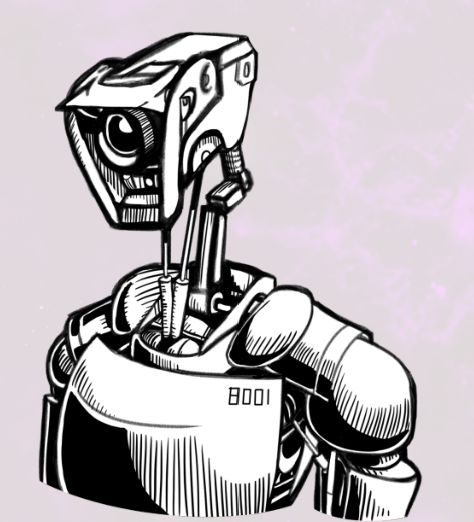
There’s a lot of original art spread throughout the document, and it all looks great. Besides characters and locations, there’s also a lot of art when it comes to the spaceships and vehicles; each one of them is illustrated, and the spaceships also have map layouts for them. The pages have a double-column layout, and I’ll also note that the PDF has a ton of internal links – if you find a mechanic that you don’t remember what it does, you can usually just click on it and it’ll take you to the appropriate chapter. This really helps, though during your first read-through, you’ll likely be a bit confused at the start – some mechanics mentioned during character creation are explained much later, though the inverse would also be true; if you had the “Playing the Game” chapter first, you’d have just as many parts from the character creation missing.
Final Thoughts
Overall, ChangedStars is a very competent and thorough sci-fi RPG system that I was very satisfied by. It has a lot of content for you to explore, and even if you end up not using it as your primary system, I think it has lots of excellent ideas and subsystems that you can implement in your games regardless. There are also some official published scenarios: Marooned, Hard Passage, and the Lode.
This post contains affiliate links. By using them, you support the blog without any extra charge being applied to you.
Join Our Mailing List
Do want…
- Extra content?
- Discounts?
- Updates about all our work?
 The Kind GM