
Unearthed Arcana returns for 2026, with new subclasses for the Monk, Paladin, Rogue, and Warlock.
These are new subclasses, not returning ones from 5e, which i’m really happy to see. Also, when I first saw “Mystic” subclasses, I thought we’re getting another psionic-themed UA since the Mystic was originally what the Psion was called, but instead it’s about magic.
We’ve got subclasses for the Monk, Paladin, Rogue, and Warlock, so let’s take a look.
Monk – Warrior of the Mystic Arts
This is a spellcaster Monk – but without spending Ki (or Focus) points for casting like the Way of the FOur Elements did in 5e. This is a normal spellcaster with spell slots. And speaking of –
Spellcasting (Level 3)
You get the standard Spellcasting feature. You get your spells from the Sorcerer list, but with Wisdom as your spellcasting ability. You don’t get a lot of spell slots, and you only reach up to a level 4 spell slot at level 19, but there’s some interesting stuff you can do with Sorcerer spells.
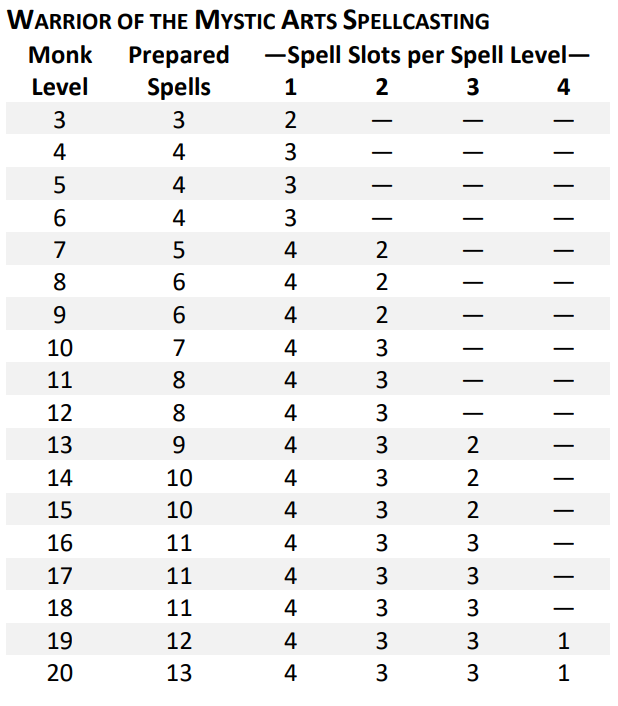
While it would certainly be a lot of fun to go for an “elementalist” style, chucking fireballs and lightning bolts in between beating people up with your bare hands, I think you’ll get the most out of your spell slots by focusing more on utility. Early on, a Burning Hands or Magic Missile is certainly still going to be impactful, but Sorcerer also gives you access to Shield, Grease, and Jump for level 1 spells, making an already very mobile and defensive class even more of a hassle to deal with. Admittedly some spells like Expeditious Retreat and Feather Fall are already in the Monk’s kit, but that just leaves you free to pick the better options.
As you level up, the damage of the spells is going to be quickly outpaced by the monsters, but that doesn’t mean you don’t have neat stuff to play with. Blur, Enlarge/Reduce, Blindness/Deafness at level 2, and that’s before we get into what everyone is going to go for – Haste and Fly. Overall, I think the spellcasting will add some (not necessarily needed, but very much welcome) utility to a Monk.
Mystic Focus (Level 6)
You can convert Focus Points to Spell Slots and vice versa. It’s a Bonus Action to get a spell slot and a free action to get focus points, and the ratio is 2/3/5/6 Focus points for a level 1/2/3/4 spell slot respectively. Pretty cheap to get spell slots, all things considered, especially as you have the Uncanny Metabolism feature that restores all Focus Points once per long rest.
Mystic Fighting Style (Level 6)
When you take the Attack action, you can replace one of the attacks with a cantrip that has a casting cost of an action. I didn’t speak about cantrips in the Spellcasting feature, but you do have some very nice ones; Blade Ward can last for up to a minute so it’s not something you’d re-cast every turn, but Thunderclap is a decent AoE that can get a lot of use since the monk loves to get up close and personal to disrupt people before disengaging, and of course Mind Sliver is amazing.
Centered Focus (Level 11)
Whenever you expend a Focus Point to use Flurry of Blows, Patient Defense, or Step of the Wind, you have advantage on Concentration saving throws until the start of your next turn. Pretty useful as you’re mainly casting utility/buff spells that require concentration, and you’re using Flurry of Blows etc almost every turn. It’s like a mini War Caster feat!
Improved Mystic Fighting Style (Level 17)
You can now cast level 1 and 2 spells as well, not just cantrips, by replacing two attacks. This is a bit weirdly worded – “When you take the Attack action on your turn, you can replace two of the attacks”. But the Monk only gets 2 attacks per attack action, so why not just use the action to cast spells? Is it supposed to be able to be used with Flurry of Blows? Am I missing something, or is it a dud as it’s written right now?
Overall, the Warrior of the Mystic Arts looks like a straightforward subclass – except for the capstone feature, which could really use some explanation or rework.
Paladin – Oath of the Spellguard
A mix of defensive and anti-magic theme, which feels like a bit of a split focus to me – but I understand that going entirely in the antimagic direction would make it a lot more niche than it already is.
Guardian Bond (Level 3)
You can use your Channel Divinity to make a bond with another creature that lasts for up to an hour. While the bonded creature is within your reach and is hit by an attack, you can use your Reaction to add your CHA to their AC. A very very powerful protective feature, essentially a Shield every turn – as long as you’re close enough, and are willing to use your Reaction, which, as we’ll see, really has a lot piled up on it.
Oath of the Spellguard Spells (Level 3)
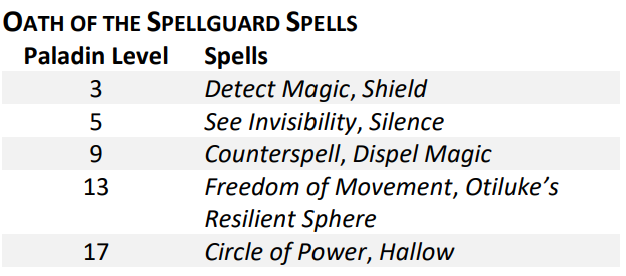
Your extra prepared spells. Expected stuff – Detect Magic, Dispel Magic, Counterspell, et cetera et cetera. Not much else to say here.
Spellguard Strike (Level 3)
Whenever a creature in reach casts a spell, you can use your Reaction to make a melee weapon attack. Pretty decent on its own, but competes with Guardian Bond – though dealing damage is always a good option, instead of maybe preventing some damage later.
Aura of Concentration (Level 7)
Allies in your Aura of Protection have advantage on Concentration saving throws. Not very exciting, this one – your Aura starts at 10 feet, and Wizards and Sorcerers generally want to be quite a bit further than 10 feet from the frontline. Plus, they usually want their own sources of that kind of advantage (War Caster, as I mentioned previously). I think a nice addition to this could be that the target of your Guardian Bond also has this advantage, even outside of your aura (within a wider distance limit, perhaps), to make it a bit more attractive to use on your spellcasters (which would also fit the subclass theme a lot), even if they won’t be next to you all the time.
Spell-Breaking Blade (Level 15)
When you hit a creature with your Spellguard Strike, you can also cast Counterspell as part of the same reaction. If your Counterspell fails, you don’t expend a spell slot. This one is quite powerful – not so much the casting itself (you could do that regardless, you have Counterspell prepared) but the fact that you can use it without worrying you’ll “waste” a spell slot, plus the combination of attack+counterspell in a single reaction. Admittedly, it still has some serious limitations; you’ll have to get within reach, and also hit with the Spellguard Strike, not just make the attack. But it’s a serious upgrade over the Level 3 Feature, for sure.
Eternal Spellguard (Level 20)
As a bonus action, you can empower your Aura of Protection for a minute, once per long rest or by using a level 5 spell slot (the standard level 20 Paladin feature). The benefits you get are:
- While the target of your Guardian Bond is within your aura, they have resistance to all damage
- You and allies in your aura has advantage on saving throws against spells
- Spell attack rolls against you and allies in your aura have disadvantage
So a loooot of protection against spells here. Quite powerful, as in the higher levels spells are more common even if you’re not fighting dedicated spellcaster enemies; though, a thing to always keep in mind is, a bunch of people all grouped up make for a tempting Fireball target even if it’s almost guaranteed they’ll only take half damage.
Overall, on the surface it looks like a very nice subclass, but it does have issues; it only cares about spells, for example, not more general magical effects. It’s also very heavy on Reactions, as well as your reach – I thought initially that this would encourage you to use a weapon like a polearm, but that only affects your reach for attacks, not in general; Guardian Bond and Spellguard Strike would still have a reach of 5ft. Though, honestly, if someone asked me as a GM to use those features with extended reach through a glaive, I’d allow it.
Rogue – Magic Stealer
Not really enthused with the name – could have gone with Spellthief, or Spellstealer, or something else. Magic Stealer sounds… I don’t know, a bit weird. Anyway.
Empower Sneak Attack (Level 3)
When a creature within 30 feet of you casts a level 1+ spell, you can use your reaction to absorb some magical energy from it to empower your Sneak Attack until the end of your next turn, dealing extra d6 equal to the spell’s level in Force damage. You can do this a number of times equal to your INT modifier per long rest.
This can also trigger from friendly spells, and early on an extra d6 is a big deal – later on, you’ll probably be a bit more picky and wait for bigger spells, but you can coordinate with your allies to know when to expect a big damage boost.
Drain Magic (Level 3)
As a Magic Action, you can touch a willing creature and end one ongoing level 1 or 2 spell on it; they immediately recover an expended spell slot of level 2 or lower (their choice). You can do this once per Short or Long rest.
This has a lot of interesting applications. First of all, of course, you can end harmful effects and get a bonus as well. However, you can also do this to “upscale” a spell slot – have an ally use a level 1 spell on themselves, then end it to give them a level 2 spell slot. Or you could use it on spells with multiple targets – a wizard could cast Sleep or Web centered on themselves, then you come in and free them and give them a spell slot back. Although I’m probably overthinking it, and it won’t be as easy to use as I’m hoping.
Magical Sabotage (Level 9)
You gain some additional Cunning Strike options:
- Spell Susceptibility (2d6): The target has Disadvantage on the next saving throw they make against a spell until the start of your next turn. Very very good in coordination with your spellcasters to set up some powerful control spells.
- Disrupt Spell (3d6): Until the start of your next turn, when the target tries to cast a spell, they must succeed on an INT saving throw or waste their action/reaction/bonus action (but not the spell slot). Sounds nice, but unless you’re fighting a pure spellcaster, it probably won’t be as disruptive as you might hope.
- Steal Resistance (2d6): Choose a type of damage. Until the start of your next turn, your target loses resistance to that damage type if they had it, and you gain resistance to that damage type. Now this is a lot more interesting – losing resistance is a pretty big deal (though DnD2024 has a whole lot of “ignoring resistance” features), so this is niche but powerful.
Occult Shroud (Level 13)
When you finish a long rest, you can cast Nondetection on yourself, which lasts 24 hours. I assume you also do it without expending a spell slot, since you don’t have one, but since it’s not explicitly stated who knows?
Depending on the type of campaign you’re playing, this can be pretty good (or practically useless) but I think it fits the theme.
Improved Magic Drain (Level 13)
Your Magic Drain now goes up to spell level 3. Expected, very much wanted, opens up whole new avenues of using Magic Drain. Mostly for upscaling spell slots – the only level 3 spells with negative effects that come to mind are Fear, Hypnotic Pattern, and Bestow Curse, that are admittedly quite powerful but I don’t expect them to be very common.
Eldritch Implosion (Level 17)
When you use your Empower Sneak Attack, you can also force the spellcaster to make a CON saving throw. On a failed save, the spell fizzles with no effect, and the target is Stunned until the start of their next turn. Now this is very powerful – a counterspell and a stun all rolled in one, with multiple uses per long rest, and the saving throw is even based on your DEX instead of your INT. Now this is a capstone feature I can get behind.
Overall, I like the Magic Stealer (eugh, perhaps not the name) quite a lot – it looks fun, depending on the campaign it can also be very powerful, and even without that Empower Sneak Attack and the Spell Susceptibility cunning strike can get you quite far on their own.
Warlock – Vestige Patron
Finally, we have a warlock subclass, where your patron is a vestige of a dying or forgotten god.
Vestige Companion (Level 3)
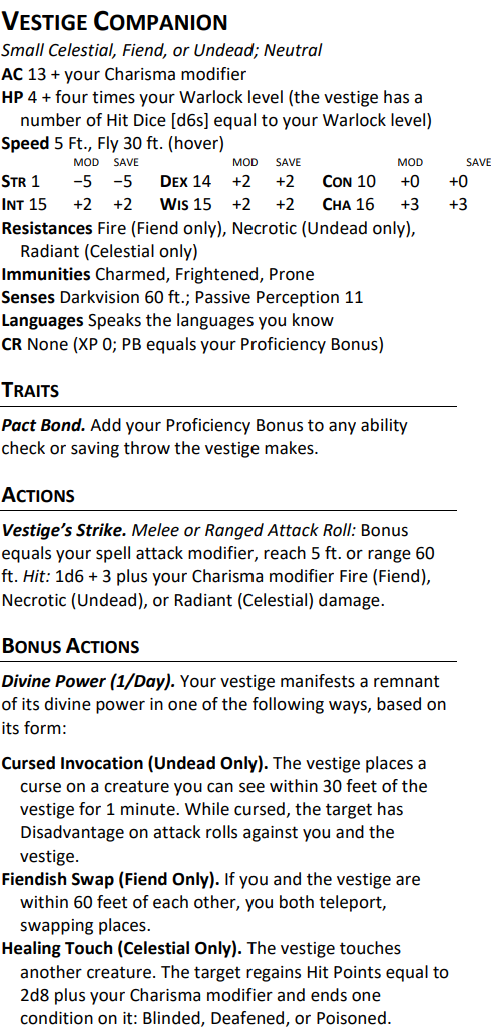
You get a pet/summon/whatever you want to call it, which is the manifestation of your patron. You can see the full stats on the left – you’ve got the standard stuff, Pact Bond, HP scaling with your level, you have to use your Bonus Action to give it orders, etc etc.
There are some interesting things here however. First, the AC starts decently high – 13+CHA means it’ll probably have a higher AC than you, though its life total isn’t very promising. A STR of 1 can cause some serious problems sometimes too. However, the vestige flies, has some decent immunities, and the default attack starts out decently strong – 60ft range (or melee, but why would you?), 1d6+3+CHA of magic damage.
You can also choose whether it’s an Undead, Fiend, or Celestial each time you summon it, which gives it a different Divine Power action and a damage resistance. I understand not wanting not “lock” players in choices they later regret, but I think that it really makes immersion suffer sometimes, and in this case changing your ming about what your god is every day is a step too much I think.
The Divine Powers themselves aren’t anything groundbreaking or overpowered – disadvantage on attack rolls, a teleport swap, and a heal – and they’re only once a day as well. Overall, starting out it’s a powerful summon, if only due to its high damage output at range – plus, you can summon it for free with just a 1 minute ritual – no need to spend spell slots or limited uses.
Vestige Spells (Level 3)
You get your extra prepared spells, but not from just one list – you get to pick and Cleric Domain from between Life, Light, Trickery, or War, and get their extra spells when you reach the appropriate level. Clerics have a lot of great spells – Guiding Bolt, for example – and healing as a Warlock is also pretty powerful.
Vestige Recovery (Level 6)
Your Vestige can now use its Divine Power every short rest as well, or when you use your Magical Cunning. As I mentioned, the Divine Powers aren’t that powerful, but getting more uses out of them helps.
Aura of Power (Level 10)
Once per long rest, as a magic action, you can cause your Vestige to emanate a 30-foot aura, lasting a number of hours equal to your CHA modifier. While inside the aura, you, the vestige, and your allies have resistance to Fire, Necrotic, and Radiant damage, and immunity to Charmed and Frightened. In addition, if you drop to 0 HP while inside the aura, you change your HP to your Warlock level + your CHA modifier. This dismisses the Vestige and you can’t summon it until you finish a long rest.
A very nice feature – it gives some excellent defenses, for several combats, to multiple people. Just when the vestige starts to drop off in effectiveness on its own, this feature gets it back into action.
Semblance of Life (Level 14)
Once per long rest, you can cast Summon Undead, Summon Fiend, or Summon Celestial without expending a spell slot (depending on the form your vestige has). The spell slot used is considered to be half your Warlock level (rounded down, up to 9), and the vestige becomes the summoned creature, using their stat block for 1 minute.
And with this, the vestige gets back into combat with a serious (temporary) upgrade. I also really like the flavor of this feature, with the vestige finally getting enough power to manifest in a more powerful form.
Overall, I really like this Warlock; I wasn’t sure I would when i started reading it, and I generally find most pet/summon subclasses to be wonky at best, but this one’s grown on me, especially since it has a ton of roleplaying potential as well.
Final Thoughts
I am relatively happy with this UA. Again, not blown away or impressed, but happy enough. The Warlock and the Rogue are interesting ideas; the Paladin is alright, and the Monk turned out to be good, but a bit boring (and losing points due to the capstone feature). I’m always glad to see more new subclasses – though, at some point, they’ll have to be exceedingly niche in order to be truly new, and there’s not enough features in one subclass to properly convey a deep theme. But that’s a limitation of a system that uses classes and subclasses – not much to be done about it.
Join Our Mailing List
Do want…
- Extra content?
- Discounts?
- Updates about all our work?
 The Kind GM