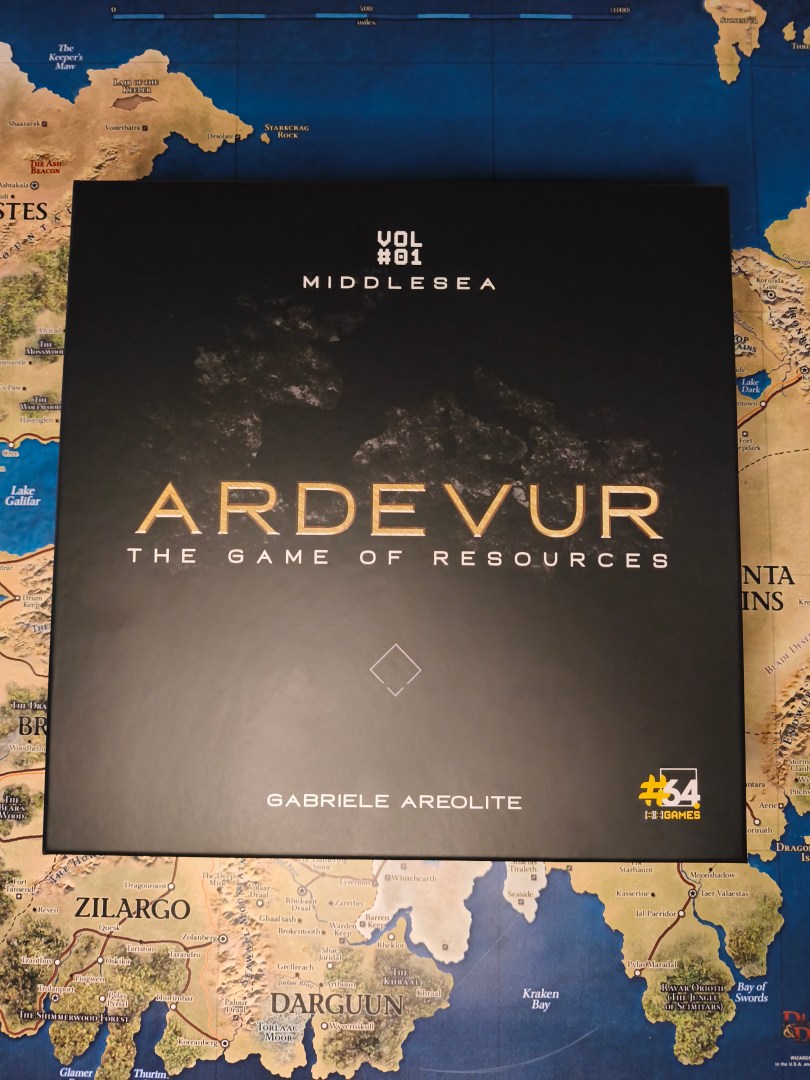
ARDEVUR: The Game of Resources is a resource and economy management boardgame about industrial mining, by Hashtag 64 Games.
Taking place on Earth in the modern era, ARDEVUR pits 2 to 4 players against each other in a competition for precious metals. Each player is the head of a mining company, establishing their presence in Africa and Europe and fighting to dominate the global market. The game usually takes between 1 to 2,5 hours, depending on the number of players.
The people at #64 kindly sent us a free copy of the game; it is still somewhat in development, with a GameFound project set to go live soon, so keep that in mind for the rest of this post.
The Box
Let’s take a look at what the box contains. I want to mention that it’s very neatly packaged; the boards all fit nicely against each other, and they all have little notches that make them easier to pick up and separate. As for the contents, we have:
- 1 Foldable Map Board
- 24 Territory Cards: the locations that you’re going to build your mines.
- 18 Development Cards: needed for most Development actions.
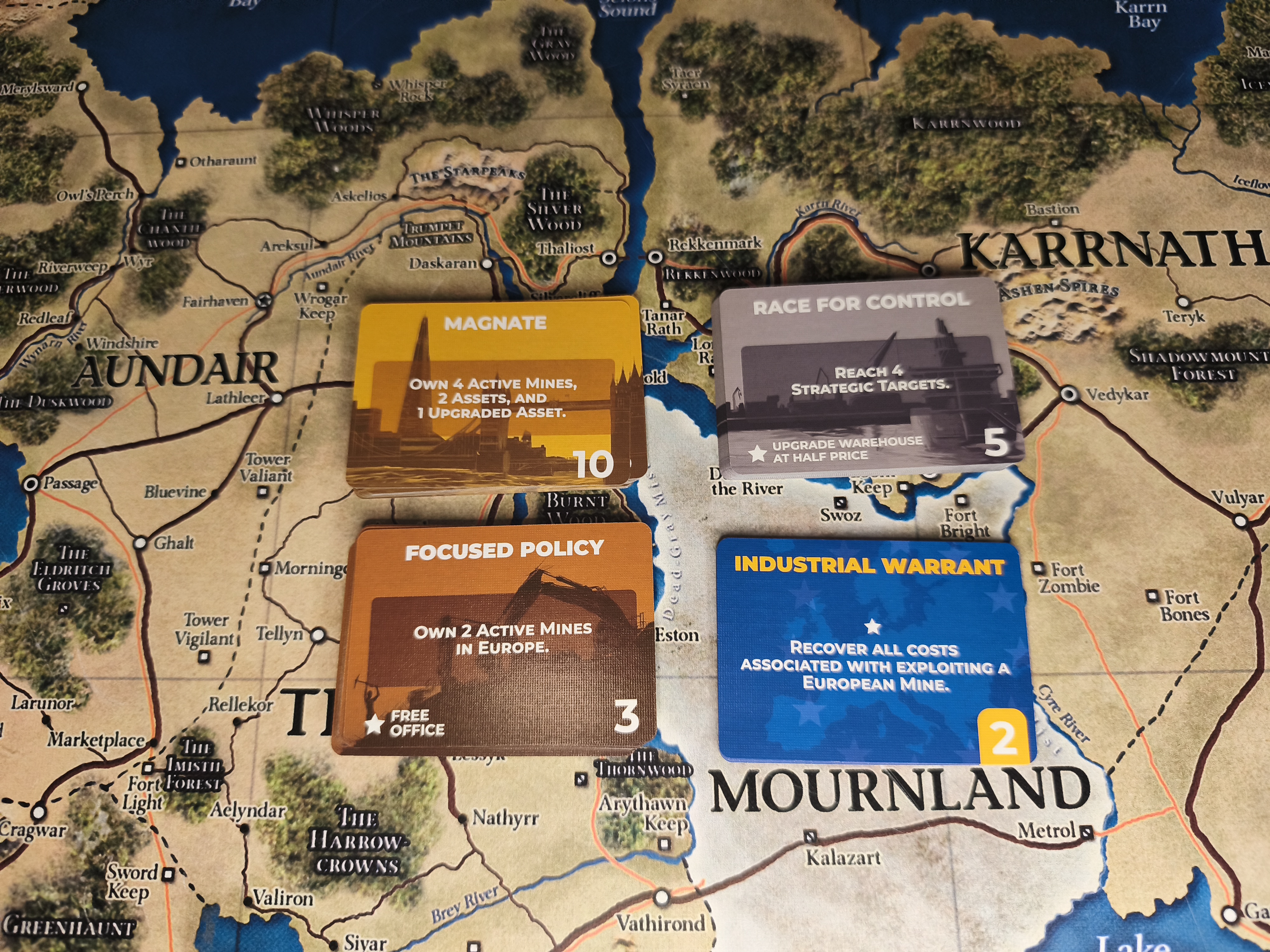
- 40 Strategic Target Cards: these give you Supremacy Points for victory, but can also be expended for bonuses. They are split into Bronze, Silver, and Gold according to their difficulty.
- 6 Government Incentive Cards: these are similar to the Strategic Targets, but have different requirements.
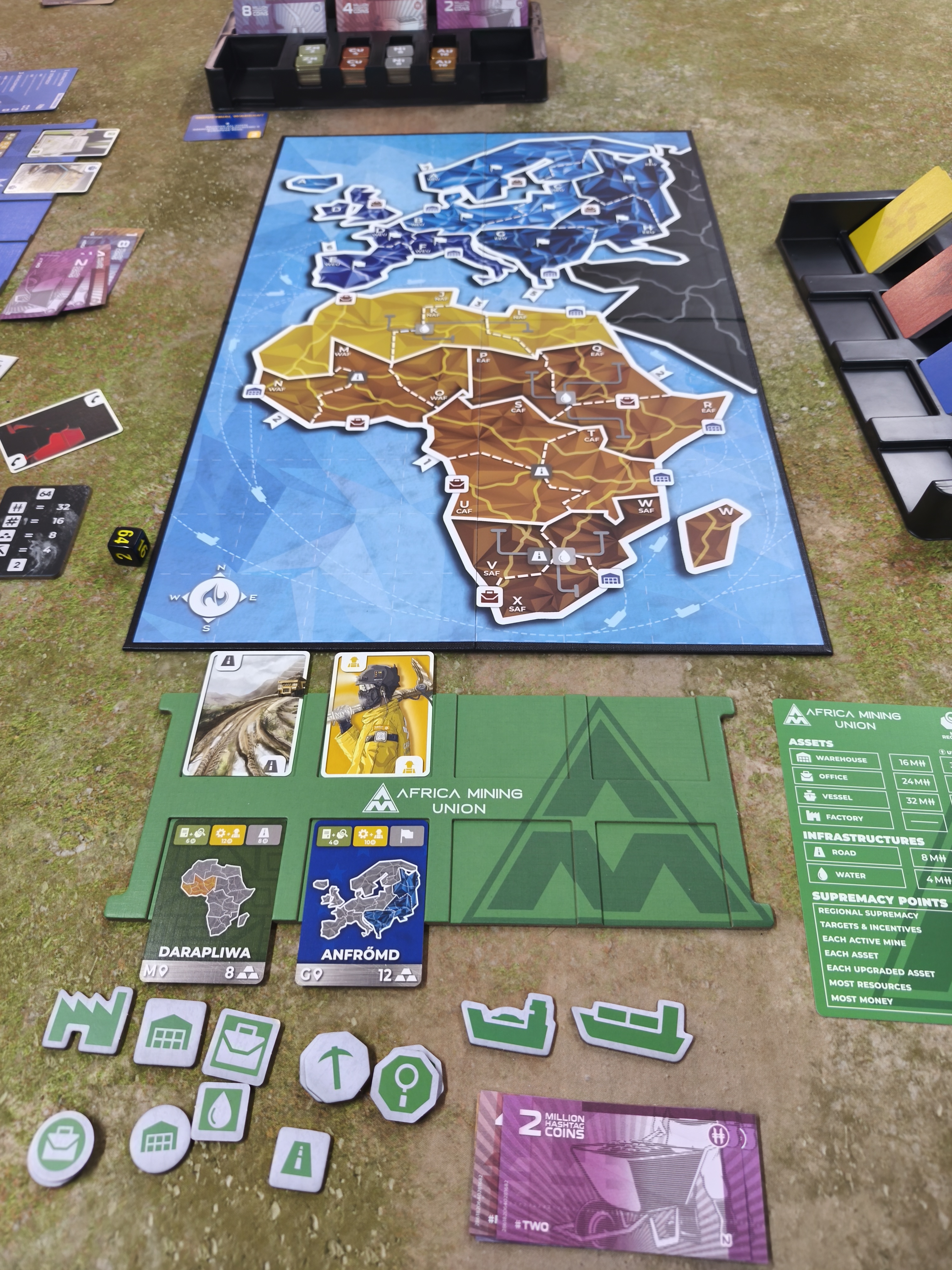
- 4 Corporation Cards: each with a signature colour (red, blue, green, yellow) and small guides on the main game mechanics.
- 56 Map Markers total, 14 for each corporation: colour-coded, this includes all the necessary markers for your mines, offices, warehouses, etc. Many of them are double-sided, since you need to flip them once, for example, your exploration site turns into a mining site.
- 64 Action Cards total, 16 for each corporation: again, colour-coded.
- 40 Resource Tokens, split into 4 tiers: Zinc, representing a value of 2, Copper for 4, Silver for 8 and Gold for 16.
- 96 Money Bills total, split into 6 tiers: from 2 to 64, doubling each tier’s value.
- 1 Target Grid, where you place Strategic Targets for the game.
- 2 Market Organisers, where you store most cards, bills, and resource tokens for the game.
- 4 Dashboards, one for each Corporation.
- 1 six-sided die, with numbers 2,4,8,16,32, and 64.
- And finally, 1 Rulebook.
They may sound like a lot, but they are easy to pack – the box isn’t as big as you might expect, though it’s certainly not something you can just drop in your bag or backpack and bring along anywhere.
The Rules and Mechanics
Now, let’s go over the rules really quick.
Setting Up & Turn Phases
As I mentioned, the game is for 2 to 4 players, competing against each other. Depending on the number of players, there are fewer (or more) cards in play; this affects Strategic Targets, Government Incentives, and most importantly Development Cards. Then, each player picks a corporation (or the players roll dice, and the biggest number gets first pick). In the “standard” game mode, you play with Action Cards included, but there’s also the “Fair Play” game mode, where they are removed. I’ll get back to the Action Cards later. Finally, the players get their starting capital, as well as 2 Development Cards and an Action Card, and the game is ready to start.
Initially, there is an Auction Phase. Territory Cards are revealed (after being shuffled), equal to the number of players; then, the players take turns rolling the dice. Whoever has the highest roll gets to pick first, another Territory is revealed to replace the one taken, then the process repeats until everyone has 2 Territories. This means that someone could pick both their territories before anyone else has a chance, if they get lucky enough twice in a row with their roll. Later in the game, there is a second auction phase (working exactly the same, each player getting an additional 2 territories) – it doesn’t have a set time that it occurs, but any player can call for it as long as each player has at least 2 active mines.
Then the players start taking their turns. Every turn is split into 4 phases:
- Extraction Phase: If you have an active Mine, you gain the amount of resources noted on its Territory card. If you have more than one active mine, you can only extract from 1, unless you have built an Office.
- Strategy Phase: You have 3 options here. Pick 1 or 2 Development cards, draw 1 Action Card, or take the Telephone card (a special Development card that acts as a wildcard, but you have to pay double for its effect)
- Development Phase: This is when you actually do your stuff – be it building mines, infrastructure, assets, or selling your stockpile for money.
- Reward Phase: The last phase – if you qualify for a Strategic Target or a Government Incentive, you may take it – only one per turn.
The game ends when a player calls “Total Control” – this can happen only if at least 1 gold Strategic Target has been claimed, or all bronze and silver targets have been claimed, or if a player has at least 24 total Strategic Targets and Incentive cards. When this final round is finished, players count up their Supremacy Points, and the one with the most wins.
Overall, the flow of the game is pretty simple – you’ll have to play a few rounds until you get the hang of it, and there are some edge cases that require you to pull out the rulebook, but mostly it goes smoothly enough. But let’s also look at some more specific mechanics.
Development Phase
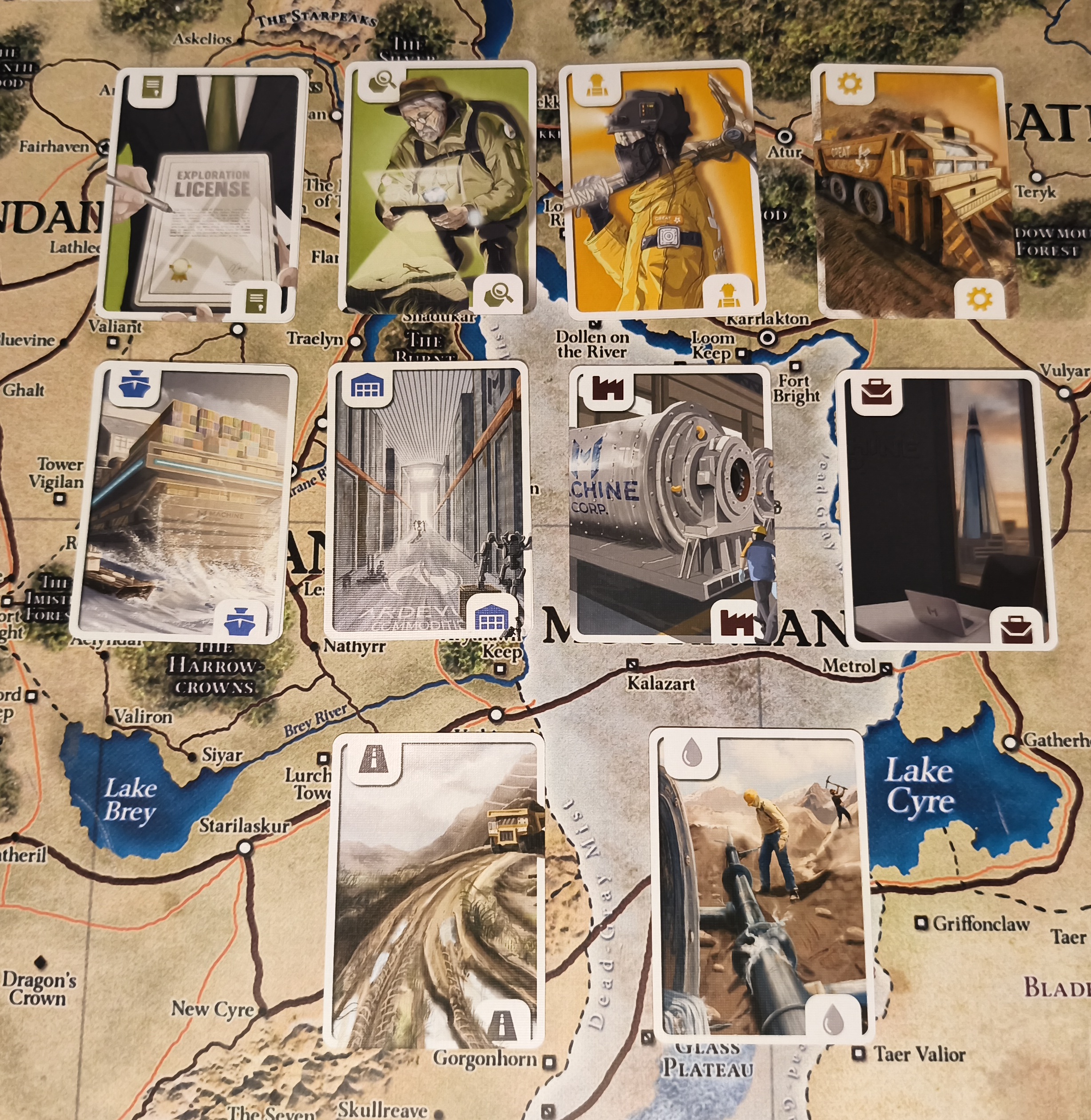
Now, a few more details about the Development Phase and Development Cards. In order to do most things in the development phase, you need corresponding development cards. For example, to set up an exploration site, you need both a Licence and a Geologist card, which you then use along with a monetary cost (written on the territory card). To turn that exploration site into a mining site, you need a Machinery and a Workforce card. To build a Road or Water infrastructure, or an Office, Warehouse, Vessel, or Factory, you need the corresponding cards as well. The number of Development cards is limited – with 2 players, there’s only 1 of each, so it’s common to block the other player’s progress by taking a card they need but you don’t, and holding it indefinitely – this forces them to use the Telephone card with double cost, or perhaps they do the same back to you and try to make a deal.
This is where picking a corporation also comes into play – at least somewhat. Each corporation has a “built in” development card that you don’t need to have (and can’t pick, either) in order to build a mine. For example, Machine Corp doesn’t need the Machinery card, and Ardevur Commodities doesn’t need the License card.
As for the Assets – the Warehouse allows you to stockpile more resources (starting with a base of 32, doubling with a Warehouse, and doubling again to a max of 128 with an upgraded Warehouse), the Vessel lets you sell your stockpile at double price (so it’s very powerful, but also expensive), and the Office lets you extract from two mines from the same continet at once – with the Upgraded Office allowing you to extract from 3 mines worldwide. The infrastructure has a different role; some territories will require Water, Roads, or both. A territory without Water sells at half price, and without a road, you can’t sell from that territory at all.
As I mentioned, the last thing you can do in the Development Phase is sell. You have 2 options; sell locally or sell globally. Selling locally will only give you half price for your resources, but it also lets you do something else with your development phase; so, for example, you can develop a mine, then sell if next turn you’re going to hit your stockpile maximum or if you’ve got something important to do and need the money. Selling globally, on the other hand, gives you full price as a baseline – but you also roll the dice to check for market fluctuations. If you roll a 2 (remember, the dice goes 2,4,8…64), you sell at half price, but if you roll a 64, you sell at double price. So there’s a high element of chance that can either punish you heavily or give you a big reward.
Action Cards
Action cards are a.. controversial part of the game. In spirit, I think they’re great; essentially, they are actions you can take, often at your opponents’ turns, to interact with them somehow, or gain additional bonuses. Each corporation also has its own deck of Action Cards, which is where most of the difference between them comes from. However, in practice, we found ourselves leaning more towards the “Fair Play” game mode, taking these out – they feel way too disruptive and powerful. For example, some of them allow you to make an opponent skip their turn, or give you all the money they got from a resource sale, or even destroy one of their mines; they create too much of a swing. There’s an argument to be made that since everyone has access to them, it all balances out somewhat, but that’s not really how it felt like. There are lots of tamer action cards that I like, such as giving you the chance to go first in a territory auction without having to roll the dice, but they feel too situational and even weak to compete – if they were all on that same power level, however, I think it would be a fantastic aspect.
Final Thoughts
ARDEVUR can be lots of fun. There’s randomness involved, which makes for big swings that some people might not like, but there’s also a layer of strategy involved as well, and I think it has the space for some fun negotiation-style interactions between players as well; there’s some mechanics that i didn’t mention because they are quite specific, but they can push in that direction a little bit. If the Action Cards get reworked slightly, I can see it being an excellent game that we’re likely going to include in our regular rotations.
Join Our Mailing List
Do want…
- Extra content?
- Discounts?
- Updates about all our work?
 The Kind GM