
What does it take to build an empire?
When I first looked at CIV: Carta Impera Victoria‘s box, I was intrigued as I could not guess what this game was about. It is also known as CIV, not to be confused with Sid Meier’s Civilization. It is a game for 2-4 players and involves hand management and creating collections.
The box
The box itself feels very luxurious. It is made of thick cardboard with art that features civilisations. Inside it, you will find a nice plastic insert with dedicated compartments that hold everything in place. The cards are on the big side, but finding sleeves will not be a problem. And of course, the cards will fit in their dedicated compartment even when sleeved. Yes, I am traumatised by Sushi Go.
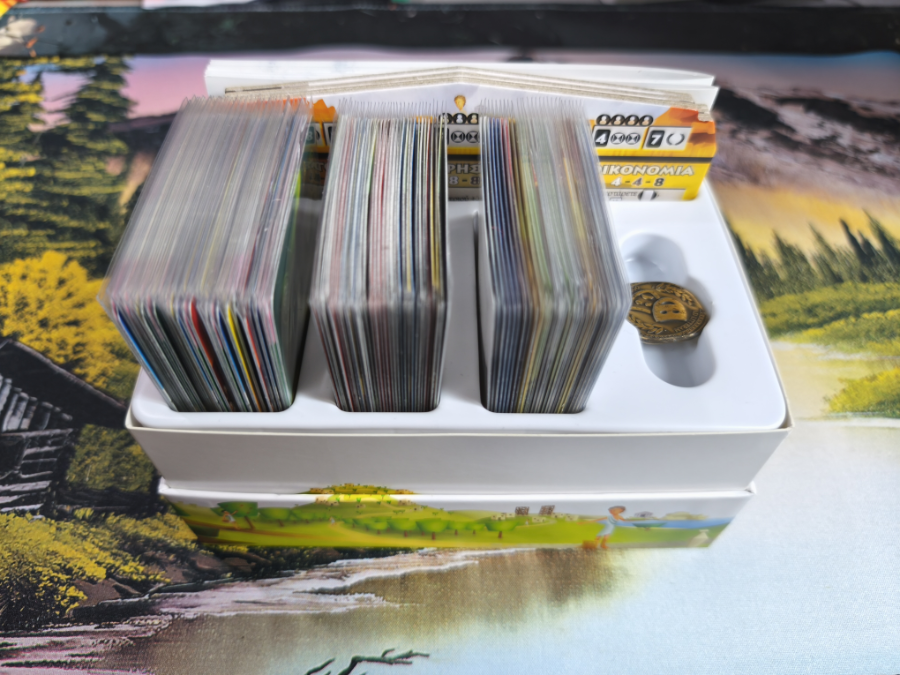
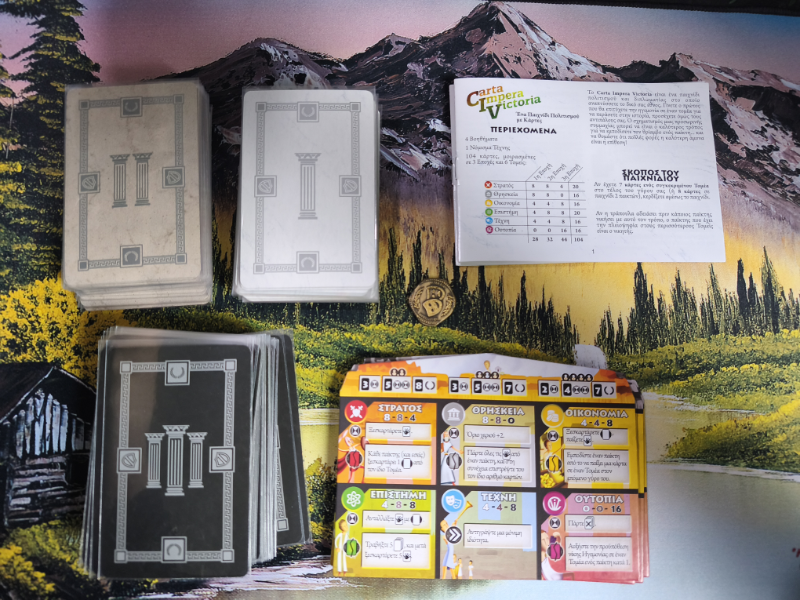
A brief overview of what’s in the box:
- 4 reference boards
- 104 cards divided into 3 ages and 6 fields
- a fancy metal coin
- rulebook
Art
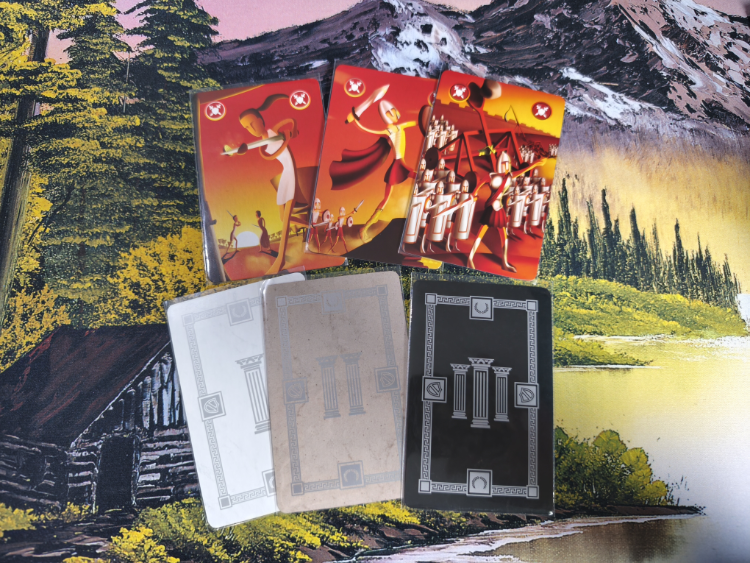
The illustrations are cartoonish and could appear simple, but I feel that this abstract design matches the game thematically. The art for each field across the three ages reflects the progress of civilisation through time, which is also a way to understand in what age you are currently playing.
Card Types
The cards are colour-coded by their field of competition: red for military, white for religion, yellow for economy, green for science, light blue for culture and pink for utopia. Moreover, each card has symbols at the top to easily distinguish where they belong. And that’s all the information they have on them, no text or names. Keep in mind that the cards are not equally split across these fields, and Religion cards are not present at the third age. –We will see how that works in a bit.
Gameplay
The gameplay in CIV is pretty straightforward. Players take turns where they place one card in front of them in its specific category each turn, activate powers when able and draw cards until they have 3 at hand. Each category has different powers, varying from increasing the hand size to copying another player’s power (that you choose by placing the coin in front of their domain). There are two categories for powers: permanent and temporary. In order to be able to use a permanent power, you have to reach a specific number of cards in the field it belongs to, except for Culture, where you have to be the player with the most cards in it. On the other hand, temporary powers require you to discard a card from any domain but Culture. The reference boards have all that information in compact mode, so you won’t have to recall it from memory, and as an extra detail, the first player’s board has a different colour.
Discarding cards from your play area is an important part of the game, as for example, Inquisition in Religion allows you to take another player’s cards by discarding one religion card of yours, and then give them back the same number of cards, meaning that you keep whatever works better for you, or disrupts your opponent’s strategy. Another strong power is embargo in the Economy field, where you stop a domain from being played for an opponent’s next round. I find the names of powers thematic to their domain.
So when does the game end? When someone collects 7 cards in one domain (or 8 if it is a 2-player game). If that is not the case and there are no cards left for drawing, then the game ends, and the winner is the one with the majority score in most domains. And that’s all for the game’s mechanics. Each game lasts under one hour, and although appearing simple, you will need strategic decisions in order to win.
Strategy
Long story short, you need to adapt your civilization according to the others and create truces to overcome the leading player. If you cannot reach the number of cards required to activate a power, then perhaps you should rethink your strategy. As mentioned before, there are no Religion cards in the third age, so by the end of the second age, it would be clear if supremacy in that field is doable. So it is better to go for a wider range of fields and have a bit of everything, to be able to adapt and sacrifice progress in one domain, and gain powers in others. Of course, if you are closer to winning the game, you will become a target for others, so you have to disrupt them and think twice about the cards you discard. It may hurt you, but will it hurt others more?
Final Thoughts
CIV: Carta Impera Victoria is the prof that you don’t need huge boxes to give premium vibes. Thoughtful design, simple components and meaningful decisions are its charm. It is portable, easy to learn and a great choice for an opening game at any table. Do you have what it takes to build a civilization in under one hour?
Stay crafty and prosper,
Your new favourite author.
Join Our Mailing List
Do want…
- Extra content?
- Discounts?
- Updates about all our work?
This post contains affiliate links. By using them, you support the blog without any extra charge being applied to you.
 The Kind GM