
The Straight Way Lost is a truly impressive 400-page supplement published by Vortex Verlag. It is both a sourcebook and an adventure, based on the works of Dante Alighieri – Inferno, Purgatorio, and Paradiso, a.k.a. the Divine Comedy. The book’s tagline says it all in that regard: Adventuring between Heaven and Hell in a Fantastical Renaissance Italy.
We were provided with a free copy of The Straight Way Lost hardcover book (as well as a pdf version of the document).
Buckle up because this is probably going to be a long one. I’ll try to not overdo it, but there’s a lot to cover. First of all, let’s do a little overview: The book is split into 2 parts, the sourcebook and the adventure, although you should probably read the first before delving into the second since it contains several things that are important to the setting. Furthermore, the book is described as 5e Compatible – not a 5e adventure etc. That’s because lots of things are honestly quite system agnostic – in fact, I’ve seen the argument that other systems might be a lot more fitting for the tone and theme of the setting and adventure, but we’ll talk more on this later.

The Sourcebook
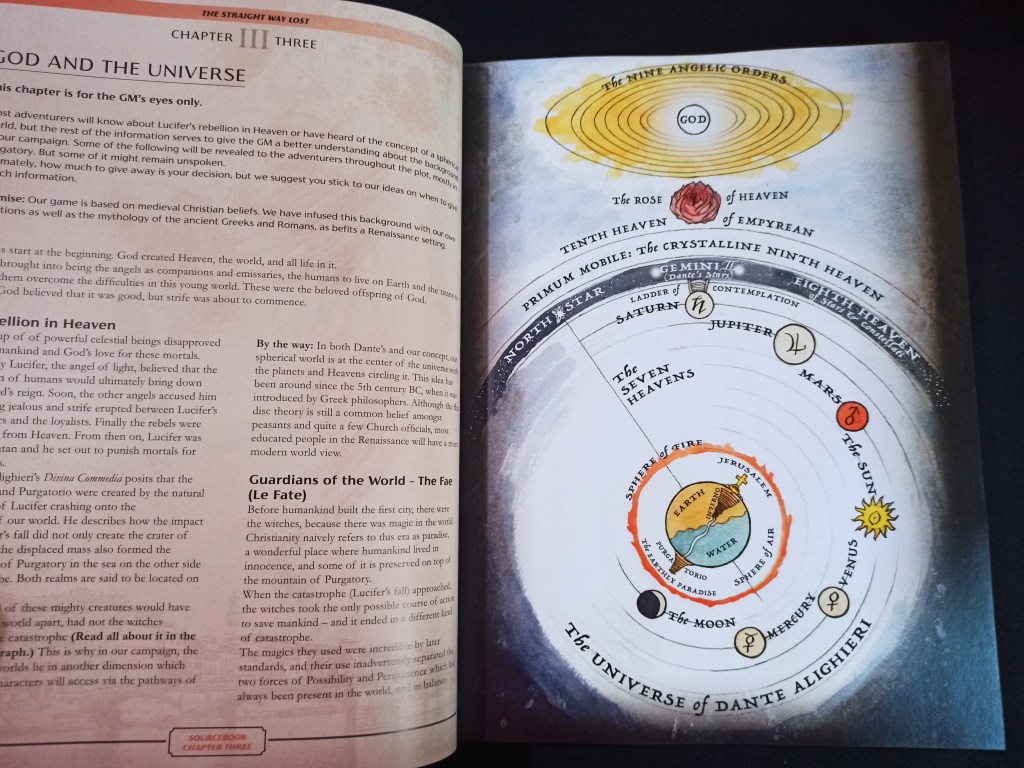
The sourcebook has 7 chapters. The first 2 are introductory, giving a very brief overview of the adventure and some background on Dante and the Divina Comedia, and then we get into the setting in Chapter 3. Before getting to 1492 Florence, we have the rest of the world to explore – a cosmology which is a mix of medieval Christian beliefs, ancient Greek and Roman mythology, and some extra fantasy as well. You have all the known greatest hits: God created Heaven and Earth and all the rest, the spherical world in the center of the universe, then Lucifer rebelled, and his fall created Hell and Purgatory – both of them actual locations on Earth. Then we’ve got some extras: there are witches, and fae, and titans, and giants, and dwarves, and a lot more. In addition, there are two main forces in the universe: Possibility and Permanence, a nice twist on the Order vs Chaos duality that we usually see, especially since they are a lot more, shall we say, morally neutral words? They used to be in balance, but Lucifer’s fall was such a catastrophe that some pretty powerful magic was used to save the world, and now they are mostly separated – Earth is mostly Permanence, and Hell is where it is the strongest – a place of eternal torment where nothing really changes. In contrast, Purgatory has the highest…concentration, let’s say, of Possibility. On the other hand, we have the realm of the fae, where almost pure possibility reigns – a chaotic, ever-changing place, with small pockets of safety and stability where Permanence seeps in, As for Heaven… well, that’s a bit too big of a deal for the “mortal” laws to apply.
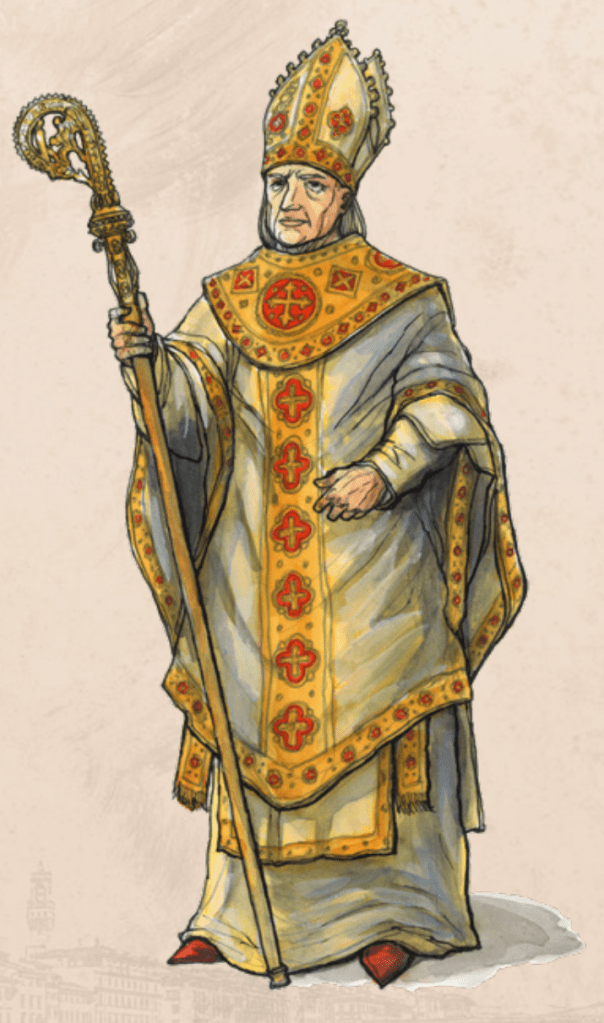
In Chapter 4, we move from cosmology and myth to a bit more worldly affairs – the state of the world in 1492, the Renaissance, the Arts, Sciences, the Church, the political and economic climate of the world – of course, focused mostly in Italy (and specifically Florence) and the wider Mediterranean and Europe. It’s not like a full historical analysis, but you get the gist of what’s going on, and it would be a bit superfluous to cram a ton of easily found historical facts in the book. Then we get to Chapter 5, Character Creation. This has a lot of advice and guidance on how to create a character that fits the setting since this isn’t just a generic fantasy land – the state of the world demands a bit more thought put into the decisions of who and what a player is and does. For example, if you casually wave your magic around, expect to be seen with distrust at the very least, and more realistically expect a visit from the Inquisition that you probably won’t enjoy. And you’d better be very careful with who you let know that you’re a Warlock!
There is also a new mechanic called Dismay – I’d say it’s similar to the various Madness or Stress mechanics you might have seen, but with some changes to fit the theme. Chapters 6 and 7 contain new (and altered) species and classes. As you can guess, there are some restrictions on what you can play – for example, there are no Dragonborn or Half-Orcs. You have Humans, Elves, Half-Elves, Dwarves, Half-Dwarves, Tielfings, and Nephilim. The same goes for classes, some of them might need a bit of an adjustment to fit and some might not fit at all – as the book nicely states, there might be a lot of monks in the Renaissance, but they don’t usually attack people with martial arts. In addition, Clerics, Paladins, Warlocks, and Sorcerers need some extra considerations. Finally, there are two new classes, the Philosopher and Artist, and a Bard subclass, the Courtier. They have some interesting mechanics and ideas, and i would call them more utility classes than combat ones, but in general, the adventure isn’t “the streets of Florence run red”, but a more exploratory and mysterious journey.
The Adventure
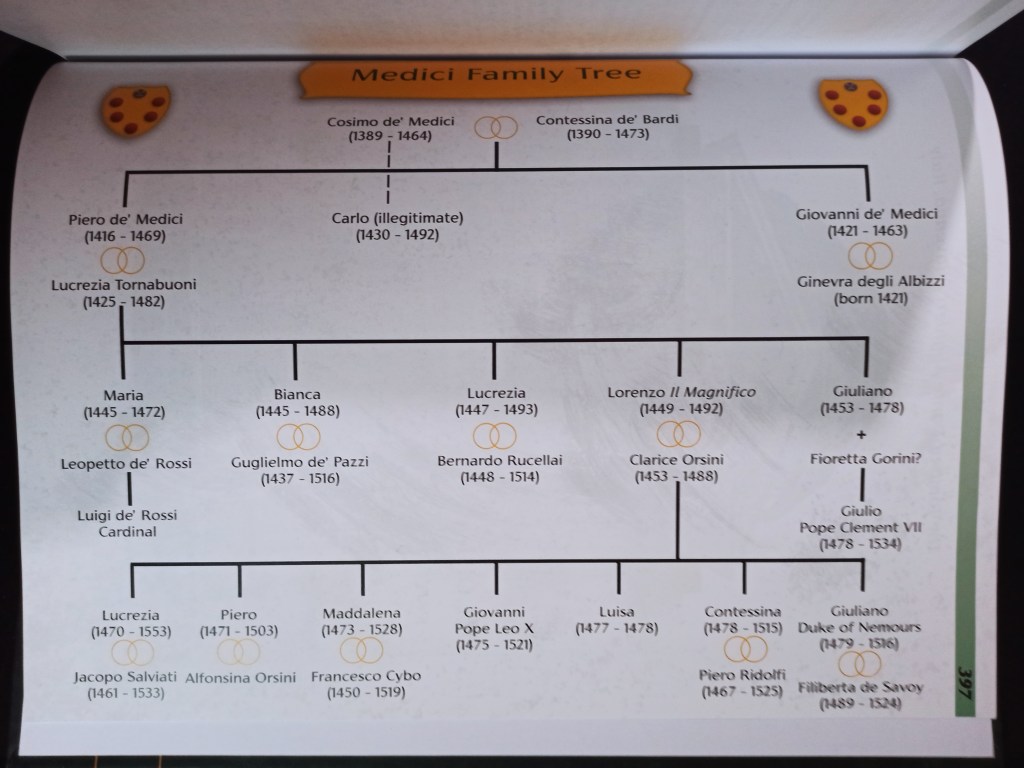
I won’t get too much into the details of the story, except to give a brief overview. It begins with a murder mystery in Florence, at the party of the influential Pierro Capponi, to which the players have been invited. They are not suspects – however, the appointed investigator, the prior of San Marco Girolamo Savonarola, levies accusations of satanism towards the guest of honour, the philosopher Marsilio Ficino, and by extension the Capponi family – who are close allies of the current rulers of Florence, the Medici family. So there’s a lot of political intrigue on top of the murder mystery. The players are recruited by Girolamo to seek the guidance of a hermit away from the city – which puts them on the course to adventure. I won’t spoil anything beyond this point, but of course it will take them on a long journey through Hell, Purgatory, and briefly into Paradise, before getting back to Earth and Florence, all the while unravelling a sinister plan and pretty much saving the world. The story is divided into 7 acts, and takes up about 250 pages – so this isn’t a one-shot, it will take a full, long-term campaign! I also have to note – obviously, considering people are going to literal Hell, there’s going to be some disturbing and mature themes – torture, violence, nudity, sexuality – and you can of course tone them down, be aware that they’re there.
After the adventure, there is also a part with NPC and monster stats, a character sheet, and an appendix with additional helpful information – including a list of possible names for players and npcs, as well as books for further study if you want to delve deeper.
I mentioned earlier that 5e might not be the only system that can run this adventure properly, and the reason is that there’s a lot of character interaction, mystery, investigation, and of course a bit of horror – all things that 5e can do, but other systems were literally made for. I don’t begrudge Vortex Verlag for their choice though – 5e is the most successful rpg system to date, and they’ve also taken care to make the majority of the story fully system agnostic, or at least trivial to convert.
The Book
And now on the more practical side of things. Most of what I’ll say here of course goes for both the digital and physical version. Let’s start with the easy stuff: The layout is great throughout the book, everything is laid out cleanly and efficiently. All the information you need is neatly put on the page, and my only issue – so minor that I’m including it mostly as a joke – is that the page numbers are on the top of the page instead of the bottom. Instant dealbreaker, right? Anyway, let’s talk about the art. It is absolutely fantastic. The 3 illustrators, Jana Heidersdorf, Mark Smylie, and Gwenevere Singly have maintained a coherent style throughout the whole book, which alternates between lively, imposing, and straight-up terrifying when it needs to be – in particular, the illustrations of the monsters of hell are unnerving and otherworldly, perfectly encapsulating the horror they’re supposed to convey, and there’s a picture for each and every one of them.
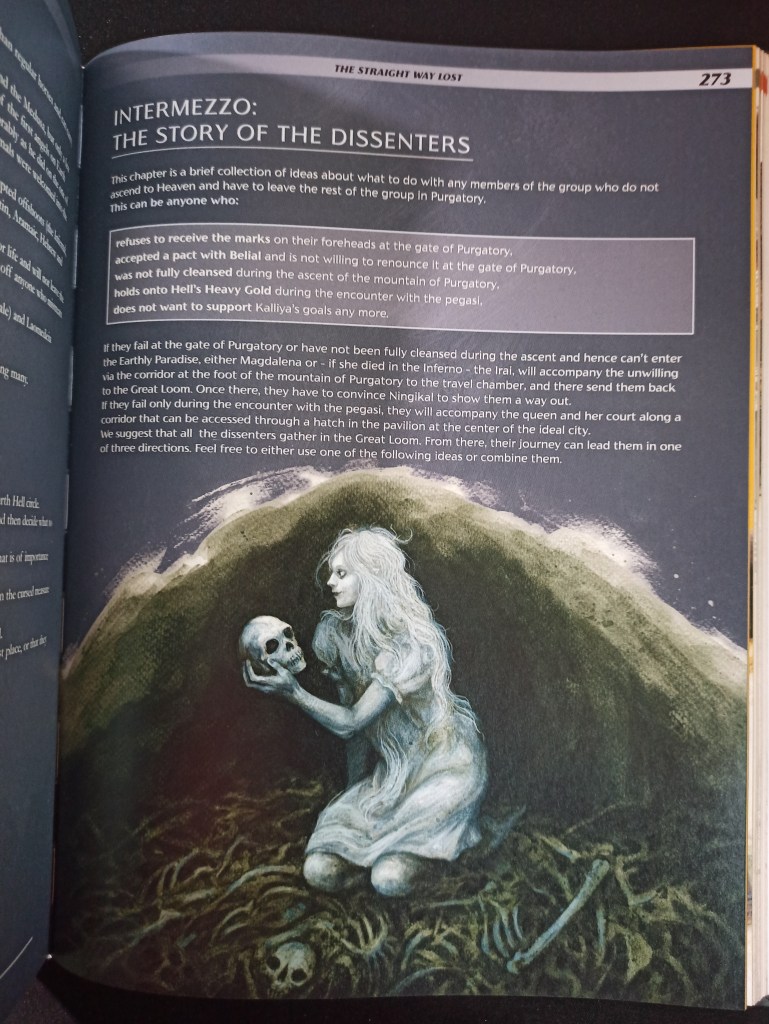
Another notable thing is the colour of the pages. I know it seems trivial, but it has quite the effect. Normally, the pages are a pretty standard cream colour, but they turn pitch black in the chapter of Hell, shifting to a deep blue/petrol for Purgatory, then bright orange for Heaven, then finally back to their original colour when the players get back to Earth. It really helps to sell the fact that they’re in a different world, even if it’s just for the GM, and the effect is even more pronounced in the physical book. And speaking of the physical book, I have to say it is excellent – sturdy, with a thick hardcover, and with a great binding – sometimes that’s an issue, especially with bigger books, but this behemoth has absolutely no problems with it. The pages are glossy and vibrant, but I never had any issue with reading the text, even with lights pretty much on top of them.
Conclusion
The Straight Way Lost is an amazing publication in every aspect, but it is not for everyone. It’s not a hack and slash loot and leave sort of dungeon crawl (not that i’m saying they are bad – i LOVE dungeon crawls), and it will take significant involvement to see it through, but if what you read piqued your interest, I think you’ll be impressed with the actual product as much as i was, if not more.
Join Our Mailing List
Do want…
- Extra content?
- Discounts?
- Updates about all our work?
 The Kind GM
Oh wow, what a very nice review. Thank you so much for your time! You seem to completely get what we were going for.
LikeLiked by 1 person
Thank you! It’s really an exceptional piece of work!
LikeLike