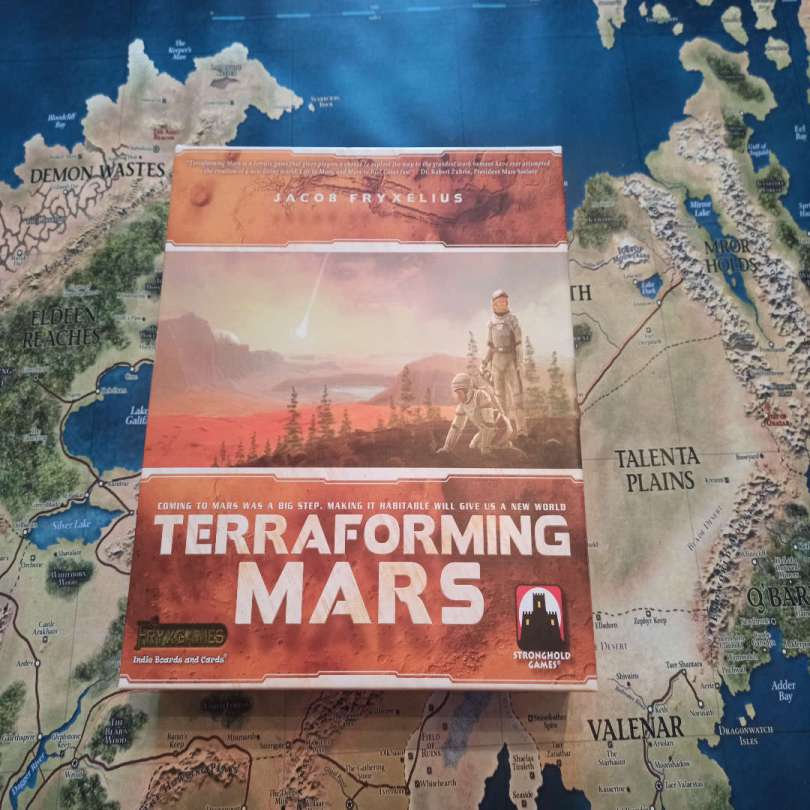
Terraforming Mars is a resource management and engine-building game for up to 5 players, with the ultimate goal of turning Mars from an inhospitable wasteland to a thriving biosphere for human colonization, created by FryxGames.
I was interested in this game from the moment I saw it on the shelf of my LGS – both the sci-fi setting and the game mechanics are exactly my kind of thing, so I just had to try it out, and it quickly became a favourite. However, I will say that, unlike Splendor which I talked about previously, this isn’t as casual of a board game – for various reasons I’ll expand upon later.
The Concept and the Box
The world of Terraforming Mars lives in the 24th century. With resources dwindling and population increasing, the World Government institutes the Terraforming Committee, with the ultimate goal of creating a new world for humans to live in – on Mars. Still, this is a pretty big project that will take a lot of time – but there’s plenty of megacorporations willing to step up, all for a big payout of course. Each player controls one of these corporations, having a distinct speciality – mining, construction, genetic engineering, research, straight-up just having a ton of money to spend, and a lot more – competing to get ahead of the others.
While there’s a general air of optimism – the power of science and technology, taming a hostile planet all for the good of humanity and all that – there’s still plenty of indications that, well, things aren’t all that peachy. Besides the fact that megacorporations exist and can have enough power to shape the world in the most literal sense, they’re also not above getting pretty nasty with each other – or the poor people who actually have to put in the work. Cards like “Raiders”, “Sabotage”, or more sinister like “Indentured Workers” and “Callisto Penal Mines” don’t paint a very pretty picture, especially with how they seem quite similar to how some real-world plans for Mars colonization could go…
Anyway, onto the contents of the box. There’s a big stash here, and I’m only covering the base game – the expansions will have their own “chapter” but I won’t go as in-depth. The box contains:
- A Rules Booklet (essential for every game)
- A Game Board (representing one half of Mars, split into hexagons – as well as containing the tracks for Terraforming and game rounds)
- 5 Player Boards (to keep track of your resources and production)
- 17 Corporation cards
- 208 Project cards
- 8 Reference cards (to remember how some mechanics work)
- 200 Player markers (coloured cubes to mark what belongs to each player, 5 colours)
- 200 Resource markers (copper, silver and gold cubes to represent 1, 5, and 10 of a resource)
- 3 Game Board markers (big white cubes to keep track of Terraforming and game rounds)
- 9 Ocean Tiles, 60 City/Greenery tiles, and 11 Special tiles (these go on the game board)
- 1 First Player marker (shows who goes first each round).
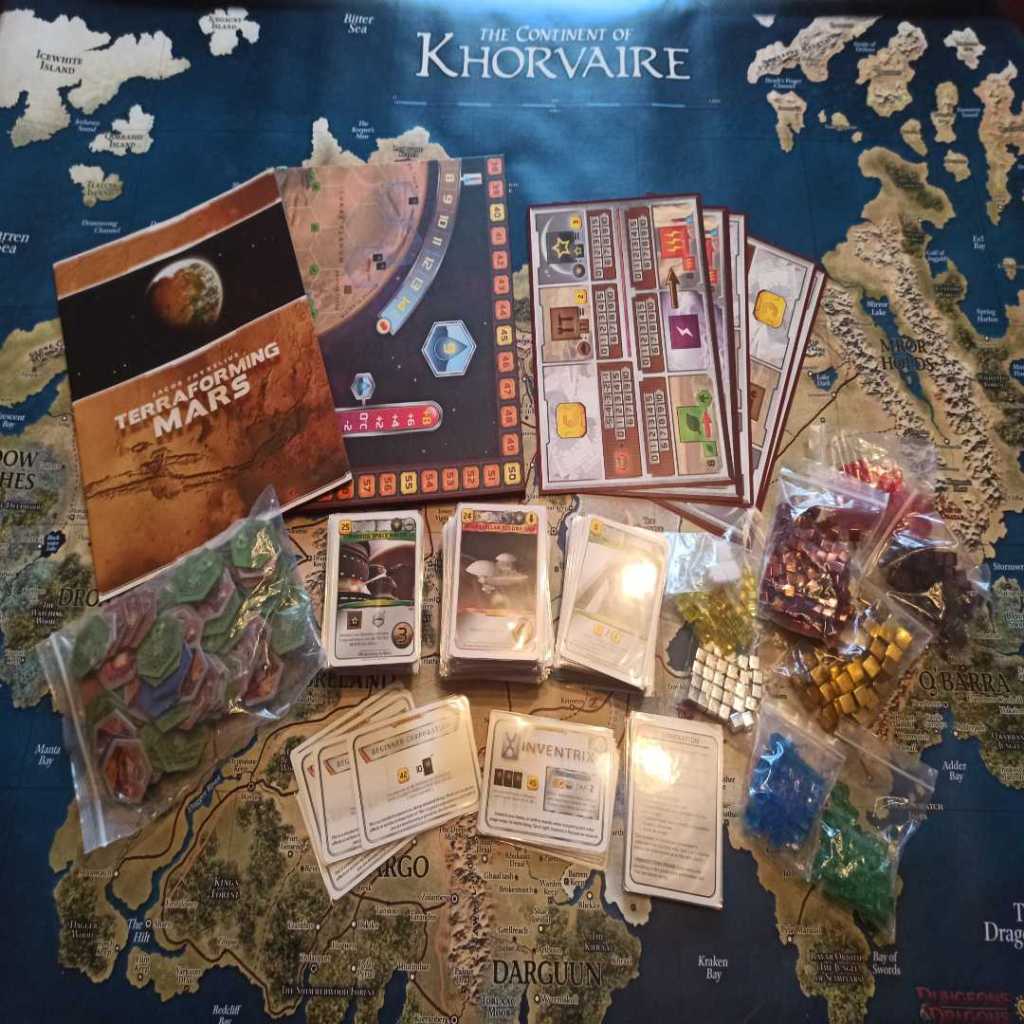
So quite a lot of stuff, and it’s a pretty big box. The game board is hard cardboard that can fold up, and it’s pretty sturdy – and while the cards are sturdy as well, it might be a good idea to sleeve them regardless.
The Rules and Mechanics
There are a bit too many rules to go over in detail, and the extreme specifics don’t really matter anyway – plus, you can easily find them online. However, I’ll go over the basics.
The point of the game is to collect Victory Points (VP), which can be done through various ways.
Terraforming
Terraforming not only gives players VP, but also signifies the end of the game. There are 3 “Global Parameters”: Temperature, Oxygen, and Oceans. Temperature starts at -30°C and reaches +8°C, Oxygen starts at 0% and reaches 14%, and there are 9 Ocean tiles in total. When all Global Parameters are maxed out, the game ends.
When a player increases one of these parameters, they increase their Terraforming Rating (TR) – which starts at 20 at the beginning of the game. Each TR gives 1 VP – but it also gives 1 MegaCredit production (more on that later). So right away there are 43 VPs to be distributed among players just for Terraforming (20 from Temperature, as it goes up by 2 for each step, 14 for oxygen, and 9 for oceans), but there are other ways to increase your TR as well – though TR will often have a big chunk of your VPs.
Now, as for how you raise these parameters: There are specific project cards for all of them, however, for Oxygen and Temperature, there is an easier and more consistent way – seen below.
Resources
There are 6 different resources:
- MegaCredits (I’ll just call them credits): The “money” resource. You use them to play Project cards and Standard Projects, so it’s pretty much the main resource.
- Steel: 1 steel counts as 2 credits when playing a project card with the ‘Building” tag.
- Titanium: Similar to steel, 1 Titanium counts as 3 credits when playing a project card with the “Space” tag.
- Plants: you can spend 8 plants to place a Greenery tile on the map. Each Greenery also increases Oxygen by 1%.
- Energy: it is used by many different cards, but also has a second use – at the end of the turn, all energy turns into Heat.
- Heat: you can spend 8 Heat to increase Temperature by 1 step (so 2°C).
Of course, all of them can have special uses as well – there are cards that allow you for example to spend steel for credits, or heat for plants, etc etc.
Join Our Mailing List
Do want…
- Extra content?
- Discounts?
- Updates about all our work?
Project Cards & Standard Projects
Project cards are the core of the game. At the beginning of each turn, you draw 4 and decide how many you want to keep – each costs 3 credits. There is also a draft variant for this phase, where each player picks one card and then gives the rest to the next player, repeating until everyone has 4 before buying – this allows a bit more strategy, as it both shows some of the cards available to opponents and allows “hate drafting” as well. Personally, I like the draft variant more. However, the first round is a bit different – instead of 3 cards, there are 10, to give players some more choices and to avoid the early game becoming a slog; in addition, there’s no draft variant for this.
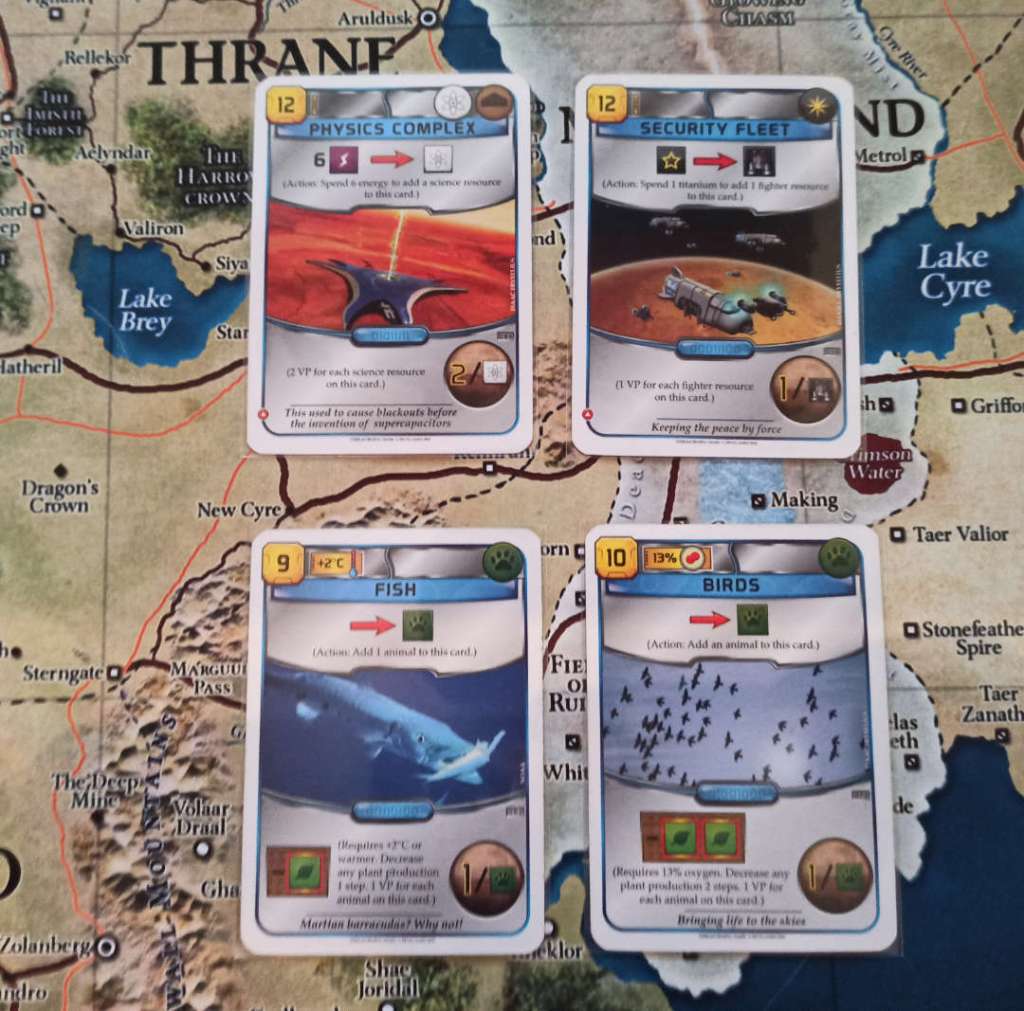
Project cards are pretty much your bread and butter. Each project has a cost in credits, and a lot of them also have tags – such as Science, Space, Earth, Plant, etc. Some of them also have prerequisites, such as a minimum temperature, or a number of other tags you need to already have in play. You can split them into 3 main categories, and they are signified by the colour of their title bar.
- Green Cards are the most straightforward – you play them and they give you an immediate effect – increasing a resource production, giving you a number of resources, letting you place a tile, etc. A lot of them also give VPs – 1 or 2, but they can stack up.
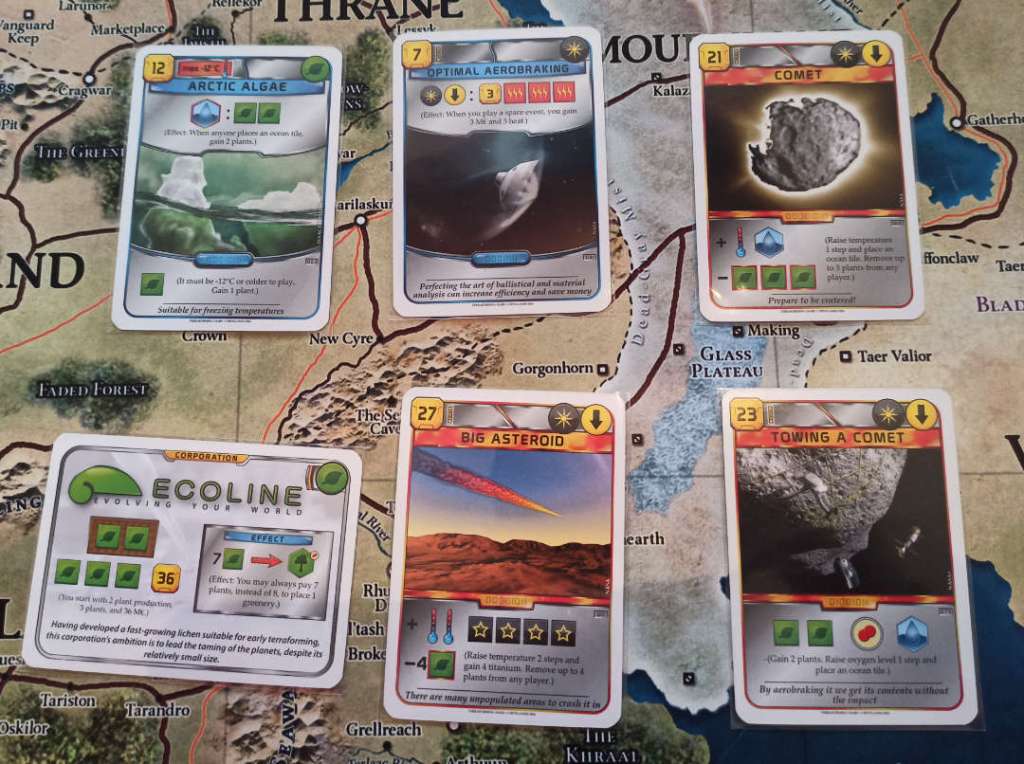
- Red Cards are Events. They are one-time things – once you play them (and they can also do pretty much what green cards do, though a lot of them increase Terraforming) they go face-down in a pile.
- Blue Cards are the most interesting – they give either an Action or an Effect. You can use an Action only once per round, but a lot of them are very powerful and can shape the way your game plan progresses. Effects, on the other hand, trigger automatically in response to something happening (e.g. someone putting down an ocean tile) and don’t have a limit.
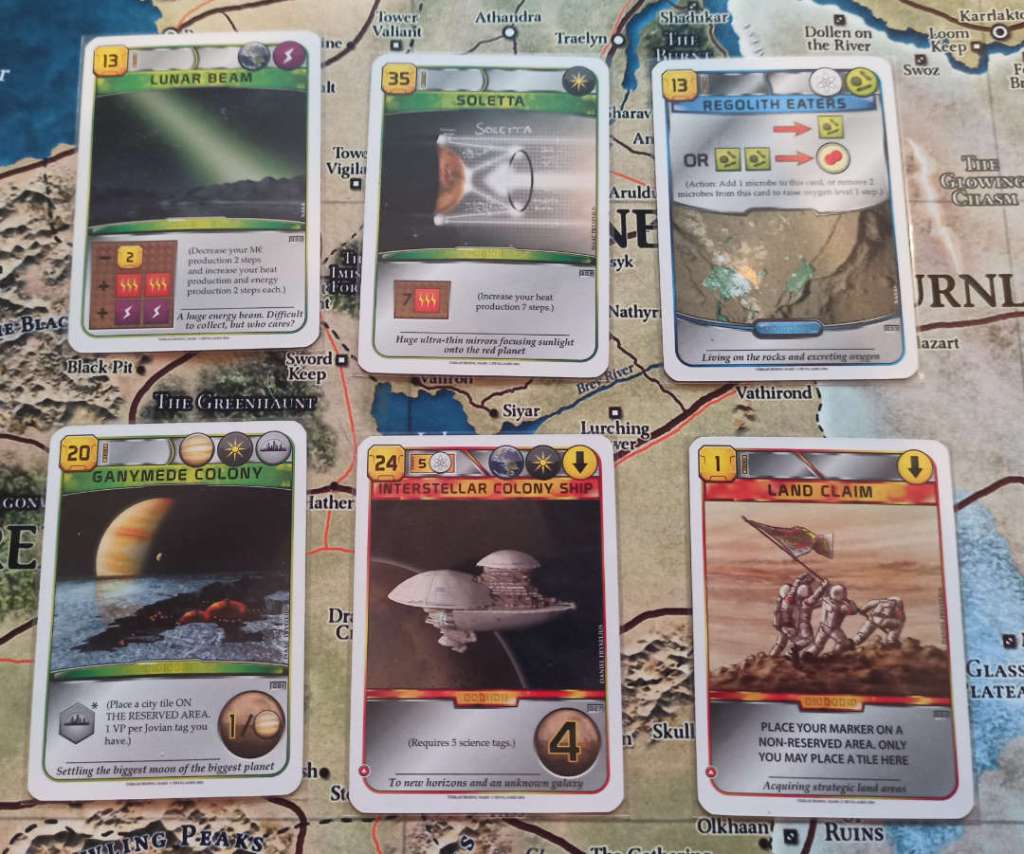
As for standard projects, these are actions that are available to all players at any time: by spending credits, they can place ocean, greenery, or city tiles, increase temperature, increase energy production, or discard any number of cards to gain that many credits.
The Round
Each round – called a Generation – is divided into phases.
- Player Order Phase: The First Player marker moves to the next player clockwise. So each round, the player who gets the first turn changes.
- Research Phase: This is the card draw phase I mentioned above.
- Action Phase: This is where the game happens. Each player can take up to 2 actions in their turn – that can be playing a project card, using a card action, using a standard project, etc. A player can take only 1 action, but if they take no actions, they end their round.
- Production Phase: This occurs simultaneously for all players. Leftover energy turns into heat, and then players gain each resource according to their production.
Nothing too complicated overall, but make sure to keep track of what card actions you’ve done with your player cubes, and remember to add your TR to your credit production!
Milestones & Awards
While most of your VP is going to come from Terraforming, Tiles, and Projects, there’s still a chunk left through Milestones and Awards.
Each Milestone costs 8 credits to claim as an action, assuming you meet the requirements. There are 5 milestones in the base game, but only 3 can be claimed in total – and no two players can claim the same one. For example, Terraformer requires you to have a TR of 35 – a pretty straightforward one that is going to be hotly contested, as opposed to Builder, which wants 8 building tags in play. Each milestone is worth 5 VP, but in truth, it’s more than that – similar to what I said about nobles in Splendor, claiming a milestone is also removing it from an opponent, so in a 2-player game it’s a 10-point swing in your favour.
Awards are a bit trickier. Again, there are a total of 5 Awards and only 3 in total can be funded, but their price goes up – first costs 8 credits, second costs 14, and third costs 20. In addition, the reward is not guaranteed – you can fund an Award, but nothing happens until the end of the game, where someone else can steal it from you. For example, the Thermalist award goes to the one with the most heat resource (not production – the cubes) at the end of the game. You might start strong and consider you’ve got this in the bag, only for someone else to surpass you later – in that case, not only have you wasted your money, but you’ve given VPs to someone else. However, there’s a silver lining: First place takes 5 VPs, but second place takes 2 VPs as well.
Playing the Game
Now that that’s out of the way, I want to talk a bit more about actually playing the game – some things I’ve found to be important, or strategies that might be useful, and also some general comments. I’m by no means a professional (I do win most games I play with Chris, although it’s mostly because he just likes building stuff and doesn’t pay as much attention to VP), but I’ve had enough practice to get a general idea of the game.
First off – I mentioned this at the start as well, but this is not a casual game. It can be, but it really rewards someone with a solid strategy – if one player is actively trying to win while the others just build the projects that look cool, they’re going to win almost every time (see what I said about Chris above). If you can have fun like that, great – we certainly do, but you should just be ready for it. In addition, it takes quite a bit of time to run. It could take a couple of hours to finish a game, and since it has a ton of “moving parts” (cubes, cards, tiles, etc) it also takes time to set and pick up. Be prepared to look under tables and couches for runaway cubes…
Anyway. The first thing I want to talk about is game modes. I’d say the base game has 3 “modes” (though they all play pretty much the same):
- Standard mode. With this, a lot of cards are not included, and every player starts with 1 production for each resource. This generally leads to shorter games.
- Corporate Era, a.k.a my standard mode – To me this is what you go for. You include all project cards and you don’t get the initial production, but there are a lot more options. Sure, it’s a longer game mode – but more enjoyable in my opinion. Still, the base mode is good on its own if you want a relatively quick game (emphasis on relative, don’t expect a 20 minute game) – just keep in mind that if you’ve played a Corporate Era game, you’ll have to dig through 200 cards and separate them again.
- Solo mode. There is indeed a solo mode, and it’s pretty fun – I’ve played it a whole lot.
Let’s talk about solo mode a bit more before I move on. Most of the mechanics are the same – project cards, terraforming, the round phases etc – but the endgame condition has changed: as there’s only one player, Victory Points no longer matter. Instead, it’s a race against time: You have 14 generations to complete the terraformation, or you lose. This of course changes the strategy significantly, making a lot of cards useless – projects that give VPs no longer matter, while events like Comet are now even more juicy than usual. It’s a good way to learn the game, get familiar with the cards and corporations – or just have fun when you can’t assemble a group to play.
Now, a few more notes. As you can probably guess, card draw is incredibly powerful in Terraforming Mars. Each turn, you get up to 4 cards in your research phase – but you have to pay for them. Very rarely will you get all 4, most of the time in my experience it’s 2 – sometimes you don’t even bother buying them. As such, every project that gives additional card draw is going to be very tempting – especially the few ones that have it as a repeatable action. As a side note, this also ties to one of the Milestones, Planner – which requires you to have 16 cards in hand. Unless you spend your first 2 rounds doing nothing but buying cards in the research phase, no one is probably getting this one – personally, I have never seen it get claimed.
Second – this is a game about resource management and engine building. With every project I buy or play, I try to think – in how many turns am I going to get a return on my investment? Let’s say I play Aquifer Pumping – a pretty good card in my opinion. It lets you place an ocean per turn, paying 8 credits instead of the 18 needed for the Standard Project and also lets you use steel to pay for the action. Its cost is 18 and it has the Building tag, meaning you can also use steel for the project itself. At a glance, it’s incredible – what a discount! However, it depends on how many times you’ll get the chance to activate it. Let’s count- you pay 3 credits for the card (presumably), and 18 to play it. In the first round, you pay an additional 8 to activate it. So you’ve paid 29 credits for just 1 ocean instead of 18. In the second round, you pay another 8 – so you’re at 37 credits for 2 oceans instead of 36 – still at a loss! Round 3, you’ve finally started to be on a net gain – assuming there are any oceans left.
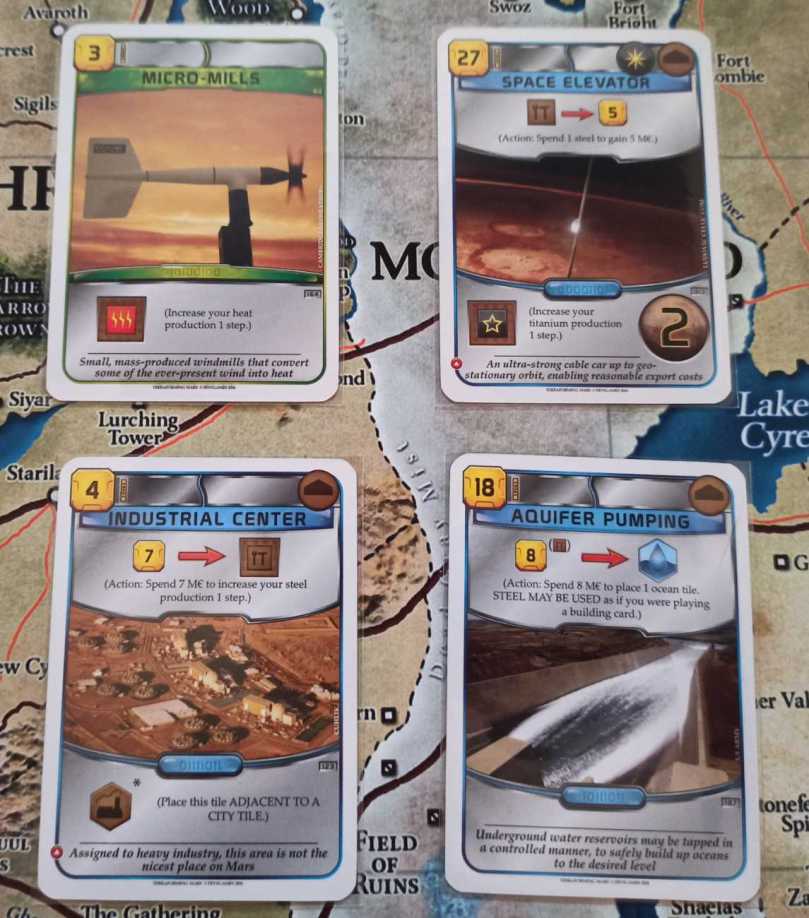
Of course, there are always mitigating circumstances – getting heavily invested in steel production and Building tags for example makes this a lot more attractive, same if you get it on your opening hand. What I want to focus on is – to think of the opportunity cost, and consider how much longer the game is going to last. If the global parameters are getting high, maybe don’t bother with that Industrial Center – and don’t even think about Micro Mills. However, when it comes to projects that also give VP, you might be willing to spend – Space Elevator might not be very useful at the end of the game, but if you have a surplus of Titanium, those 2 points might be worth it.
Speaking of game length, another trend I’ve noticed is that there are essentially two competing strategies: drawing the game out for as long as possible, or finishing it as early as possible. Of course, it depends a lot on what the card draw brings, but rarely have I found myself going on a “normal” pace – I either try to rush or stall.
As you can guess, rushing is usually easier (assuming you get some tools). While several cards can hobble your opponents, including a lot of events that destroy plants, you can’t rely on them and they don’t have that big an impact anyway. Some strong events and projects with actions that raise temperature and oxygen, or a strong beginning production of plants for example along with a corporation like Ecoline can finish a game before other players can solidify a position. On the other hand, going for the long game can give you a ton of Victory Points – the longer the game goes, the further away you rise from the other players, using projects with actions that stack VP.
Expansions & Other Products
There are a ton of expansions available for Terraforming Mars. There are alternate game boards with new Milestones and Awards, various promo cards not included in the base game, as well as bigger expansions with new mechanics. Each of these can be added or removed without affecting the others.
The simplest one is Prelude (and Prelude 2): these are pretty straightforward, giving each player 2 (choosing from 4) prelude cards at the beginning of the game. Prelude cards simply give an extra bit of production or resources, helping kickstart the game a bit faster.
Venus Next is a big one though. Sure, terraforming Mars is well and nice, but why not go even further beyond? Why not terraform Venus as well? This includes a new Global Parameter for Venus, a ton of new cards and corporations, and a new mechanic called Floaters for various projects. Floaters are used for various actions, and in my opinion, give more depth and interaction to the game.
Colonies also has a huge impact, even though it doesn’t add a whole new planet. Instead, it adds several new moons – each moon has a colony specializing in a single resource, and by sending trade fleets you can gain large amounts of it. Trade fleets use energy, titanium, or credits, so you can “exchange” for example a surplus of useless energy for a big load of plants, steel, or even cards. This can be both good and bad, as some resources that might have been bottlenecks to players are now much more easily available – games become more “explosive”, with people getting access to expensive cards they might otherwise not consider. Also, prepare for arguments – colonies build up a surplus the more rounds pass without a trade fleet visiting, so someone putting down a colony and “stealing” the buildup of resources you had your eye on is quite annoying.
Finally, there’s Turmoil – and I’ll be honest, it was one step too far even for me in terms of complexity. There are political parties, delegates to the Terraforming Committee, and Global Events – I’m sure the after a few practice games it gets smoother, but I just couldn’t find it in me to get through it. I’m not saying it’s bad – I’ve seen a lot of people saying they’ve had fun with it, but it’s just not for me, and I can’t really give an opinion on it considering that fact.
Besides the gameplay expansions, there’s also some cosmetic stuff you can buy – neat things like 3D tiles, sleeves, that sort of thing. There’s also a trilogy of books, which was interesting to find out!
You can get the expansions separately, or you can get several different bundles – there’s the Expansion Bundle with all the expansions I mentioned above, the Gameplay Bundle which is the same but with all the promo cards as well, and the Ultimate Bundle which includes the cosmetics.
If you’re looking to buy Terraforming Mars, I would suggest the Expansion Bundle. Venus Next and Colonies are good ways to add more to the game, and the Preludes are a nice bonus – I’ve made my position on Turmoil clear, but with the discount on the bundle it’s certainly a good deal. If you’ve already tried TM (for example in your LGS, or with a friend) and you really want the complete package, the Gameplay Bundle is still a great choice – it’s personally what I’d go for since the promo cards will add a lot of variety if the game has gotten a bit stale.
Finally, there’s a digital adaptation of the game available on Steam – however, with Mixed reviews and lots of complaints about game-breaking bugs and other issues, maybe it’s better to hold off on that.
An interesting piece of news I just discovered, however, is that there is a BackerKit about a Terraforming Mars TTRPG by Shadowlands Games that ended just yesterday (March 20th) – funded way above its goal of €9,000, reaching over €320,000. The Quickstart Guide is available for free, and I’m quite curious to see what the end product is going to look like.
Final Thoughts
Terraforming Mars is perhaps my favourite board game (so far). It’s fun, engaging, and strategic, all wrapped up in a sci-fi package. It might not be for everyone – the long playtime and just the sheer amount of stuff makes it a bit harder to get into or enjoy on a casual game night when you don’t want to spend a lot of focus on something, but I suggest you give it a try if you can and it might just get you hooked as well.
Join Our Mailing List
Do want…
- Extra content?
- Discounts?
- Updates about all our work?
This post contains affiliate links. By using them, you support the blog without any extra charge being applied to you.
 The Kind GM
It’s a good one, there aren’t many board games that I’ve played dozens of times and still want to break out
LikeLiked by 1 person
Agreed! It’s very replayable, every time is just a bit different and it’s fun to do different strategies.
LikeLiked by 1 person