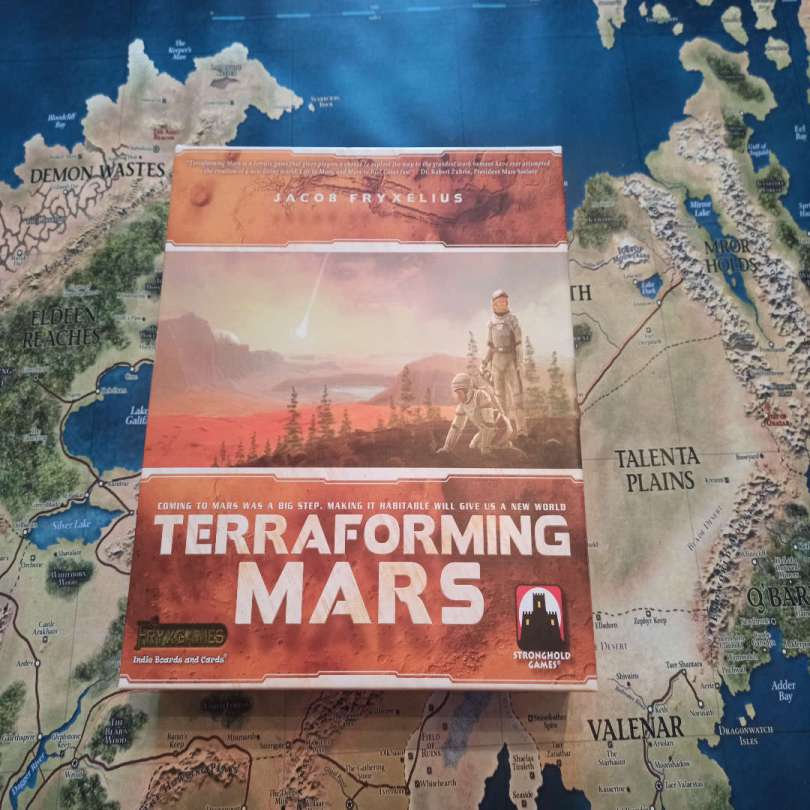
A few months ago, I wrote one of our first Boardgame Briefs about Terraforming Mars, a personal favorite. Since then it’s become a recurring post here (every third Friday of the month!) to write about board games – but today we’re revisiting TM to take a closer look at its expansions.
I touched on them briefly in the previous article, but I think they deserve a more detailed post, in case you’re curious about whether you want to include them in your games or not. Of course, the only way to be 100% sure is to try them out yourself, but you’ll have to buy them first in order to do that – so I hope this can at least give you an idea of what to expect. I wouldn’t call this a buyer’s guide though; I’m going to be talking more about the mechanics than whether it’s “worth it” to buy a particular expansion.
GAME BOARDS
Let’s start with something simple – alternative game boards. There are 3 such expansions, each with a pair of new boards:
Each one of them also gives new Milestones and Awards to mix up your play. The strange thing is that it impacts the game both very little and very much – the main strategies are the same, the cards are the same, but it can change things up completely by forcing you to readjust your thinking. I’ve found out that, especially with the base game, I’ve settled into an almost identical chain of tile placements every time; first aim for the oceans that give cards, since they’re the ones that can be taken the most easily, then for other tiles with cards, then try to aim for the tiles that give the most credits from ocean adjacency. Same goes for the Milestones – you’ll generally try to aim for Terraformer, Builder or Gardener (TR, Building Tags, or Forest tiles respectively), almost certainly ignoring Planner (have 16 cards in hand). With new goals to aim for, and new tile configurations, you’ll get some fresh games. There’s also some additional (though limited) synergy with other expansions – Terra Cimerria has a tile that lets you place a Colony cheaper, and Amazonis Planitia and Vastitas Borealis have some interactions with the Delegates from Turmoil.
I will say this, however: It’s not that hard to figure out the best tiles in the new boards either. The Elysium board has a tile that draws 3 cards, for example – that one’s pretty much your first pick 99.99% of the time. But, on the other hand, it’s still great to have some variation – you can cycle through boards and get a pretty different experience every game, if you feel the base layout of Tharsis has gotten a bit stale.
Overall, I would say that if you play a lot of Terraforming Mars, at least one of the board expansions would be a great investment to shake things up; especially if you like to play a lot of solo games. But if you play it less frequently, or more casually, the base board will do just fine.
In the same vein, you can get a pack with all different Awards and Milestones from all 7 boards in the form of tokens, without the boards themselves – then you can pick and choose (randomly, preferably) which ones you want each game. There’s a total of 35 for each (5 for each board).
PROMOS
Before we get into the expansions with actual cards in them, a quick word about promo cards and packs. There are a ton of extra cards, mainly Projects but also a few Corporations and Preludes, that you can buy either individually or as part of packs. Usually, they have some mechanics that are a bit weirder, more complicated, or perhaps outright janky (at least in my opinion): Corporations like Mons Insurance, which gives you a significant head start in credits production in addition to making all other players lose 2 credit production at the beginning of the game, but then makes you pay out those insurance policies – every time a player has resources destroyed or stolen, or has a production reduced, you pay them 3 credits. Or Martial Lumber Corps, letting you use plants to play cards with the Building tag. Or just the humble Potatoes – lose 2 plants to gain credits (and Mons Insurance better pay for those taters!!). You get my point – it’s certainly an eclectic mix of cards.
There are new synergies to be found – a new type of resource called Asteroids has a few cards that interact with it, more ways to spend the resources you already have (plants, energy, etc), and some more interactions with Animals and Bacteria resources. They can be a lot of fun… but I think most of the time they’re not really something you’ll find yourself playing, because in terms of power level they’re in the lower end (at least that’s the feeling I have).
In addition, there’s a steady stream of new ones coming out – for example, I just saw that Static Harvesting is a new promo card for autumn of 2025, automatically included in every order you make until November 30. Actually getting all the different promo cards is going to be a bit difficult though – for example, even the “full” official Promo Pack Bundle doesn’t have cards that were released solo – only promo packs. So, there’s a difference between “should you get them because they’re fun?” and “should you spend the effort to actually get them physically?”, for which the answer is probably “No, unless you REALLY like Terraforming Mars”.
PRELUDES
There’s 2 sets of Prelude expansions, Prelude and Prelude 2. They add a new type of card, the Prelude cards. Each player draws 4 of them at the beginning of the game, and choose to keep 2. They are played (for free, they don’t have a cost) as the first actions of your game, and usually give you a small bonus to a production or a chunk of resources to kickstart the game. There are also some new Project cards and new Corporations, with Prelude 2 especially adding a lot more synergy between expansions.
Honestly, I’d say that if you want to buy expansions, definitely get this one as well – it really speeds up the game, and as much as I love it, Terraforming Mars can get daunting when the hours start to drag on. It also lets you plan better – if you have some power generation from your prelude, you’ll be more open to keeping and playing cards like Electro Catapult, GHG Factories, or the City projects that all need Power. If you have a Biolab which lets you draw 3 cards, you can be more picky with your drafting and save some credits. And if you get lucky with a nice combo for Ecology Experts, which lets you play a card ignoring its global requirements, you’re set for a good game.

I only have 2 more honorable mentions here. First, a new corporation: Point Luna. This is honestly my favorite one, because it’s probably the strongest. Every time you play an Earth tag, you draw a card. Earth tags are some of the most common, and with several options to reduce their cost – so you can chain a bunch of cheap, powerful cards one after another and get some truly explosive turns. Combine it with some Earth preludes, and once again you’re set for a great game (for you, other players’ opinions may vary). Second, a prelude from the promo sets: Merger. You pay 42 credits, and you get a second corporation. Honestly this might not even be that good – but it’s certainly a ton of fun, and I’d even suggest you run a game where every player has Merger!
Finally, there are some changes to the Solo Mode – if you’re playing with Preludes, you have only 12 generations to finish instead of the standard 14. Understandable, really. However, there’s also an additional option – instead of aiming for completing all the global parameters, you can instead aim for a Terraforming Rating of 63. You also get a new Standard Project that increases TR by 1 for 16 credits. Honestly I prefer this second win condition – I think technically it’s more TR that completing all the global parameters, but it’s certainly easier to fulfill in my experience since sometimes you may get stuck on a particular one – usually Oxygen, as it’s also the most expensive to raise if you’ve gotten unlucky with plant production.
VENUS NEXT
Now we’re going into the real changers. Venus Next is, as the name implies, an addition that lets you terraform Venus as well. Let’s take a look at the main mechanics one by one.
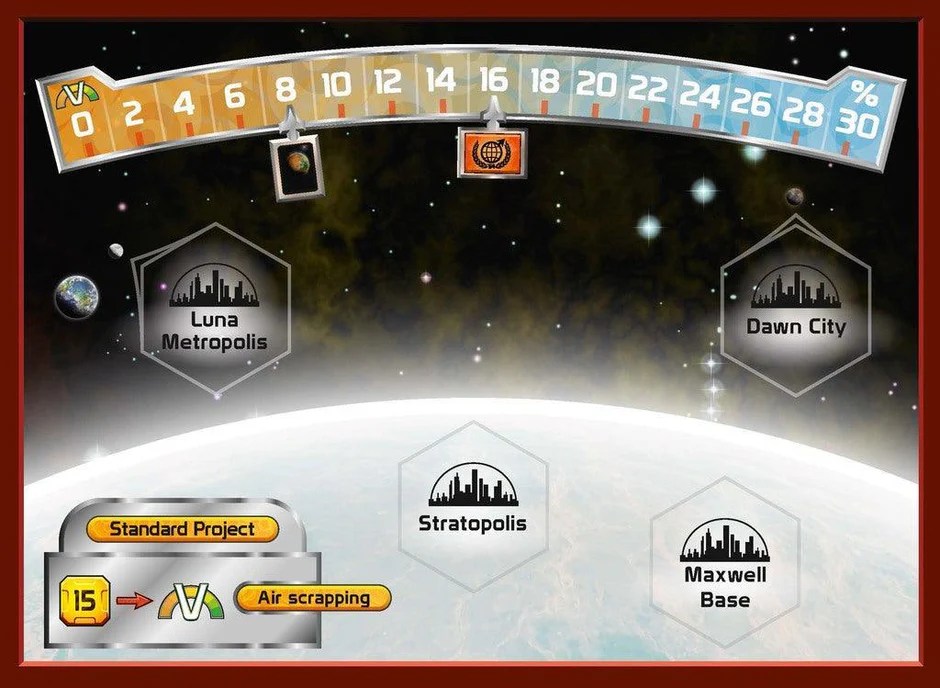
There’s a new global parameter which tracks the terraforming process – from 0% to 30% in increments of 2, so 15 steps in total. At 8% you draw a card, and at 16% you increase your TR by 1. You get a standard project to increase Venus terraforming by 1 step with 15 credits. Pretty simple overall; it’s a good way to get some extra TR, and ALWAYS keep an eye out for that 8% – try and get that card! In addition, it’s not necessary to max this out for the game to end (though you can treat it as mandatory as well if you want to).
As for the project cards and corporations, many of them are focused around a new resource/mechanic called Floaters. Floaters are a resource token (like microbes, or animals) that is spent for various act ions – for example, Deuterium Export lets you spend a Floater from it to increase your energy production by 1. Cards that spend Floaters can also add them to themselves – for free, or by paying (credits or titanium, mostly), but there are also cards that generate Floaters for other cards: Floating Habs lets you place a Floater on another card, or on itself for Victory Points. The actions can be quite powerful, the issue however is that you are hesitant to buy a floater card if you don’t already have the support for it, since you’ll need to spend every other turn generating the Floater for it, and that you’re also hesitant to buy cards that generate floaters if you don’t already have a sink for them. And with how big the deck is, you’re not very likely to get them both – there’s only 7 cards that actually use floaters, 8 if you include a corporation and maybe getting up to 18 I think if you add all the other expansions as well (Colonies mainly, with a couple of Promos too). This out of a deck that can reach 300+ cards. So while i think that as a mechanic it’s very nice, and I really enjoy it when it works out, it’s not really reliable – there’s a corporation that lets you tutor for Floater cards at the beginning of the game, but even so, not very likely to hit something good – and then your gameplan sort of falls apart.
Finally, there’s also a new phase each round – the World Government Terraforming. At the end of each generation, the active player chooses a global parameter and increases it by 1 step – not getting any bonuses such as TR, or if it hits a specific milestone (like putting an ocean at 0 degrees). The addition of Venus can obviously drag the game out, so this is sort of a counterbalance – as long as you remember it; I know I’d probably forget it every time.
Overall, I like this expansion – I just feel it needed something more. More floaters, perhaps; I wouldn’t say more cards, because it already has about 50ish new projects, but it feels a bit disjointed and diluted when combined with the main game.
COLONIES
Colonies is my favorite expansion of the bunch. It adds a new mechanic that’s always available, and it’s a godsent for trying to balance out your productions, letting you get a LOT more flexible with your builds. Sort of like Prelude, which I mentioned I already like a lot, but even better – though it needs some investment.
The main aspect of this expansion is trading. There are 11 Colony tiles, mostly on moons – Io, Titan, Luna, etc, as well as Ceres and Pluto. Each colony focuses on a specific resource: Io for heat, Luna for credits, Ganymede for plants, et cetera. At the beginning of each game, you randomly draw a number of tiles equal to the number of players +2 (or 5 tiles, if playing with 2 players) – these are the colonies that will be in play. Then, each player gets a Trade Fleet token, with one of their player markers inside it to mark who owns which.
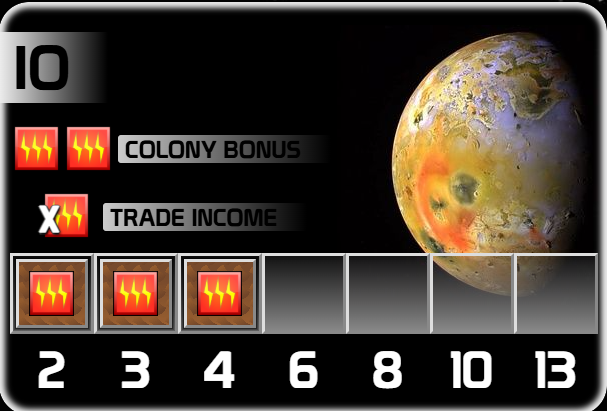
Trading with a colony is an action – but not a standard project. To do so, you pay the cost (3 energy, 3 titanium, or 9 credits), then take your trade fleet and put it on the colony tile you want. Each colony can only get one trade fleet per turn – so you block other players from trading there. Now, what do you get when you trade? Well, it depends on where the marker (a different marker, a white cube) is on the colony track. Each turn, it advances by 1 on the track, increasing your profits – and returning back to the start when someone trades. For example, Io: When you place the colony tile at the beginning of the game, you also place the marker on the first block of the track. That means that if you trade right then, you will get 2 heat. If the marker gets to the 5th block of the track before you trade, you get 8 heat, etc.
That’s the basic trading – however, you can build your own colonies on each colony tile. That’s a standard project costing 17 credits, and there are also cards that let you do that. When you place a colony, you put a player marker on the leftmost available block on the track, and get the bonus you see inside that block. In our example, when you put the first colony on Io, you gain 1 heat production – and now that the first block is “occupied”, when someone trades, the colony marker goes back to the second block. In addition, however, when anyone trades with Io, you also get the Colony Bonus – so 2 heat. So you can actually build colonies and never even trade, and profit off other players. The catch is that each player can only build 1 colony on each tile – you can’t build a second one (well, you can, but only with a couple of specific cards) – and there can only be a total of 3 colonies in each tile. A bit complicated in the beginning, but once you make sense of it it’s actually pretty simple. Finally, for the trading mechanic, there are also a couple of cards that give you additional trading fleets, that let you trade more than once per round.
With all that out of the way, why do I like it so much? Well, as I said, it lets you tune your build, diversify your production, plan better, and it also adds another layer of both strategy and tactics to the game. If someone is looking like they’re going to trade a lot, you an build colonies and passively get rewards (as i just mentioned). If someone is aiming for a specific colony and you’ve got some energy to spare, you can trade with it first and block it. And the main purpose of them, if you’re desperate for a specific resource, colonies gives you a sustainable source of it – as long as you don’t mind paying.
There’s some additional support for Floaters, with some new cards as well as the colony on Titan (which gives floaters when you trade), but as I mentioned on Venus Next it’s not enough to really make them that more attractive – even though the steady supply through Titan is probably the best thing that could happen to them, the deck is still too sparse to make it a reliable build. Similar to Titan, there are a couple of colonies that you’re either VERY happy to see, or are complete duds – Enceladus gives microbe resources, and Miranda gives animal resources, so they’re either a ton of VP for someone or no one will bother with them. Pluto, on the other hand, gives card draw, so it’s easily the one you want every game.
Overall, this is the perfect addition to the game in my opinion – if you want just one expansion to get, it’s this one.
TURMOIL
Oh boy, Turmoil.
I’ll be honest – I can’t give an objective review of it because I only managed to figure out exactly how it’s played while writing this review. It’s just one step too far in terms of complexity for me; and even if it was simpler, the extra friction it adds to an (already pretty long) game would make it something I’d avoid regardless.
In short – Turmoil adds politics. There’s a new board (not a map – more of a parliament) of the Terraforming Committee; in, it, players send Delegates to the various Parties, trying to influence policy. In addition, there are new Global Events – every turn, each player is affected with the same (positive or negative) effect, which can be mitigated or improved according to their Delegates.
To get into a bit more detail; there are 6 parties, each with their own focus. Each party has a Ruling Policy and a Ruling Bonus; the bonus occurs for all players whenever the party gains power, and is in most cases a small sum of Megacredits, depending on the number of specific tags. The Policy is either a “passive” effect while they stay in power, or an action available for everyone.
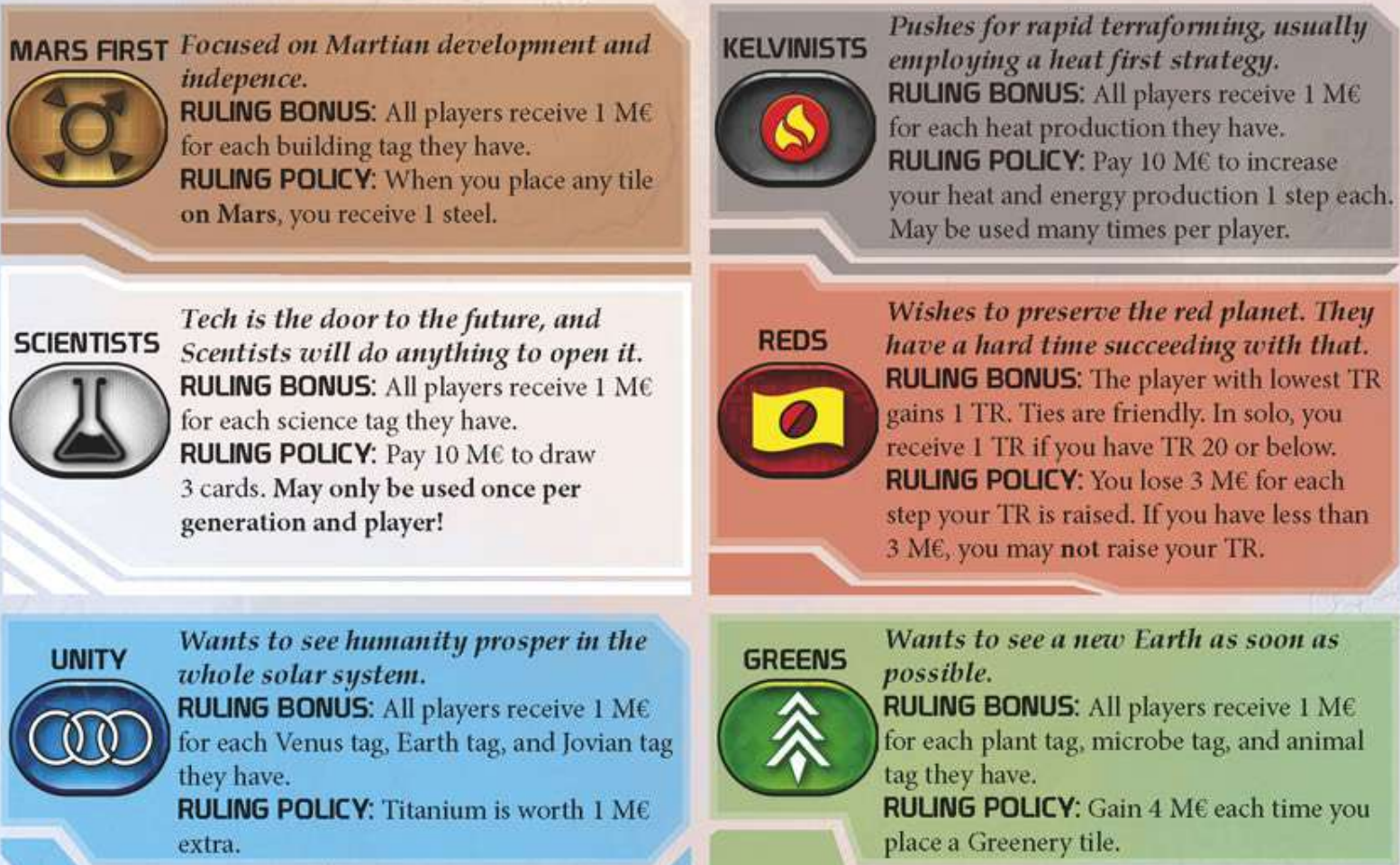
You can see the Policies and Bonuses on the image to the right -and pay special attention to the Reds. Their ruling policy is that whenever someone increases the Terraforming Rating, they must pay 3 credits – perfect for someone who has a ton of action cards that stack VPs (stuff like the Animal cards or Security Fleet etc), and who wants to stall the game as much as possible, but it can turn the game into an unbearable grind – and that’s before we get into the fact that with Turmoil, everyone loses 1 TR every round automatically. Yep. Prepare for double-digit hours of Terraforming!
On top of all that, you now have to keep track of where everyone puts their Delegates, as well as what Global Events are coming; and when a Global Event is revealed or is activated, that’s when the Neutral Delegates come into play; one of them is placed to the appropriate party shown in the Event card. That’s not even getting into how to accumulate Influence, another mechanic – if you have he Chairman, the Leader of the dominant party, or a delegate in the dominant party, you get 1 influence for each, to a maximum of 3; and as I mentioned earlier, this lets you mitigate the impact of bad events or further exploit the good ones.
So overall, rather than feeling like a natural expansion to the game, it feels more like an entirely different minigame stacked on top. And it’s also one that you have to engage in; with Venus, or Colonies, you can ignore them even if they are in game, but Turmoil is so intrusive and disruptive to the normal play that it feels like it almost overtakes the base terraforming – not necessarily in terms of cards or even actions, but in sheer attention and brainpower to keep track of it. Personally, I don’t like playing with it; I don’t consider it bad from a mechanical standpoint, but it just doesn’t fit.
Final Thoughts
There’s certainly a whole lot of extra stuff to buy if you like Terraforming Mars. There is also one additional expansion I did not cover, Automa, which completely changes the way solo games are played; but I don’t have any experience with that one, so I can’t really give an opinion. Personally, I can suggest everything except Turmoil – and there are also big bundles with all expansions included; the Expansion Bundle, Gameplay Bundle, or even Ultimate Bundle.
I’m curious – if you’ve played any of these expansions, which ones are your favorites? Is there one that is always included in your games?
Join Our Mailing List
Do want…
- Extra content?
- Discounts?
- Updates about all our work?
This post contains affiliate links. By using them, you support the blog without any extra charge being applied to you.
 The Kind GM
Interesting, I’ve not played Colonies sounds like a good addition
LikeLiked by 2 people
Colonies is a really nice addition. It adds another layer of complexity as you need to be aware of a lot of things happening, but this isn’t necessarily a bad thing.
LikeLiked by 1 person