A few months ago, I wrote about Slay the Spire. Today, I’m revisiting it to talk a bit more about the various archetypes you can build each character around – starting with the Ironclad.
I’m going to assume that you haven’t played the video game; I might make references to it occasionally, but to be honest, it doesn’t affect anything. I will assume, however, that you’ve played the board game and are familiar with the mechanics, and that you’ve unlocked all the cards (or the cards for the specific characters, at least).
I’m also going to talk about “good” and “bad” relics and cards. Most of the time, “bad” means “you won’t be able to take advantage of their special upsides”, not “unplayable” – as for “good”, there are some cards that are so good that you’d pick them every single time you saw them, so I don’t think I need to mention them every time.
Ironclad
So, the Ironclad. He is perhaps the most straightforward character, and quite forgiving too. His starting relic, Burning Blood, heals you for 1 at the end of each combat; this lets you be more aggressive, and also synergises with some of his cards. His cards are also relatively simple: deal damage, gain block, draw cards – with his “signature” effects being strength and vulnerable. He starts with the standard Strike and Defend cards, as well as Bash; for 2 energy, it deals 2 damage and applies a Vulnerable, which stays strong throughout the game.
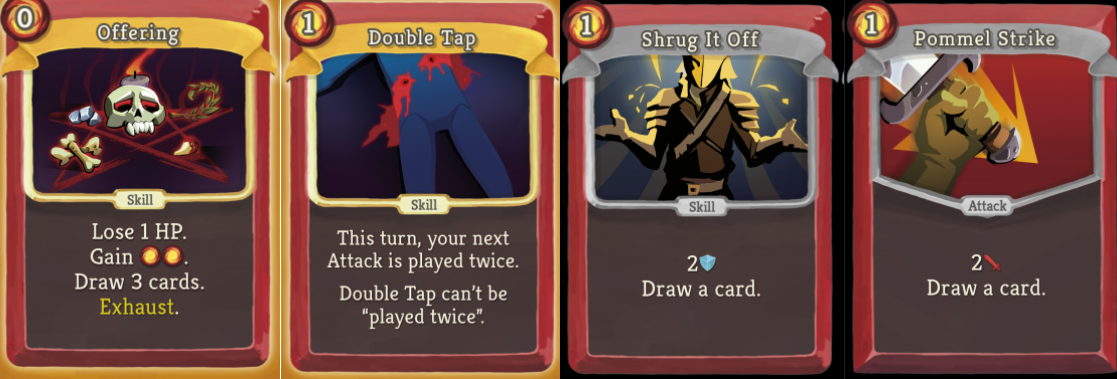
The good thing with Ironclad is that you can easily make a “good stuff” deck. Most cards are pretty good on their own and can go in any type of deck; particular standouts are Pommel Strike, Shrug It Off, and Battle Trance. And Offering is, of course, a card that can be picked at any time you see it, regardless of build. However, there are also some pretty good synergies to go for, if you get the core parts early enough.
Strength Stacking
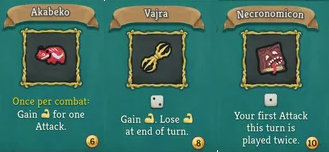
The most straightforward, full-on attack build. Besides strength-granting artifacts like Vajra and Red Skull, there are also several cards on the Ironclad that can give you (temporary or permanent) strength: Flex, Spot Weakness, Inflame, and Rupture in the normal rewards, and Demon Form, Feed and Limit Break in the rares means you’re quite likely to see one – though the rare ones are a bit more niche. Demon Form takes a turn to ramp up, Limit Break needs you to already have at least 1 strength, and Feed needs to kill an enemy, though a 3 damage for 1 energy is a great card all on its own.
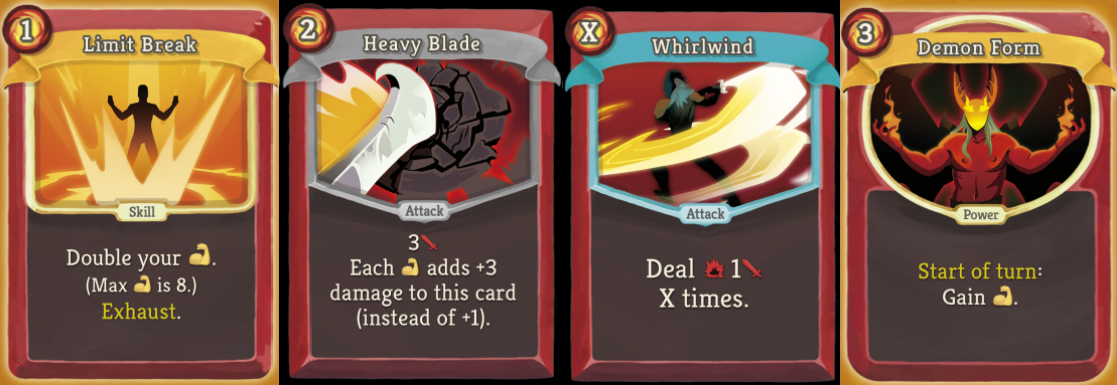
Again, strength is generally good on its own – with a couple of strength, even the basic strikes start hitting pretty hard, and with a vulnerable from Bash, you can really mow down some normal battles quickly. Twin Strike and Cleave are particularly effective, benefiting from multiple applications of strength, but the real winners are Heavy Strike and Whirlwind. Heavy Strike gets 3 damage from each strength (5 if upgraded), which means that in a dedicated build, with 4 strength (which isn’t too hard to get), it’s 23 damage with one attack – if the enemy has vulnerable, it goes up to 46. So it’s a real boss killer, especially if you’ve kept your deck thin and can just go at it again next turn – this is where a Headbutt also shines. In contrast, Whirlwind is a better Cleave, so it obliterates fights with lots of minions easily; good to have against bosses that resummon like Gremlin Leader or The Collector, or even the Sentries. Fiend Fire also benefits from strength a lot, and can be very tempting as well as it burns away useless cards in your hand, but usually your rare rewards are quite contested.
The main weakness of this deck is the lack of survivability. You need at least a turn, probably 2, to draw what you need and get your buffs together, and that means eating several attacks. It’s not that bad, though; as I said, the Ironclad heals on his own, and with just a couple of nice block cards like Shrug It Off and Impervious, you’ll be mostly fine; in addition, while a few upgrades are critical, you don’t need all that many and can instead Rest and campfires to regain more HP. And of course, depending on your luck, relics can also ameliorate a lot of issues.
Overall:
- Top Cards: Heavy Strike, Whirlwind, Limit Break, Double Tap
- Top Relics: Akabeko, Vajra, Necronomicon
- Good Cards: Flex, Rupture, Spot Weakness, Demon Form, Headbutt, Cleave, Twin Strike, Fiend Fire
- Good Relics: Mutagen, Red Skull, Ninja Scroll, Pen Nib*
- Bad Cards**: Bludgeon, Perfected Strike, Wild Strike, Carnage
- Bad Relics: Nothing that’s anti-synergistic, just the ones you can’t use.
*Pen Nib can be on any player – not necessarily on you.
** By “Bad Cards” I mean ones that don’t synergise that well – attacks with high cost and high base damage aren’t ideal because we want to instead spend that energy building up strength and having more cost-effective attacks that utilise it. An upgraded Heavy Blade with just 1 strength outperforms most of these.
Pros:
- Probably the best single-target damage dealer (perhaps behind Watcher)
- Excellent area damage as well
- Lots of ways to get there
Cons:
- Squishy, so needs either good block relics or a partner that can give him block
- Needs a small deck to get the strength online quick and get going
Block Stacking
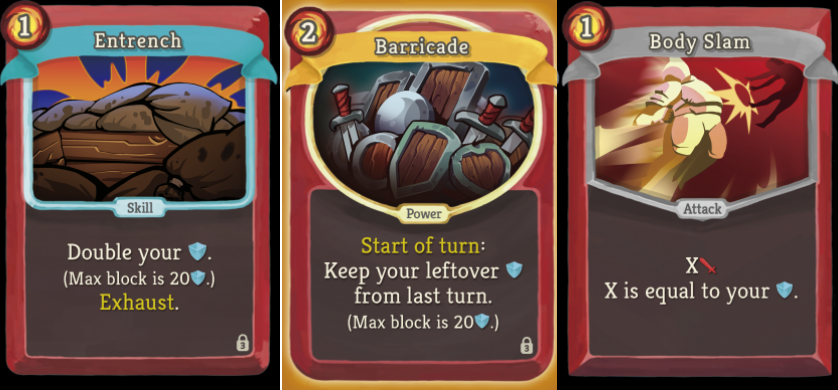
This is a great build, but it requires more specific cards to function – so it’s more dependent on a bit of luck to get it together. The premise is simple: Stack a ton of block, and deal damage based on that block. The best cards for this are two: Barricade from the rare rewards, which lets you keep your block between turns, and Body Slam, which deals damage equal to your block. You’ll still need ways to generate block, of course, and here’s where Shrug It Off shines again, but you’ve got other options as well; Entrench, Metallicize, Power Through, and True Grit Impervious are all excellent – pretty much every one of the Ironclad’s block cards are fantastic. Barricade isn’t strictly necessary, but it really makes the build smooth to play – Body Slam is pretty important though, as it’s your main (if not only) way of dealing damage. Juggernaut might be tempting, but that energy is better spent in other ways, in my opinion, as the damage doesn’t scale that well.
This sort of “Fortress” build also lets you conserve your health, letting you spend it in other ways; primarily casting Offering if you’re lucky enough to get it, but otherwise also letting you pay life at certain events while still getting to Smith at campfires, healing up after each combat from Burning Blood instead. It also lets you play a more supportive role with other players; get your block up to max, or at least high enough, and you can then shield the others and let them dish out the damage unimpeded.
This type of build also benefits a lot from some cards from the following archetype, but I’ll talk about that in more detail a bit later.
Overall:
- Top Cards: Barricade, Body Slam, Impervious
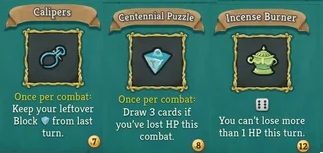
- Top Relics: Calipers*
- Good Cards: Ghostly Armor, Shrug It Off, Entrench, Power Through
- Good Relics: Captain’s Wheel, Horn Cleat, all the Block relics pretty much.
- Bad Cards: Blood for Blood**
- Bad Relics: Centenial Puzzle**, Self-Forming Clay**, Orichalcum, Incense Burner, Blood Vial, Regal Pillow
* Functions as a decent alternative to Barricade if you haven’t found it yet, or even if you’ve found it but you tend not to draw it right away.
** Special cases; these can be amazing if you’ve found a way to self-damage like Offering, but otherwise you’re maximising defence so you won’t be able to take advantage of them that often.
Pros:
- Pretty much unkillable after the first turn
- Can skip resting most of the time to smith
Cons:
- Struggles early on, lacking damage
- Needs 2 very specific cards, one of them a rare, to be fully functional
Exhaust
Now we’re getting into a bit more niche archetypes – you’ll have to get several cards to truly have exhaust as the core mechanic of your deck, but I can’t deny that it’s a whole lot of fun if you manage to gather the proper pieces. So for this deck, you need three things: first, you need a way to exhaust cards. Second, you need a way to have a payoff from the exhaust. Third (and perhaps less important) is a way to generate extra cards as fuel to exhaust.
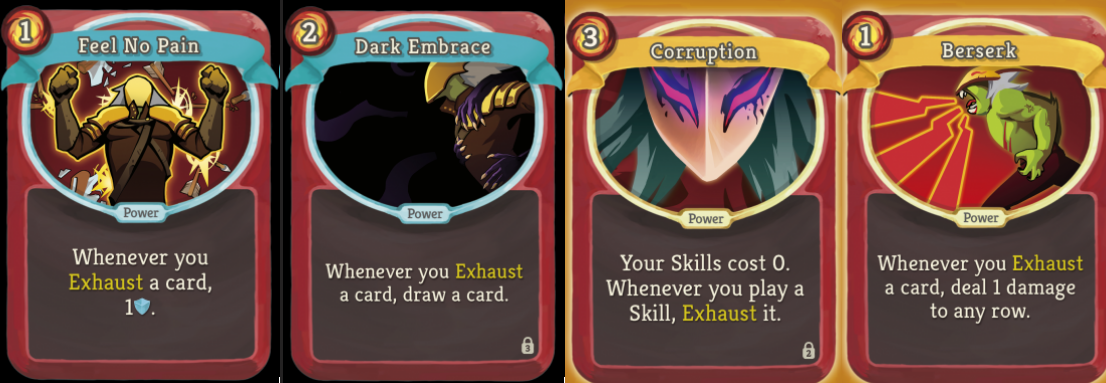
The first part has several cards that can help: lots of cards exhaust on their own, and you also have True Grit, Second Wind, Burning Pact, and Havoc in your normal rewards, along with Fiend Fire in the rares. And of course, there’s always Corruption. So that’s not that hard to get; you have options. The second part is perhaps the trickiest – you now need to have something that lets you take advantage of exhausting. There are 3 powers we’re interested in here: Feel No Pain gives you block, Dark Embrace lets you draw, and Berserk deals damage. Dark Embrace is a favourite – drawing cards means more fuel to exhaust and more ways to trigger exhaust, and paired with Corruption, it can usually let you go through your entire deck in one turn. The downside is that after that big turn, you’re left with nothing, so you’d better hope everything died already.
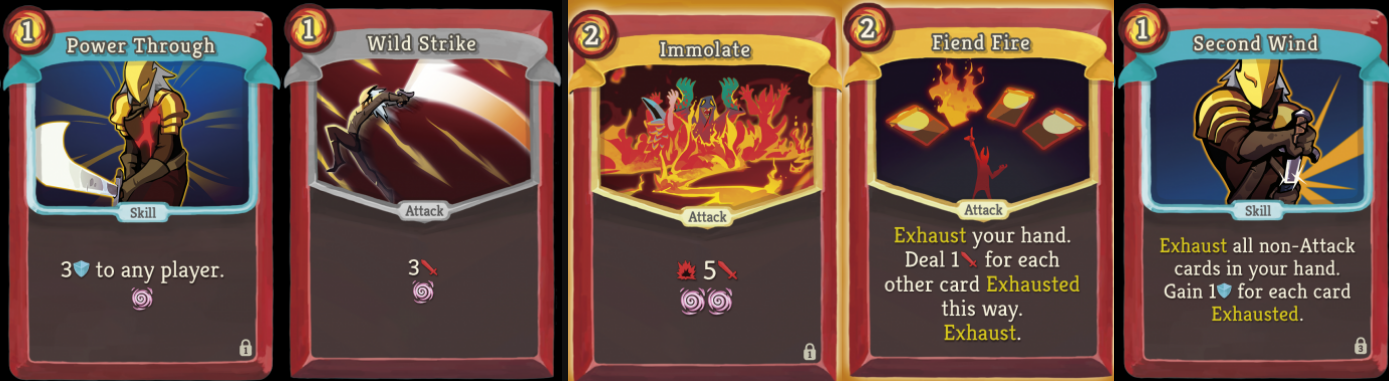
And this is where the third part comes into play: generating cards to be exhausted. You’re pretty limited in options here. You’ve got Power Through, Wild Strike, and Immolate – and Snecko Eye, but that’s a boss relic and one with a random outcome at that. But having even one of these is going to be a decent addition for a bit more consistency, even when you’ve blown through most of your stuff. In addition, they make Evolve a lot more tempting too; and Fire Breathing as well, but that’s more of a bad substitute for Berserk. Something to keep in mind as well, though, is that you can lean a lot more into curses as well: You don’t plan to keep them in your hand anyway, so it’s extra fuel that you can use.
I mentioned above that lots of cards here could fit in a full block build, and that’s true – Feel No Pain, Second Wind, True Grit, and Impervious are all excellent block cards, and since there’s plenty of exhaust going on, tossing a Dark Embrace for extra draw can also be great.
Overall:
- Top Cards: Corruption, Dark Embrace, Feel No Pain, Berserk
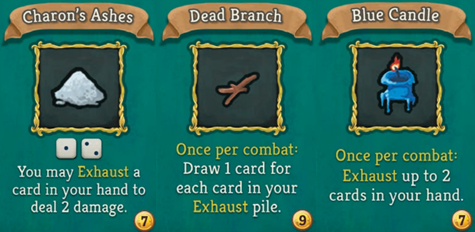
- Top Relics: Dead Branch, Charon’s Ashes, Blue Candle
- Good Cards: Burning Pact, Havoc, Power Through, Second Wind, Sentinel, True Grit, Fiend Fire, Seeing Red, Rampage, Offering
- Good Relics: Cursed Key, Snecko Eye, Du-Vu Doll
- Bad Cards: Nothing in particular; even bad cards can just be used as fuel for exhaust.
- Bad Relics: Omamori*
*Again, not bad, but you can leave it for someone else since you can actually use the curses.
Pros:
- A lot of fun. Chaotic.
- A good mix of offense and defense.
Cons:
- If you run out of things to exhaust, you’re done.
- If you have too many things to exhaust, you don’t draw your important cards reliably.
Good Stuff
Not quite an archetype, but the ironclad pulls it off better than the other characters, in my opinion. Just pick good cards and go for it – no particular theme, a little bit of everything. I guess you could also call it “Big Stuff” – this is where you’re probably picking cards like Rampage, Clothesline, Bludgeon, Immolate, and Uppercut.
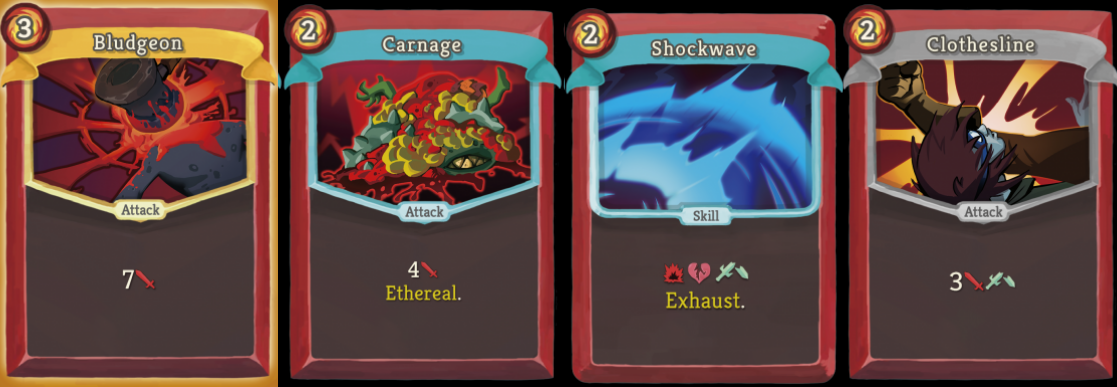
You might get a little bit of strength, or some exhaust synergy as well; but you’re likely not committing to a very specific playstyle. For example, if you get an early Golden Ticket with Bludgeon, it’s a great way to blast through the first Act; and if you don’t get anything specific that further pushes you in a direction, you’ll have to make do with cards that are generally good but don’t have the potential to be amazing.
Overall:
- Top Cards: Bludgeon, Uppercut, Carnage, Shockwave
- Top Relics: None? All?
- Good Cards: Clothesline, Headbutt, Demon Form, Immolate, Rage
- Good Relics: All
- Bad Cards: Clash, Body Slam, Rampage
- Bad Relics: None
Pros:
- Good early on (well, most decks during Act 1 would qualify as this type)
- Versatile – can even transition out of it
Cons:
- Falls off – might not have what it takes for Act 3
- Lots of random cards – if you want to pivot to a different deck, you’ll have to remove a lot
Final Thoughts
Overall, the Ironclad is a solid character throughout the game – and usually the simplest one, so ideal for new players. Something to always keep in mind, though, when building your deck (and this goes for all characters) is that once you see a card in a reward, if you don’t pick it, you generally don’t expect to see it again. Commons have an extra copy, but your important combo pieces are a 1-of. So if you see a Barricade early, for example, and don’t take it, you should know that if you go for a block build later, you’ll have to do without.
Next time, the Silent; one of my favourite characters in both the video game and the board game.
If you are interested in purchasing Slay the Spire, it is currently on sale on Miniature Market.
Join Our Mailing List
Do want…
- Extra content?
- Discounts?
- Updates about all our work?
This post contains affiliate links. By using them, you support the blog without any extra charge being applied to you.
 The Kind GM
where is part 2???
LikeLiked by 1 person
Part 2 isn’t out yet, but we’re going to cover all 4 characters!
LikeLike