Continuing this series of Slay the Spire-focused posts, last time we examined the Silent; now it’s time for the Defect.
It’s been a while since our last post in this seires, but we’re back. Before we get into the Defect though, there’s a couple of Slay the Spire-related news I’d be remiss to ignore.
First of all, earlier this month we had the release of the much anticipated Early Access for Slay the Spire II on Steam. I haven’t gotten the chance to play it myself yet, but from what the general consensus seems to be, it’s going great so far – and hopefully any issues that crop up will be dealt by the time the full release comes. A huge new addition is multiplayer co-op, with up to 4 players – somewhat like the board game, although all players fight the same enemies (and not different “rows”), plus you can also have multiple of the same character. As an aside, the first Slay the Spire is also on a 75% discount at the moment, so if you’ve enjoyed the board game and haven’t played the original, it’s a good opportunity to grab it for cheap.
Secondly, it’s not exactly news as I remember this being announced several months ago (if not years), but the date is approaching for the Downfall boardgame expansion Kickstarter to launch on March 24th. Based on the very popular mod for the videogame, it’ll bring 4 new characters: the Hermit, as well as the three bosses of Act 1 (Hexaghost, Slime Boss, and Guardian) as playable options. I’m curious to see if we’ll get any new mechanics, or how compatible it will be with the base game – from what I read online, you can mix and match the characters, but can you play Downfall without having the base game, or is it required? I know it’s called an expansion, but from the promotional material I’ve seen so far, the boxes are roughly equal size (which, ow, my back – I’m already feeling the strain of carrying the base box).
The Defect
Anyway, let’s get back to our main topic – the Defect, a combat automaton which became self-aware. This one is Chris’ favorite, and I can’t deny I enjoy playing it very much as well. Reminder for its core mechanic: you can channel up to 3 orbs. Lightning orbs deal damage at the end of your turn and more damage when you evoke, Frost orbs do the same but for block, and Dark orbs only deal damage when you evoke but scale with how many powers you have.
The defect is perhaps the hardest to talk about in terms of distinct, separate archetypes. You might say that you can split it into Orbs and Attacks, but that’s a bit too open-ended, and you can seperate that into sub-categories as well; even making a distinction for the separate orbs isn’t really correct, because you can work perfectly fine with 2 or even all 3 of them together – and you can also work with a half-orb half-attack deck, utilizing both. So, unlike the previous 2 posts for the Silent and the Ironclad, I won’t have as strict separations between archetypes, because the borders are quite fuzzy. Perhaps you already noticed this trend – the Ironclad was very well defined archetypes, the Silent had a bit of overlap with each other and had more cards that could be used in every situation, and now the Defect has a ton of generically good cards – spoilers, but the Watcher also follows this, with several cards that you can always consider taking. In truth, I’d say we’re starting to shift from archetypes more to the characters being specialized due to their unique mechanics; the Defect really wants orbs, so a bunch of cards that affect all types of orbs will always be good. The Watcher has her stances, and… well, we’ll get to that in the next post, let’s not get ahead of ourselves.
So that means that I can’t really have 3-4 clearly defined sections. Everything else can sort of mix together in an amorphous mass, and while of course you can specialize to a degree, most of the cards are the same across specializations; each section would just start with the disclaimer “you already know 90% of the good cards, so here’s 2 or 3 cards for this specialization”. In that sense, there’s not really a need to go over the “good” cards, because almost all of them are almost always good. For example, let’s take a look at card draw.
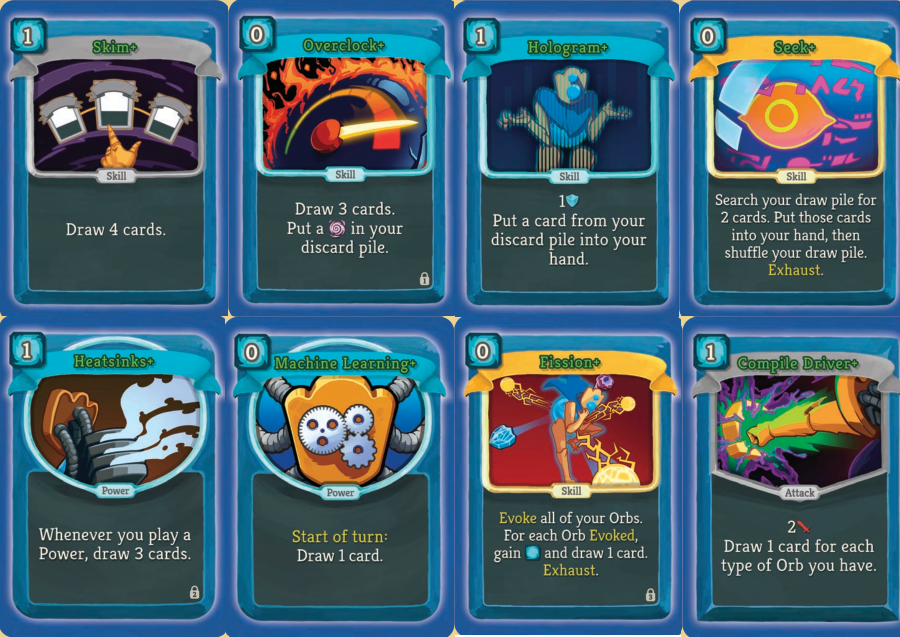
The Defect has a LOT of different ways to draw, and draw a lot of cards too; Skim and Overclock are top tier, and personally I’d put Overclock as the #1 – 0-cost draw is just so hard to beat. Seek and Hologram aren’t technically draw cards – but Seek is arguably even better and can be always taken, although as I’ve mentioned plenty of times (and will continue to mention) in the rare slot it competes with more specific but also more impactful cards. Hologram on the other hand is an uncommon that can also fit in every deck and gives you some great utility – and the block also helps, though it’s not the main reason you play it. Heatsinks is conditional, but pretty much every Defect build benefits from powers; though you’d prefer to already have the ones you want and pick this up as an extra bonus, rather than take it early and hope for the best. Finally, Fission is amazing if you stack enough orbs, but it really needs an upgrade to reach its full potential.
Now we get into the mediocre draw cards – not bad ones, because I don’t think the Defect has them, but they’re more like stopgaps or early pickups rather than something you’d always at least consider. Compile Driver is 1-2 cards most of the time, but it can still work as a sort of replacement for Skim if you’ve got all types of orbs. As for Machine Learning, it looks like an always pick at first glance, but it really depends on how long you expect each fight to take, since it essentially starts paying off 3 turns after you’ve played it: The turn you draw it, it takes the place of another card you could have drawn; on the second turn after you’ve played it, it replenishes the draw it “ate”, and on the next turn onwards it’s a net positive. And if you don’t draw it on the first turn, it takes even longer; but it helps with Power synergies and if you have Heatsinks out it replenishes itself right away. Sweeping Beam is pretty good, but not because of the indivudual elements – AoE and card draw – but their combination; it’s not great at either, but in one card for 1 energy it’s a solid generic card. Coolheaded is another one like this; you don’t take it for the card draw, but if you like frost orbs, it’s a good source of them with the draw on top. Perhaps the worst card in this category is FTL, and it’s because ot has a very narrow activation requirement; and even that isn’t a bad card, considering it’s a 0-cost attack.
I could go on about other cards as well – energy production, block, utility, et cetera – but then i’d have to mention every single Defect card and that would be too much. Instead, let’s just take a look at the various different archetypes (let’s go back to this word, even if I said it doesn’t apply as strictly as the other charcters).
Lightning Orbs
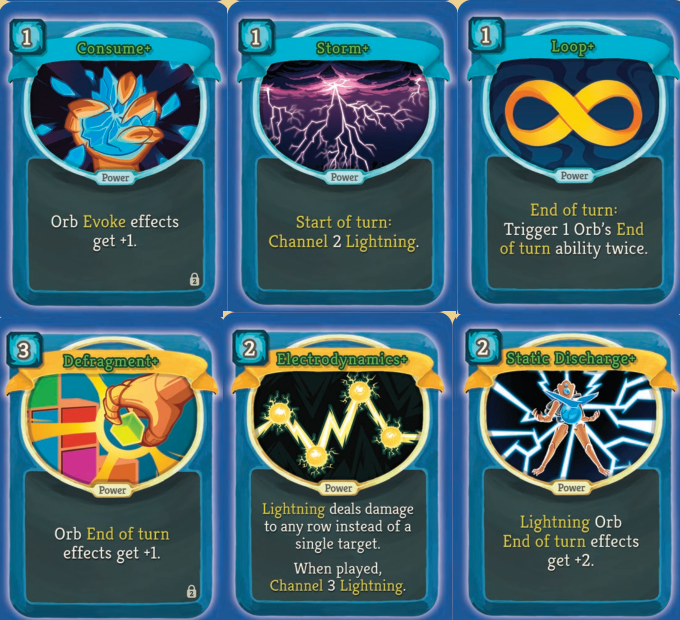
This is the archetype with the most support, and the one you’ll gravitate towards most commonly as it’s the easiest to build around. You already have Zap, and there are tons of ways to generate more lightning orbs – and to increase their damage. You also have lots of rare cards to help you, and while that’s bad on one hand because you won’t get to use all of them most of the time, it’s also good because it means your rare rewards have a much lower chance to be a miss. Defragment is of course great for most orb builds, but you also have Electrodynamics and Static Discharge, and Thunder Strike – as well as Fission and Multi-Cast. For non-rares, you have more powers like Storm, Loop, and Consume – Capacitor is a bit of a strange one, because if you precer to channel lots of orbs to evoke them it’s sort of bad because it takes up more effort to reach the max, but it also means more end of turn effects – in the end, depends on what you focus on more.
Pros:
- Lots of damage – evoke has even more, while end of turn lets you focus a bit of defense and let the orbs do the work (a bit like poison)
- Easy to build with lots of support
Cons:
- None, really? It’s simple, easy, and strong.
- Perhaps the biggest weakness is that it needs a couple of turns to set up all the powers and fill up on orbs
Frost Orbs
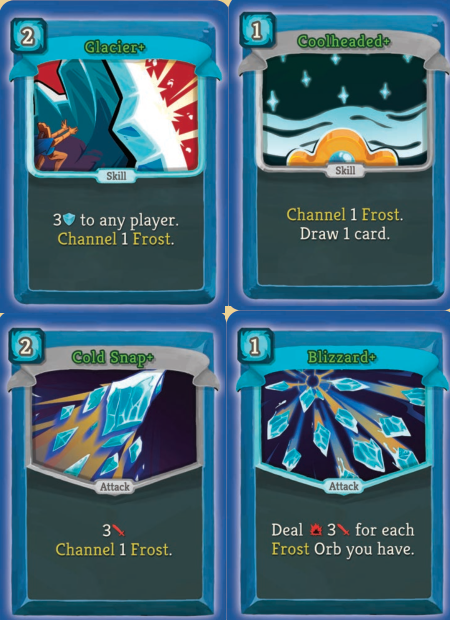
On their own, frost orbs are generally not that good. Sure, you can get a ton of block, but the only payoff for them is Blizzard, a single uncommon. They also have less ways to channel compared to Lightning; Cold Snap, Coolheaded, and Glacier. They’re good as more of a defensive supplement to Lightning Orbs, rather than their own full investment. You still want most of the same cards though – Loop, Consume, Defragment, Capacitor, Recursion. It’s also decent if you’re going for a more of an attack build, without aiming for 0-cost (which are up next) – getting stuff like Barrage, Melter, Streamline, or Meteor Strike and relying on your Frost for block rather than skills.
Pros:
- Massive defense (obviously)
- Lets you do other things while handling the block
Cons:
- Can’t do much on their own
- Needs you to do other things to handle the damage
- Low number of cards
0-cost
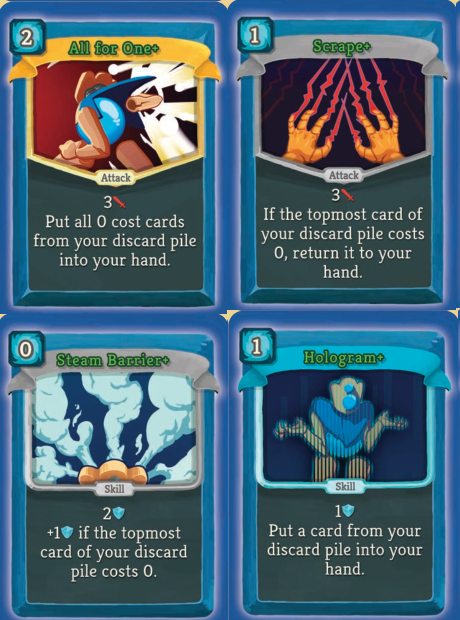
The defect has several cards that cost 0 energy, and also cards that care about them. Most important of all is of course One for All, giving you massive value and really is a core enabler of this type of build; play all your 0s, then get them back and go again. If you have enough energy, you can then play Hologram, get One for All back, and do it a third time – even though 0-cost attacks generally don’t do much damage, at a certain point you’re just playing so many of them it works out. You definitely want Scrape and Steam Barrier as well, plus Turbo for lots of card draw. However, you can go into 2 (or 3-ish) different directions with this.
The first is to go for attacks: FTL, Go for the Eyes, Claw (of course, Claw is the Law) – upgrading your strikes is also a bit better than the other classes because instead of dealing 2 damage, they cost 0 energy instead. Reprogram is also amazing in this case, because you’re not really caring about orbs that much. Rares are simultaneously extremely important and not at all for this build; you really, REALLY want One for All, but once you get it you don’t need much else. Seek and Echo Form are great, of course, and Buffer and Core Surge are also nice to have – but most of the rest are focused on orbs. Hyperbeam is also a good choice though. Powers are a tricky thing – even though Streamline and Force Field count as 0-cost in your discard pile if you have enough powers active, there aren’t many you want; I’ve already talked about Heatsinks and Machine Learning, and I don’t know if it’s worth picking up other unrelated ones just to reduce those costs.
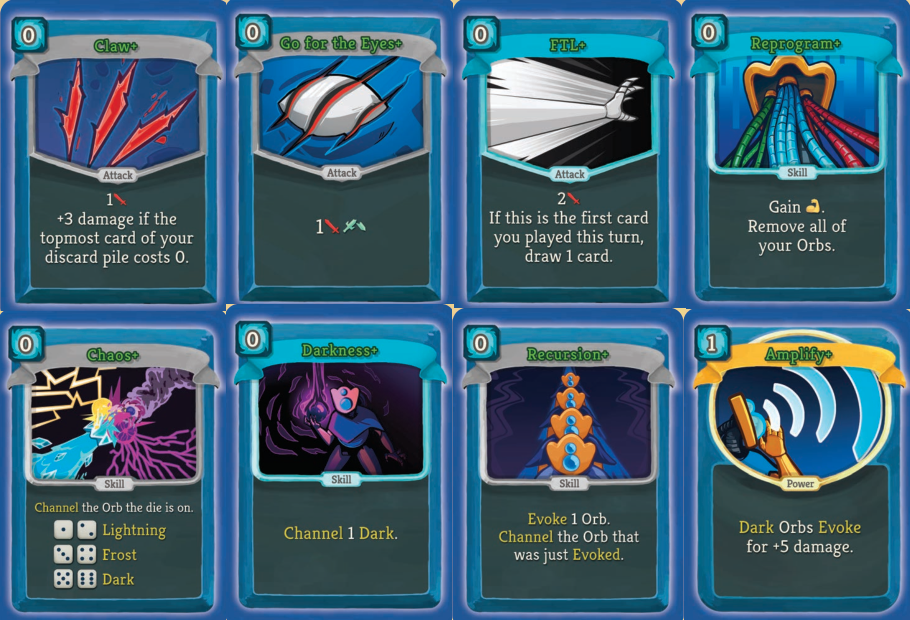
The second option is to go for orbs, and do a lot of cycling/evoking. Zap and Dualcast are already in the deck, and cost 0 upgraded, and Chaos and Recursion are also 0. Orbs have a lot more valuable powers, but in this case you can focus more on evoking rather and end-of-turn, so you want Consume more than something like Loop, Static Discharge, or Defragment. This is also a good way to build for Dark orbs; they has no end of turn effect, but Darkness costs 0, they want to evoke a lot, and they also have Amplify if you get lucky enough to get it. The issue is that besides Darkness, the only other way to channel a dark orb is with Doom and Gloom, which is a 2 energy attack, Rainbow, which again is 2 energy and exhausts, or Chaos, which relies on the die roll. So it’s hard to get enough pieces to really get to the best possible build for this.
Another think about 0-cost is that they have lots of good options from Colorless cards; Finess, Flash of Steel, Good Instincts, Swift Strike, and Impatience are great – but if you have One for All and Hologram, Madness will also allow you to double down by discounting the first One for All.
Pros:
- Fun, lots of cards being played
- Good damage
Cons:
- Perhaps lacking a bit in defense
- REALLY needs One for All
- Small pool of cards, very specific
Hodgepodge
This isn’t an archetype – it is, perhaps, the opposite of it. But it also works just fine. Essentially, you just pick a bunch of cards, and since the Defect has a ton of good cards, you end up with a good deck. Example: you have something like Charge Battery, Glacier, Ball Lightning, Recycle, Skim, and Sunder. If Sunder can kill something, it’s free damage, then you can Skim and look for more options. If you’re facing a lot of incoming damage, Glacier + Charge Battery will get you massive block, and you most likely also now have the energy for a Ball Lightning. If none of these work, you can start with Skim, and then Recycle either the Sunder or the Glacier for more energy – etc etc. So you just make sure that each turn you have a lot of options to play. This can really shine when you’re playing solo, because you have to account for all possibilities – with others, you can focus on damage for example while the Silent shields you or something like that.
Final Thoughts
The Defect is always a ton of fun, because you can end up with a viable build no matter how you go about it. But it’s harder to start with a specific build in mind and try to aim for it – not that that’s a good strategy most of the time, but with the Ironclad and the Silent you can sort of have a rough aim – “I want strength stacking” or “I want Shivs”, but here you can’t really say “I want 0-cost Dark orbs”, because it’s too specific and you won’t assemble the cards you need. In that sense, it might feel like you’re playing the sameish build every time – but it’s still a very fun build, for me at least. Next up, the last character – the Watcher. Hopefully with less of a wait than this one – but until then, don’t forget to check out the Downfall expansion Kickstarter!
Join Our Mailing List
Do want…
- Extra content?
- Discounts?
- Updates about all our work?
 The Kind GM