Another discussion about Slay the Spire‘s characters and what you can do with them. Last time we looked at the Ironclad, so today we’re moving on to the Silent.
If you are interested in purchasing Slay the Spire, it is currently on sale on Miniature Market.
Silent
The deadly huntress from the foglands. Once again, I’m assuming you have unlocked all the cards for her – I’m also mostly going to have the upgraded versions of the cards.
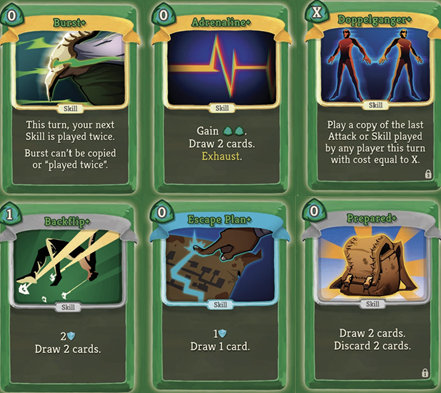
As with the Ironclad, there are some cards (especially lots of the rare ones, though that’s not unexpected) that can fit into pretty much every deck, and should indeed be taken almost every time you see them. The very top of this list has 2 contenders: Burst and Adrenaline. I think Adrenaline in particular is the best skill in the game; 0 energy to play, draws cards, and gives you extra energy. And as for Burst, well, the Silent is very heavy on skills, so it’s a no-brainer – similar to how the Ironclad has Double Tap, but even better in lots of cases. Doppelganger is similar to Burst; more expensive, but also more versatile. For non-rares, Backflip is very solid – quite cheap for what it offers, both block and card draw – and 0-cost card draw like Prepared or Escape Plan is always nice.
Block & Support
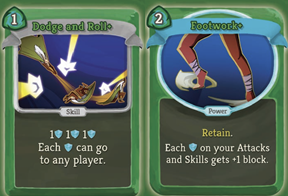
Let’s start with Block. This isn’t quite an archetype of its own – but it’s a sub-archetype, let’s say, that can supplement most others. The Silent has a lot of reliable ways to reach high block – as opposed to the Ironclad, who can certainly get there but essentially devotes the entire deck around it, or the Defect, who can also easily reach max block but requires a bit of setup. A very important card here is Footwork; this can really supercharge your defenses, turning your mediocre cards into decent ones (basic defends, for example) and good cards into absolutely insane ones – the prime, #1, top tier, absolute best card for this is upgraded Dodge and Roll, which for 1 energy gives you 6 block to distribute among players. Yep. Add a Burst as well, and you can take care of a full round of blocking for everyone and let them unleash their damage. Just one thing to take note with Footwork- it specifically mentions blocking from Skills and Attacks, not Powers (or Relics), so it won’t buff Distraction or After Image.
Overall:
- Top Cards: Footwork, Dodge and Roll
- Top Relics: Calipers
- Good Cards: Escape Plan, Deflect*, Blur**
- Good Relics: Nothing in particular.
- Bad Cards: None.
- Bad Relics: Centennial Puzzle, Incense Burner, Orichalcum, Self-Forming Clay
- Good Colorless Cards: Dark Shackles, Finesse, Good Instincts
*If you are playing a Shiv deck
**If you are playing a discard deck
Now, for Support – the Silent has perhaps the most cards that can help your teammates. Again, this isn’t really an archetype of its own – and it’s probably not really worth it to completely build around it – but it can be a powerful enabler for your friends, whether you’re 2 or 4. Combined best with the Block build I just mentioned, having your Ironclad or Watcher just build strength and pump out attacks without worrying about silly things like blocking can get pretty silly with the damage output. The same goes for the Defect, especially with their reliance on Powers (which are pretty expensive to play).
Another thing that helps here is the Silent’s access to Weak; not only do they have lots of great cards that apply it, they also start with Neutralize. So you can further reduce damage for everyone pretty easily.
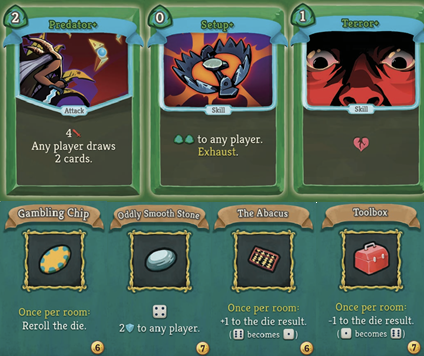
- Top Cards: Footwork+Dodge and Roll, Predator, Setup
- Top Relics*: Oddly Smooth Stone, Pen Nib, White Beast Statue
- Good Cards: Terror, Piercing Wail, Malaise, Distraction**
- Good Relics*: Dolly’s Mirror, The Abacus, Toolbox, Gambling Chip
- Bad Cards: None
- Bad Relics: None
- Good Colorless Cards: Trip, Panacea, Blind, Good Instincs, Sadistic Nature**
*These are, of course, great relics for anyone – but if you pick them up, you leave other, perhaps more synergistic relics to your allies. This is assuming you’re playing with the variant rule that you open a number of relics for each player, and you can pick rather than automatically get what’s opened for you, but personally, I find it a lot more fun this way.
**You put a lot of tokens on enemies, particularly Weak, so these two can be a nice extra bit of defense and damage.
Poison
The first main archetype for Silent is Poison. It’s quite strong; poison is reliable damage every turn, bypasses block, and once you apply it, it stays there forever, so you can spend your energy on blocking. It’s also an excellent counter to some enemies that don’t like getting attacked, like the Spikers in Act 3 or the Guardian. However, it also has several issues; it’s great for single-target damage but can struggle against multiple enemies, and the Slime Boss is a very tough matchup.
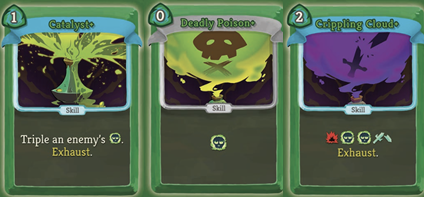
The most important card you’re looking for here is Catalyst. Upgraded, it triples the poison on an enemy, so this is what will get you through most fights, particularly elites and bosses; and you also REALLY want burst with it, since it turns from a x3 to a x9 multiplier. With just 3 poison, you’re already up to 27, close to the maximum cap of 30 – and this can easily happen in the first turn. Another excellent combo with Burst is Malaise; not only does it put another big batch of poison, but it also adds a ton of Weak that will probably last for the entire combat.
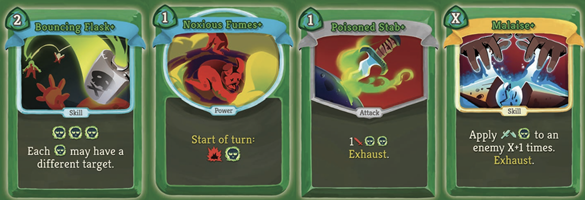
As for the other poison cards, all of them can easily fit in the deck without any issue; just remember to have enough defense and card draw. Sometimes, getting something like an Expertise or an Escape Plan will let you dig through your deck faster to get your Catalyst, making it more consistent than adding a second Deadly Poison.
There is, however, one exception to the poison cards that I can’t really decide where it fits more, and that’s Envenom. Is it powerful? Oh yeah, it’s amazing. But does it really fit in a poison deck? At a first glance, of course it does – that sounds like a stupid question, free poison on every attack? However, when you build for poison, you don’t really have attacks, you have skills. Sure, you have your starter strikes, maybe a Poisoned Stab or a Bane, but that’s not enough to justify 1) picking Envenom for a rare reward when you might have better options, and 2) spending 3 energy (or 2 upgraded) to play it.
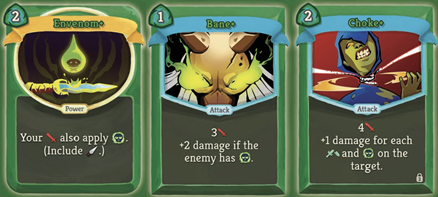
Envenom, in my opinion, is something you build around, and only if you get it very early – say from a Neow’s Blessing, or a lucky Golden Ticket. IF this happens, then you can make a pretty fun deck – but instead of getting stuff like Deadly Poison and Noxious Fumes, you’re looking for multi-hit attacks: Skewer, Flechettes, and the top contender, Dagger Spray. You can also combine it with Shivs (which we’ll talk about as their own archetype just below); still, it ends up looking more like a “Good Stuff” deck than any dedicated single archetype. Not that that’s bad, of course; sometimes, you have to work with what you’re given rather than chasing or trying to force a specific deck.
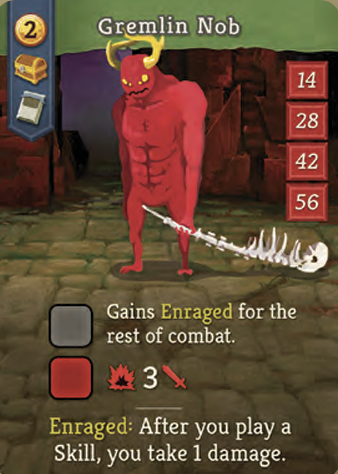
I mentioned in the beginning that poison can struggle against certain fights. To be more specific, the Silent in general has troubles in Act 1, especially solo. She just lacks early damage, and while she can block all day long, sometimes that’s not enough against scaling enemies. With poison specifically, you can handle one big monster or several really small ones (like gremlins), but the real issue is when you are up against just a couple of medium enemies. The Act 1 Elites are also particularly hard; the Guardians have the same issue I just mentioned, and the Gremlin Nob is a death sentence solo with this kind of deck. Things that respawn can also be an issue; lots of poison cards exhaust (Catalyst, Poison Stab, Crippling Cloud), so you might be left without enough juice to finish the fight. Playing coop, however, can mitigate a LOT of those issues, and by Act 2 onwards, you’ve got your deck going so you’re mostly fine.
Overall:
- Top Cards: Catalyst, Malaise
- Top Relics: Nothing that particularly interfaces with poison.
- Good Cards: All the ones that apply poison, Distraction, Choke.
- Good Relics: Toxic Egg, War Paint – but these are good for the Silent almost all the time.
- Bad Cards: Most attacks and Shiv cards are just not a good fit.
- Bad Relics: Most attack/strength focused relics won’t really help you much.
- Good Colorless Cards: Sadistic Nature
Pros:
- Lots of single-target damage
- High defense – once you apply poison, you let it do its thing while you block
Cons:
- Somewhat bad AoE
- Bad early game
- Some really bad matchups
Shivs
This is the second major archetype for the Silent. Shivs are 0-cost attacks that deal 1 damage, and are represented by Shiv tokens; you can have up to 5 at any time, and if you get more, you can spend them on the spot instead of losing them.
Shivs, in my experience, are a bit harder to build around than poison. It’s not that they’re weaker, it’s more that they need you to assemble more pieces; poison is, in a sense, self-scaling. Each poison you apply increases damage by 1, and it happens on its own every turn. Shivs, on the other hand, are a limited resource that requires you to spend energy to generate; and when you use them, one shiv is 1 damage instead of +1 damage, if that makes sense.
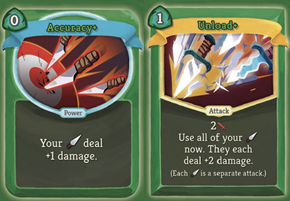
So, how do you scale shivs? Well, the most obvious answer is Strength; however, the Silent doesn’t really have native access to it, so you’ll have to rely on Relics for that. After that, you have 2 options that specifically increase Shiv damage: Accuracy, and Unload. Unload is better with some setup, building up your full stockpile of shivs before using it, but even with just 2-3 it’s a great attack. Finally, we’ve got Envenom; I spoke about it at length in the Poison section, so I won’t get into it again, but it does synergise particularly well with Shivs.
Now, as for producing Shivs, you’ve got 5 options: 2 common (so 2 copies of them in your reward pile), 2 uncommon, and 1 rare. Ironically, the common ones are perhaps the better options; Blade Dance gives you 3 shivs for 1 energy, and Cloak and Dagger gives you 2 shivs and 1 block again for 1 energy. For comparison, Riddle with Holes gives you 5 shivs for 2 energy; so a lower shiv-per-energy ratio than Blade Dance (the upgraded versions, at least), but taking card draw into account (1 card gives you max shivs, while you’d need 2 Blade Dances), it still pulls its weight. But all of this talking and analysis is a bit wasted, because you still pick every shiv generator you see of course. Infinite Blades is a consistent source of shivs, however, it starts producing them the turn after you play it – that’s a common issue with powers: Do you spend the energy now, for a stacking payoff later, or is that energy better spent on something else that might mean the fight is over by next turn? Still, at least Infinite Blades is a cheap one at just 1 energy.
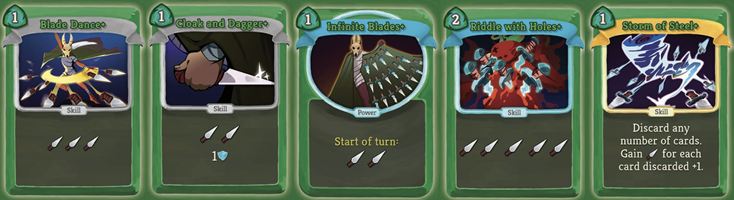
Finally, for the rare one, we have Storm of Steel. This is a bit finicky; sure, the Silent has plenty of options for drawing cards (including her starting relic), but you’d often rather play those cards than discard them. It also costs 1 energy, so again, you’d prefer to spend the other 2 you get for the turn; but that means fewer shivs. Somewhat like Envenom, this is a card caught halfway between 2 archetypes (shivs and discard), which sort of fits both and you definitely pick it if it comes up, but you’d rather have the other rare card that fits more (Unload, in this case). Still, perhaps I’m being too harsh; if you draw your 5 cards for the turn, and play 2 of them, Storm of Steel is still 2 shivs for 1 energy unupgraded and 3 shivs upgraded. A particularly nice combo then is Expertise, drawing you to 7 cards, then discarding them all for 7 shivs – but that’s getting a bit too into specific interactions that would take too long to analyse all of them.
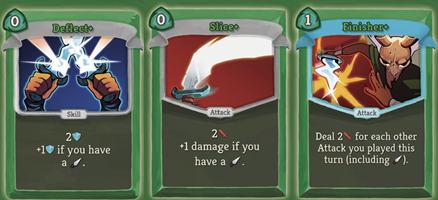
Finally, there are some extra cards that do not generate or buff shivs themselves, but they do have a lot of synergy. First, Deflect; 0 energy for 3 block is pretty good I’d say, so you take this every time. With Footwork, it’s also 5 block instead. Second is Slice. Now this is a bit less interesting; yes, it’s a 0 energy attack for 3 damage, but you’ve already got enough attacks from the Shivs themselves – I actually don’t think you pick this up most of the time. Finally, we’ve got Finisher, which is a great payoff for all your shivs; with the max 5 it’s 10 damage on its own, and you can easily play more than that. It also scales great with Strength if you manage to get some!
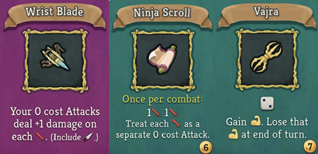
Overall:
- Top Cards: Blade Dance, Accuracy, Unload
- Top Relics: Wrist Blade, Strength relics
- Good Cards: Everything that has a Shiv icon on it, except Slice
- Good Relics: Ninja Scroll
- Bad Cards: Nothing with explicit anti-synergy, just the ones you can’t use properly
- Bad Relics: None
- Good Colorless Cards: Nothing especially broken; Flash of Steel and Impatience are a bit above the rest.
Pros:
- Lots of small attacks – you can finish off low-hp enemies so that allies can use burst damage on other targets
- Pretty fun – you can toss out several dozen shivs during a single fight
- Excellent damage output when all the pieces are assembled
Cons:
- Harder to scale – needs highly specific cards and relics
- Relies heavily on both skills and attacks, so vulnerable to enemies that counter either; both the Guardian and the Gremlin Nob, for example
Discard
The last major archetype – discarding cards from your hand. For obvious reasons, you also want a very strong draw engine; and while it’s often built-in to the discard cards, it’s nice to have extra. So, as with every archetype, the questions are:
- How do you discard cards?
- What’s the payoff for doing so?
- How do you actually kill the enemies?
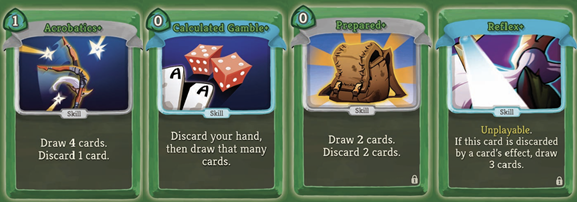
Let’s start with questions 1 & 2, which are usually answered both in each relevant card. Usually, you discard cards to draw more cards. Example: Acrobatics, Calculated Gamble, Prepared etc. Of course, on its own, this isn’t enough to win you a fight, but drawing is always good. There are also some cards which block or damage – you start with Survivor, and there’s also Dagger Throw and Storm of Steel – but the general gameplan here relies mostly on 0-cost (or net-0) attacks. Masterful Stab, Slice (ironically it’s better here than in shivs), Neutralize, and most importantly Sneaky Strike; the goal is to loop through your entire deck several times each turn with cheap, mass draw.
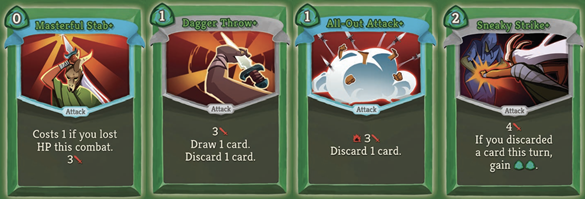
Perhaps the 2 most important cards in this deck are Prepared and Reflex. Prepared is a 0-cost draw+discard, and Reflex is even more draw on its own when discarded; combined, these will be your bread and butter, and in fact are the core of the simplest way for an infinite combo. I won’t elaborate on that as it’s probably going to be the subject of a future post, but you can see how it’s going to work; draw your entire deck into your hand, then cycle through just a couple of free cards over and over.
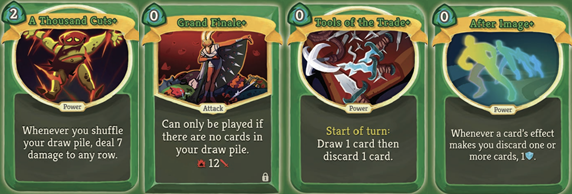
There are several rares that you’re looking for, though none of them are mandatory; the best is After Image, as it helps you stop worrying about block and focus on more draw and damage, but A Thousand Cuts is also a fantastic damage output. Tools of the Trade can fit in any deck, but it shines in discard-focused ones, and of course, I’ve already spoken at length about Adrenaline, Burst, Malaise, and Doppelganger. Finally, there is an honourable mention here, and that’s Grand Finale. Yes, it’s certainly a meme card, especially in the video game, but the board game has a massive advantage that makes it… perhaps sometimes viable? And it’s that there’s no maximum hand size, so you can draw your entire deck into your hand and play this.
Overall:
- Top Cards: Calculated Gamble, Prepared, Reflex, Sneaky Strike, After Image
- Top Relics: Ring of the Serpent, Bag of Preparation, Ink Bottle
- Good Cards: Acrobatics, Tactician, A Thousand Cuts, Concentrate, Blur
- Good Relics: Red Skull, Anything that draws more (even more)
- Bad Cards: Bullet Time*
- Bad Relics: None.
- Good Colorless Cards: Flash of Steel, Finesse, Purity**
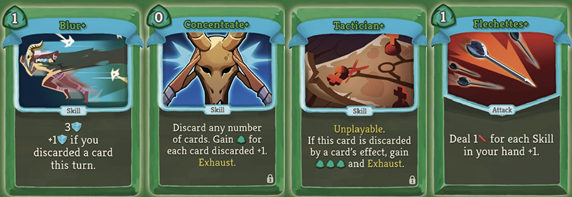
* You want to draw more, not less.
** You could exhaust a bunch of basic Strikes and Defends for even more reliablity, though that’s a bit of overkill.
Pros:
- Lots of draw means your turns are more reliable
- Quite flexible; can be mixed with other archetypes
- Can go infinite, or at least almost-infinite
Cons:
- Your turns are going to last a very long time. You’ll also wear out the sleeves faster from all the shuffling.
- Time Eater
Final Thoughts
The Silent is perhaps the character I’ve played most in the board game, and she is a lot of fun, primarily because of the feel that she can pull off interesting and powerful combos. Whether it’s Burst-Catalyst, or a Finisher after 10-15 shivs in one turn, or going infinite with Reflex, or just helping your allies pop off with Dodge and Roll or Setup; you feel the satisfaction of putting all the pieces together and watching the mechanism get to work. However, if one of those pieces is missing, you tend to feel like you can’t really do much – as I said at the start, this is particularly evident during Act 1, where she struggles the most.
Next time, the Defect; a particularly popular character, at least in our group, as it’s always in play (and sometimes even contested).
Join Our Mailing List
Do want…
- Extra content?
- Discounts?
- Updates about all our work?

