
It’s been several months since we got a UA, but now it’s back – in villain form, with new subclasses for the Cleric, Druid, Fighter, and Sorcerer.
Besides the subclasses, this Unearthed Arcana also has some additional Feats as well, which is always interesting.
Cleric – Pestilence Domain
Putrefy, rot, spoil, and fester. The followers of Nurgle have found their way into UA with this one.
Blight Weaver (Level 3)
You have resistance to poison and necrotic damage, and poison and necrotic damage from your cleric spells and features ignore enemy resistances. Finally, if you deal poison damage with your cleric spells or features, you can turn it into necrotic damage and vice versa. I’d say this is a pretty good feature; lots of enemies have resistance to poison damage, or even immunity – even the humble zombie, so switching to necrotic can help a lot. And there are plenty of enemies and effects with poison or necrotic damage, so your resistances are quite nice as well. Though, for once again, I will reiterate – ignoring resistances is something I believe should be rarer, or at least it should come at higher levels; plus, the damage type switch also partially fills that role. But anyway.
Pestilence Domain Spells (Level 3)
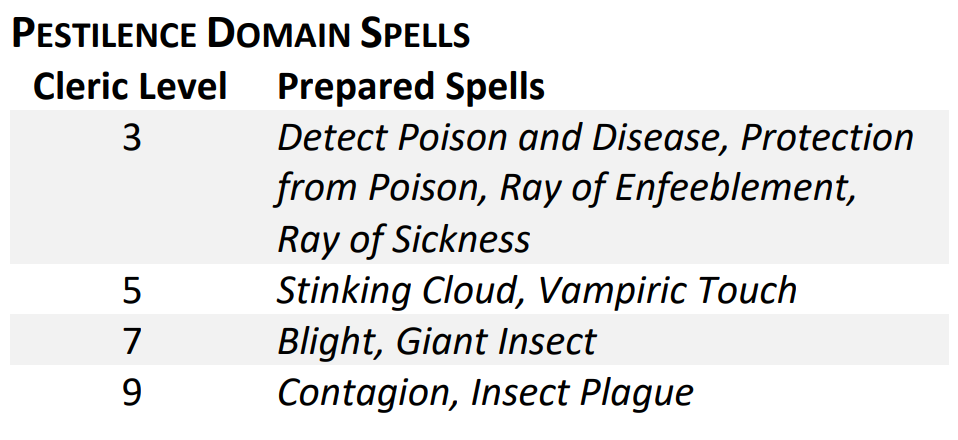
The usual – extra prepared spells. You can see them to the side, but you can also guess what’s included: sickness and vermin and stuff, all those happy things.
But they’re a good bit of damage, as well as some control stuff; the Rays and Stinking Cloud, for example.
Plague Blessing (Level 3)
Another level 3 feature, this one for your Channel Divinity. You manifest a 5-foot emanation, centred on yourself or another willing creature; creatures of your choice that start their turn there must make a CON saving throw. If they fail, they gain an Exhaustion level, up to a maximum equal to your WIS modifier. Reminder that exhaustion works differently in 5.5 – for each level, you get a -2 penalty to all D20 tests, and a -5 penalty to your Speed. As an effect, it’s obviously quite powerful, but it has a very short range and you probably won’t get to apply it more than once; to get it to ramp up on an enemy, you’ll need to spend multiple turns in melee range (or, well, the party barbarian/monk/fighter will, as you’ll probably dump it on them), and they need to fail their saving throw. But the good thing is that once you start it, the exhaustion will make them worse at subsequent saving throws, and it’s not something they can get rid of easily.
Virulent Burst (Level 6)
When an enemy is reduced to 0 hp within 60 feet of you, you can use your Reaction to cause a 10-foot emanation to erupt from them. If they had an exhaustion level, that is increased to 20 feet, so it’s an extra incentive to use Plague Blessing. As for the effect, each creature of your choice in the emanation must make a CON saving throw; on a fail, you choose one of the following effects:
- Putrid Shock: they are incapacitated, and their speed is 0 until the end of their next turn, or
- Toxic Infection: they take 3d6 poison or necrotic damage.
You can use this feature a number of times equal to your WIS modifier per long rest.
Putrid Shock is obviously very, very powerful, but Toxic Infection is also pretty decent for weaker enemies. Additionally, the way it is written, you get to choose the effect for each individual enemy, not as a whole for the emanation, which makes it a lot more versatile. Still, the activation requirements are quite restrictive; you need a creature that not only drops to 0 HP but also has other creatures around, and for it to have exhaustion, you also need to have used Plague Blessing and have affected it once.
Vermin Form (Level 17)
The capstone feature, this looks pretty disappointing if I’m being honest. As a bonus action, you shapeshift into an alternate form composed of a swarm of vermin (your equipment remains as is) for 10 minutes. You gain the following benefits:
- You have immunity to the Grappled, Paralyzed, Prone, and Restrained conditions.
- You have resistance to piercing, slashing and bludgeoning damage.
- You can enter and occupy another creature’s space and gain a climbing speed equal to your speed.
- Whenever you enter a creature’s space, or it enters your space or starts its turn there, you deal poison or necrotic damage to it equal to your WIS.
You can use this once per long rest, or by expending a level 5+ spell slot.
This is a bit pathetic for a level 17 feature in my opinion, and it’s strange because there’s so much they could do – for example, you could increase Plague Blessing’s area while in Vermin Form, or make it so that you get a free use of Plague Blessing on yourself when you activate this, or even just make it so that the damage while you enter a creature’s space also triggers a CON saving throw for Exhaustion; do something to give it an extra bit of synergy with the rest of the subclass’ features and make the Vermin Form stronger.
Overall, it looks like a decent option with a strong theme – it just needs a little bit more in Vermin Form to be really good.
Druid – Circle of the Titan
Now this is something that I’m sure will appeal to a lot of people – essentially a Kaiju druid. There’s some stuff i want to discuss, but I’ll gather them all at the end when we’ve seen all the features, so let’s get to it.
Circle of the Titan Spells (Level 3)
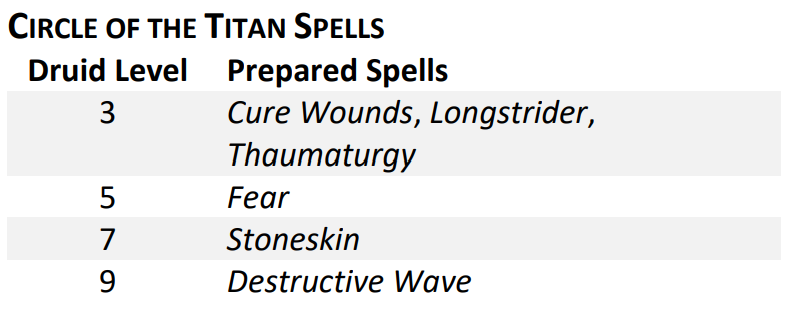
I’m not sure what sorts of spells would make sense to have here. You could have lots of things, but this list looks alright. You could also include something like Enhance Ability or Enlarge/Reduce, but that last one especially might be a bit of an overkill – because this isn’t just the usual “you have these spells prepared” feature that most casters get: these spells are also available to you while you are in your Titan Form, which is an alternate form of Wild Shape and thus normally doesn’t allow spellcasting.
Titan Form (Level 3)
You have access to an alternative form of Wild Shape, with 3 different forms: Behemoth, Leviathan, and Insectoid. These forms start at a Large size and can get up to Gargantuan as you level up, as well as gain new abilities. All 3 forms have some things in common: you keep your Constitution, Intelligence, Wisdom, and Charisma scores, and your Strength and Dexterity scores are equal to your Wisdom. You have 60 feet of Darkvision, a melee (reach 10ft) attack that uses your Wisdom for attack and damage rolls and deals 1d8 damage (the type depends on your form – slashing, bludgeoning, and piercing, respectively), and Multiattack at level 5. You also get 2x your druid level in Temporary HP when you transform, as opposed to just 1x with normal Wild Shape.
Now for the differences: First off, AC. Behemoth gets 11+WIS, Leviathan gets 10+WIS, and Insectoid gets the lowest and a very fragile 8+WIS. Your speed is 40 feet for all forms, but Behemoth gets climbing, Leviathan gets swimming, and Insectoid gets flying – along with the Flyby feature. Finally, each gets a special action/reaction that lets you use spell slots: Behemoth can deal 2d8 radiant damage per slot level on a 60 foot line (DEX saving throw, half on success), Leviathan has a reaction that releases a heavily obscuring cloud of ink in a 15-foot cube and can move up to your speed (no scaling with slot level for this one), and Insectoid can restore a total of 2d8 plus 5 times the slot’s levels of HP, divided as you choose to any number of creatures within 15 feet of you. As I mentioned, you gain more abilities as you level up, but we’ll get there when we get there.
Dire Impact (Level 6)
You can choose to deal Acid, Cold, Fire, Lightning, or Thunder damage when you hit with the Titan’s Rend attack. In addition, when you first transform (or as a bonus action to expend a level 1+ spell slot), you create a 15-foot emanation that forces creatures to make a CON saving throw or fall prone. This is a pretty good sink for low-level spell slots if you start getting into the higher levels, and the fact that it’s a bonus action helps a lot.
Primal Havoc (Level 10)
Your first big improvement on your Titan form – you can now get to Huge size, and you unlock your extra ability. Behemoth gets the Rampager trait: When you enter the space of an enemy smaller than you, they must make a STR saving throw or fall prone. If they’re already prone, they instead take 2d6 bludgeoning damage. Leviathan gets the Toxic Stench trait: Creatures that start their turn within 10 feet of you must make a CON saving throw or take 2d4 poison damage and become Poisoned. Finally, Insectoid gets the Hive Mind trait: When you transform, you create a telepathic link with a number of creatures you can see equal to your Druid level, as long as you are on the same plane. I assume the link breaks when you transform out of Wild Shape.
Leviathan technically has the strongest ability, but we’ll get to the comparisons at the end.
You also get another benefit – if you are Huge or larger, Difficult Terrain by snow, ice, rubble, or undergrowth doesn’t cost you extra movement. I assume this includes magically created difficult terrain, which is a pretty important detail – if this makes it to a release, that should be clarified.
Monstrous Appetite (Level 14)
You can now grow up to Gargantuan size. You also get to grab things and eat them:
- Grappling Rend: Once per turn, when you are Huge or larger, and you hit an enemy with Rend, you can give them the Grappled condition. You can have only one enemy Grappled this way.
- Swallow: As a bonus action while you are Gargantuan, choose a Large or smaller creature Grappled by you. They make an STR saving throw – on a fail, they are swallowed by you, which means they are Blinded and Restrained, with Total Cover from all attacks, and they take 2d8 acid damage at the start of your turn. You can have a number of creatures swallowed equal to your WIS modifier, and you must maintain Concentration to keep them there. If you lose Concentration or leave Titan Form, they are regurgitated and fall Prone somewhere within 10 feet of you.
So, these are the features. Now, let’s talk about the Titan Form in total. It certainly looks like a fun archetype, stomping around as a natural disaster and crushing the puny and tiny foes underneath, but I have some questions and concerns.
First of all, your Rend damage doesn’t really scale. This is something we generally see with alternate forms and summoned minions, though I think you could at least increase the dice as you get Huge and then Gargantuan – from 1d8 to 1d10 and 1d12. However, the Druid also has the Elemental Fury feature at level 7, which says: “when you hit a creature with an attack roll using a weapon or a Beast form’s attack in Wild Shape, you can cause the target to take an extra 1d8 Cold, Fire, Lightning, or Thunder damage”. This specifically mentioned a “Beast form” – does the “Titan form” count for this? Or is this (very important for your damage) feature useless for this subclass? The 3 Titan forms are Monstrosities after all, and not Beasts. Same goes for the level 18 Beast Spells feature, which again mentions “Beast form”. Looks like a very big oversight if that’s the case.
Anyway. The forms in general don’t look to be that strong – they’re pretty good at level 3, I think, but others will soon outpace them through the levels. Their AC is really bad; Behemoth caps out at 16 with a +5 WIS, and Insectoid can only get up to 13; so you’d better have Barkskin up before you transform. Their damage is… alright-ish I suppose, if you include Elemental Fury, but that’s the same as any other Wild Shape. You’re incentivised to use your spell slots with the special abilities and Dire Impact, but even those are worse than most spells – at least you can cast Destructive Wave though. No increased speed, no increased reach, no increased damage or AC or anything as you increase up to Gargantuan. Insectoid has nothing besides the flight – it can heal but you can use Cure Wounds in any form anyway, and the Hive Mind feature is cool in concept but you won’t stay in Titan Form 24/7; it could at least give the creatures some kind of bonus to saving throws against charm or fear or CHA/WIS in general, something to actually give you a reason to use it in combat besides the fact that it’s just there. Leviathan’s Toxic Stench is pretty good, poisoned is a strong condition, but the fact that you have to wait for them to start their turn inside the area rather than having a way to trigger it on your turn is a big disadvantage, and Ink Cloud is kind of a joke compared to what the others get. Behemoth feels the most like a proper Titan with Rampager and Incandescent Breath, so it gets a pass.
I think they should have differentiated between forms even more; give Behemoth the raw stompy damage, give Leviathan smaller bonus attacks since it’s a tentacle-y monster and more poison stuff, and give Insectoid some more magical stuff; a ranged psionic attack perhaps. They could be a lot more interesting and stronger mechanically as well.
Fighter – Hell Knight
Another very interesting concept, that – spoilers – doesn’t live up to the expectations.
Diabolical Gift (Level 3)
You know Infernal, and you can see in both magical and nonmagical darkness for 120 feet. Not a bad start, seeing through magical darkness is very nice.
Hellfire Weapon (Level 3)
When you attack with a weapon, you can turn it into a Hellfire Weapon for 10 minutes, letting you use the rest of the Hell Knight features – and also letting you deal Fire damage with it instead of its normal damage. I’m not exactly sure why this distinction needs to be made for Hellfire weapons. There’s no limit to the number of times you can use this, and depending on how you read it, there’s also no limit to how many weapons can be Hellfire at once. Anyway, this is just the “foundation” feature that lets you use all the other ones.
Infernal Wound (Level 3)
Your Hellfire Weapon can inflict Infernal Wounds. What this means is that once per turn, you can deal an additional 1d6 fire damage with it, and creatures with Infernal Wounds take an additional d6 at the beginning of their turns for 1 minute, or until they regain HP or someone uses an Action to staunch the wound. Infernal Wounds don’t stack on the same creature, but you can spread them out. You can use this a number of times equal to your CON per short or long rest.
Nothing special; a standard bit of extra damage. Less damage upfront than the Battlemaster’s manoeuvres, and less utility as well, of course, but you probably get at least an extra d6 per enemy – though i don’t expect them to live more than a couple of turns total (which is the main issue with damage-over-time type effects). But you at least get plenty of them.
Advanced Wounds (Level 7)
When you roll a 6 on the Infernal Wound die, you choose an additional effect to apply:
- Purulence of Minauros: Each creature within 5 feet of the target takes Acid damage equal to your CON, and the primary target is Poisoned until the start of its next turn. Which looks a bit off to me, because that means that unless they take some form of reaction or saving throw until then, it won’t really affect them – strange that it’s not until the end of their turn, or the start of your next turn.
- Rupture of Cania: The target takes force damage equal to your CON.
- Stygian Gangrene: The target takes cold damage equal to your CON, and can’t take reactions until the start of its next turn.
I’ll be honest, this looks SO bad. Getting a 6 on the roll is just so unreliable – statistically, you’ll have to roll 6 times to see it, so even if we assume you have 20 CON and take a short rest, it’ll still happen around 1.5 times per session. And the effects are just too weak as well – yeah, 5 extra damage, and for Purulence of Minauros and Stygian Gangrene, something that will most likely have no effect whatsoever unless you have a very particular initiative order to let others take advantage of it. Sure, Purulence can have a decent outcome if your allies dump spells with saving throws after, but it’s absolutely not something you can rely on.
Hell-Forged Equipment (Level 7)
While wearing armor or having a shield, you have resistance to fire damage, and you ignore fire resistance for damage you deal with weapons or Fighter features. This looks good; lots of things have resistance to fire, and lots of things deal fire damage, but it makes sense to have this for someone gaining powers from hell.
Hellfire Surge (Level 10)
When you use your Action Surge, you can cause each creature of your choice within 10 feet of you to make a DEX saving throw, or take… 1d6 fire damage and start burning. Wow, what a massive burst of damage! (he says, sarcastically). Yeah… not much else to say about this, right? Well, technically, it’s not just a d6, it’s an Infernal Wound die, so it can trigger Advanced Wounds.
Blister of Avernus (Level 15)
When you roll a 6 on the Infernal Wound die, you can roll another d6 and add it to the damage. You can only do this 3 times per turn. Why? I don’t know – let people have their fun if they get THAT lucky, come on. But I do like this as a feature, I just think it should have something extra as well.
Hellfire Condemnation (Level 18)
When you reduce a creature to 0 HP from your Hellfire Weapons or Infernal Wound, it dies, and its soul rises from the River Styx as a Lemure in a layer of the Nine Hells of your choice in 1d4 hours. If it isn’t revived until then, only a Wish spell can turn them back to life.
An interesting feature that’s mostly for roleplaying/story-related reasons, as I don’t see it directly affecting combat that much.
Infernal Bargain (Level 18)
When you roll a 1 on your Infernal Wound die, you can treat it as a 6 instead. This is really what you need to get this subclass going – too bad you get it so late, and it’s still very, very, very unreliable.
I could have said a lot more things in each feature, but like with the Druid, I wanted us to first have a look at all the features. But you get what I’m thinking; this looks like a very weak option. Very nice thematically, sure – but that’s not much of a consolation. The problem is that so much of the power is concentrated on hitting a 6, and while Infernal Bargain helps a little bit, it’s just so late, plus as I mentioned, it’s not even that much of a boost. And even when you do hit that 6, all you get is 5 extra damage; I suppose the best case scenario is to be in the midst of a big pack of enemies and hit it for your Hellfire Surge – but again, you can’t really plan for that.
I think this could be reworked to be a little bit like the Battlemaster. So instead of having your 3 Advanced Wounds, you have several more options and slowly pick more as you level up, like with Maneuvers. You could also improve the Infernal Wound die to a d8, d10, etc, but also keep the roll of 6 as a threshold for Advanced Wounds – so for a d8, it’s on a 6,7, or 8. And Infernal Bargain could instead give you rerolls or something. And if that sounds too strong, you can tone down the power of the Advanced Wounds – trade the “spikes” of high damage and powerful effects for more reliability. I don’t know – but if i wanted to play a demonically empowered type of fighter, I’d still probably go for a bladelock or a reskinned battlemaster.
Sorcerer – Demonic Sorcery
Abyssal Rupture (Level 3)
When you spend at least 1 Sorcery Point as part of a Magic action or Bonus action, you can manifest one of the following effects:
- Demonic Lash: One creature you can see within 20 feet of you takes 1d4 slashing damage, and if it is Large or smaller, you can pull it 10 feet.
- Fiendish Carapace: Until the beginning of your next turn, attacks against you have disadvantage. Yeah, I think we all know which one you’re picking 95% of the time.
Demonic Spells (Level 3)
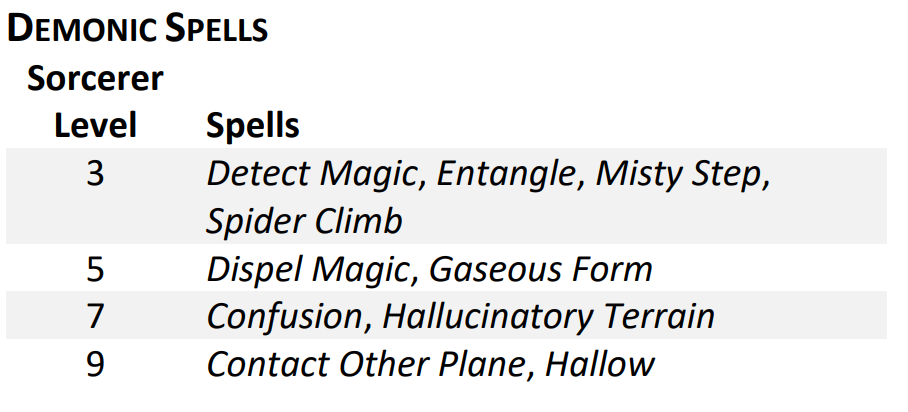
Some decent spells, but nothing groundbreaking. Misty Step is always nice, and you can always use Detect/Dispel Magic.
Abyssal Aura (Level 6)
When you use your Innate Sorcery, you also manifest a 10-foot emanation centred on you with a random effect. You can do this once per long rest, or by spending 2 sorcery points. I’m not going to list all the effects, but they mostly deal a little bit of damage, and also have an additional effect – difficult terrain, charm, frighten, that sort of thing. The fact that it’s random is a bit frustrating, but all the effects are alright (though some are more alright than others).
Abyssal Conduit (Level 14)
Your Abyssal Aura extends to 20 feet, and you can reroll the effect and choose whichever result you want. A pretty big improvement to it.
Fiendish Servant (Level 18)
You can cast Summon Fiend without a material component, and once per long rest also without expending a spell slot (I assume at its lowest level – usually they mention this as well, but I guess it’s implied by now).
Overall, it looks good? Not very exciting – but I suppose the other subclasses evoked stronger feelings, so now that I’ve gotten to this one, it just looks uninteresting by comparison. I certainly don’t think it’s bad, though.
Paths of Villainy
Besides the subclasses, we also get some extra feats. These work more as sort of… prestige classes? I’m not sure if that’s the proper term, really. Side-classes, perhaps. You have 2 “paths” of feats, Path of the Death Knight and Path of the Lich. Both of them work similarly; you have an Initiate feat for them, 4 additional feats that require it, and an Ascension feat that needs level 12+ and two other feats of that path (one of them obviously being Initiate).
Path of the Death Knight
The feats all give you a +1 to an ability, Strength, Constitution, or Charisma – usually, you choose from a pair of those. Death Knight Initiate also gives you Death Points equal to your proficiency modifier, and you spend these points to cast certain spells, which are also enhanced. Initiate gives you Wrathful Smite, Dread Authority gives you Command, Harbinger of Doom gives you Bane, Deathly Presence gives you Fear, and Unholy Steed gives you Spectral Steed.
Finally, Death Knight Ascension turns your creature type into Undead, gives you resistance to necrotic and poison damage, and also gives you an ability that you can use with Death Points that acts a bit like a Fireball – 2d6 fire and 2d6 necrotic damage per death point used on a DEX saving throw, with a 120-foot range and as a 20-foot sphere.
Path of the Lich
Similar stuff to the Death Knight. +1 to Intelligene, Wisdom, or Charisma per feat, but no Death Points here. Instead, the Initiate gives you a Spirit Jar that you anchor your soul to, and the Soul Siphon ability. When you reduce a humanoid to 0 HP (or someone else does that to a humanoid within 10 feet of you), you can siphon their soul, dealing an extra 1d6+your spellcasting ability modifier of necrotic damage on your next attack that hits. Two of the other feats improve this Soul Siphon: Arcane Restoration also lets you recover spell slots of total level up to 4 (once per long rest), and Transfer Life gives you Temporary HP equal to your proficiency bonus plus your spellcasting ability modifier.
Undead Grasp gives you the Chill Touch cantrip, and lets you spend spell slots when you cast it to increase its damage and paralyze targets. Finally, Lich Ascension also turns you into an undead like Death Knight Ascension, lets you resurrect next to your Spirit Jar when you die, and also gives you the Fear spell.
On their face, these look pretty good – both paths have some decent options and are certainly good for roleplaying. However, feats are just so rare and have so much competition that I don’t know if they’re worth the investment – at least purely from a mechanical standpoint.
This is also an interesting design decision, because it shifts character options to a more freeform, less class-dependent system. However, classes are a very deep, inherent part of the DnD system, which means that trying to do this half-class half-feat type of thing is destined to fall short (at least in my opinion) – I feel like there’s not enough space in the system for them to truly work out. I’d love to see more experimentation in later UAs – I really like the more classless, feat/perk dependent systems (though they have their own issues), but unless we see a radical shift to something that won’t really be called DnD anymore, I don’t have high hopes of it working out.
But if you’re a DM, you can always just “award” these feats freely – if you remove the ability score improvement, you can give them to players who want to follow these paths narratively in conjunction with the normal feat progression. But that goes into the realm of homebrew, and everything is possible there – not really part of the UA analysis.
Check out Unearthed Arcana: Villainous Options, and let me know if you think I’m being too harsh and I’ve missed something, or if you have other comments on this.
Join Our Mailing List
Do want…
- Extra content?
- Discounts?
- Updates about all our work?
 The Kind GM