
Another UA Analysis, this time doing some more catchup for January’s release of Forgotten Realms Subclasses.
Last time we took a look at the new Psion, a new and exciting psionics class. This time, we’ve got 8 more subclasses, each for a different class, having ties to either locations or organizations specific to the Forgotten Realms. As usual, you can also watch the related YouTube video from the official Dungeons & Dragons channel.
Let’s get into it.
Bard – College of the Moon
A new archetype for the bard, this one has a druidic flavor and ties to the Moonshae Isles – focusing on lore, folk tales, and fairy tales (and obviously ties to the Fey as well).
Moonshae Folktales (Level 3)
You can use a Magic action to gain a permanent bonus to your Bardic Inspiration, until you use it again to choose a different one. At first I found the wording a bit confusing, but it’s just this way to allow you to switch easily without waiting for a rest. As for the bonuses:
The first, Tale of Life, gives additional healing. When you restore Hit Points to a creature with a spell, you can expend a Bardic Inspiration die and add the roll to your healing – once per turn. It’s a decent feature, but I think using your Bardic Inspiration for its original purpose is usually more impactful. The second, Tale of Gloam, gives you the ability to take the Disengage or Hide action with the same Bonus Action that you use to give someone Bardic Inspiration. An interesting ability – bards aren’t too resilient, so a free Disengage is pretty nice, though niche. Finally, the third option, Take of Mirth, gives you the ability to spend a Bardic Inspiration die as a reaction when an enemy succeeds in a saving throw, in order to reduce their roll by an equal amount. This is by far the most powerful option, giving your allies a better chance of casting some high impact spells or using certain features. If you want to stun, paralyze, drop prone etc a high value target, this is going to be a very nice insurance.
Primal Lorist (Level 3)
You learn Druidic and a Druid cantrip. You’re probably looking at Guidance, though Shillelagh might also be a tempting choice. You also gain proficiency to one of Animal Handling, Insight, Medicine, Nature, Perception, or Survival. If for some reason you don’t have Perception yet, this is an obvious choice, with Insight second and the others coming after.
Blessing of the Moonwells (Level 6)
You always have the Moonbeam spell prepared, and you can cast it once per long rest without expending a spell slot as a bonus action. In addition, if you use this feature, when an enemy fails their saving throw against Moonbeam, a creature you can see within 60 feet regains 2d4 hit points. This has the potential to give a lot of healing; Moonbeam is only 5 feet wide, so you’re probably only getting one creature per turn, but creatures trigger the saving throw when they enter the beam or end their turn there as well – so placing this on a choke point and forcing enemies to walk through, or planting it on top of an immobile enemy means you can get the healing to trigger multiple times per turn (and there is no explicit limit of once per turn/round for this, as there often is for other features). In addition, your Moonshae Folktales is also helpful, reducing enemy saving throws. I don’t think that the way it’s written the Moonshae Folktales healing bonus would apply to this, but honestly I’d let that happen.
While I said you can only use this once per long rest, you can also reuse it if you expend a level 3 or higher spell slot – though Moonbeam is a level 2 spell, so it’s up to you to decide if it’s worth it. Personally, I don’t think so.
Bolstered Folktales (Level 14)
As the name implies, your Moonshae Folktales are improved. For Tale of Life and Tale of Mirth, instead of spending a Bardic Inspiration, you can roll a 1d6 instead. At this level Bardic Inspiration is a d10, increasing to d12 on level 15, so while it’s a decent potential difference, it also let’s you be a lot more liberal with it’s application – pretty much using it every single time it’s available. Tale of Life (the healing boost) probably doesn’t have a reason to use Bardic Inspiration anymore at all, while Tale of Mirth can still use one in case you want to be extra sure. As for Tale of Gloam, you can now also (not or, you can do this on top of the normal choice between Disengage and Hide) teleport up to 30 feet. This sort of makes the Disengage obsolete, as you can just blink away, but it does make Hide more valuable – teleport into an obscured spot, then try to Hide (though you do need to see your target location, and so probably so do your enemies, unless you’re far on the backline).
I quite like this feature; using the simple d6 let’s you keep your Bardic Inspirations, and Tale of Gloam is now probably more about the teleport than it’s original bonuses.
Overall, I like both the theme and the implementation of this subclass. I like the druidic approach, and the Folktales features are quite nice and flexible – though with a clear winner in the Tales of Mirth over the others.
Cleric – Knowledge Domain
A returning domain, but with a significant overhaul in almost every feature.
Blessing of Knowledge (Level 3)
This is pretty much the same, you gain 2 skill proficiencies (and expertise), although you also get proficiency in an artisan’s tools as well now. However, do note that you now get this on level 3 instead of level 2 as you did in 5e, since the archetypes are now all ‘normalized’ at level 3.
Knowledge Domain Spells (Level 3)
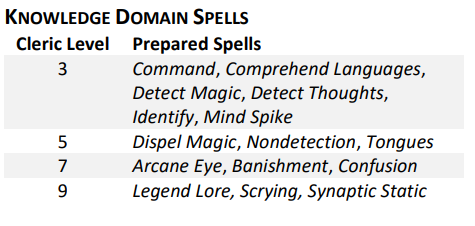
Your new extra spells – mostly the same as 5e, though with some additional combat options, and overall a greater number.
Mind Magic (Level 3)
You can essentially use your Channel Divinity instead of spell slots to cast your Domain-specific spells. No need for material components either. Since it’s just for domain spells, I feel that there’s a sweet spot at levels 7-9 where you get your last ones where it’s the most powerful; Banishment an Synaptic Shock are probably your go-tos, but i can also see it used for some thing like Command at level 3. It certainly beats using the damage aspect of Divine Spark, and it clears up your spell slots for other healing spells, so I expect this to be the main use for Channel Divinity for a while.
Unfettered Mind (Level 6)
You gain telepathy for up to 60 feet, and you can keep contact with a number of creatures equal to your Wisdom Modifier. Although there’s no mention of what exactly counts as “contact”, so if you just broadcast – send out without caring for a return signal, so to speak – I’d say that number could increase.
More interestingly though, if you roll an Intelligence check and the result is lower than your Wisdom score, you can use the latter in place of the former.
Divine Foreknowledge (Level 17)
As a bonus action, you can activate an effect that lasts one hour. During that, you gain advantage on all d20 Tests. Pretty simple, pretty nice – ‘global’ advantage is not something you turn down, especially for a full hour, without concentration.
Again, you can use this once per long rest, or spend a level 6+ spell slot to reuse it.
This is a huge change from the 5e version, which was essentially postcognition – seeing the past of an object or location. I think it was an interesting feature, if not a bit janky and hard to properly describe and use, so I prefer this simpler (and admittedly more powerful) version.
Overall, I again like the implementation of the mechanics, although I’m not sure I’d lean into the telepathy aspect as much, instead of general knowledge (although admittedly 5e leaned into the telepathy even more than 2024).
Fighter – Purple Dragon Knight
This subclass first appeared in the Sword Coast Adventurer’s Guide, but the new version is… pretty much a complete departure in both theme and mechanics. They now have a psionic theme, and they bond with Amethyst Dragons, using them as mounts as well.
Knightly Envoy (Level 3)
You learn an additional language, and you can cast Comprehend Languages as a ritual. This replaces a feature that lets you heal allies when you use your second wind, though it’s also taking the place of the former level 7 feature called Royal Envoy that gives Proficiency and Expertise to Perception.
Purple Dragon Companion (Level 3)
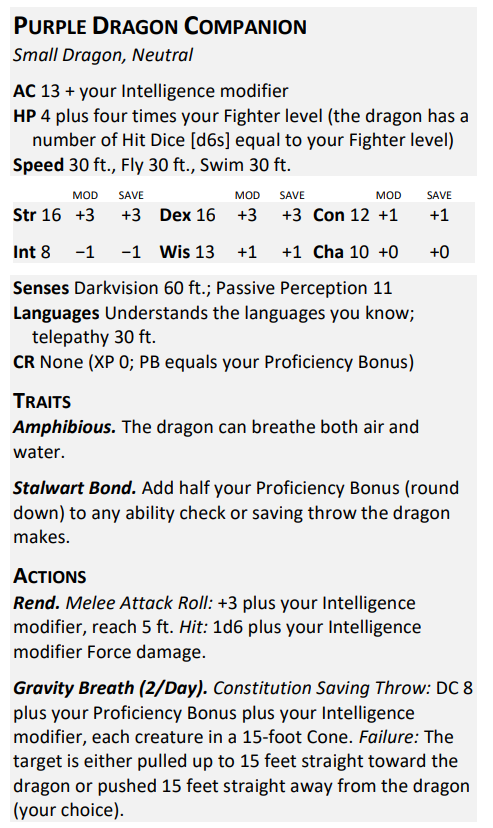
The main feature of the class, gives you a dragon companion, starting at Small size. As usual, you command it with your bonus action, otherwise it just uses Dodge.
You can see the stat block on the left; it has a Gravity Breath that only pushes or pulls creatures (it deals no damage at first), and it uses your INT for its stats. The main issue is that besides HP, it doesn’t really scale – its damage remains 1d6+INT, so it quickly falls off. In addition, it requires quite some investment into INT, since its AC is also reliant on it.
Dragon Rider (Level 7)
The dragon grows to Medium size and you can now use it as a mount. It can still fly, though it can’t sustain flight with you on it – at the end of its turn it falls if it’s still airborne. Furthermore, the Gravity Breath now deals 2d6 Force damage on a fail, and when you use Second Wind, the dragon also recovers 1d6+your Fighter level Hit Points, as well as one use of Gravity Breath.
The damage on Gravity Breath is nice, though again, no further scaling on it – I’d like to see it grow with your levels, as well as maybe gain 1 or 2 more uses per day (Though I suppose Second Wind counts for that now).
Rallying Surge (Level 10)
This is pretty similar to the 5e feature in that level, Inspiring Surge, though with quite an upgrade. When you use your Action Surge, you can select up to three allies (from just one, or two at level 17) within 30 feet of you (down from 60) using their Reaction, they can either make a weapon attack, or move up to half their Speed without provoking opportunity attacks (each one chooses what they want to do). The movement option is new as well.
Of course, your dragon can be one of those allies, though unless all your other allies are spell casters, it’s not a very attractive choice due to its low damage.
Amethyst Pinnacle (Level 15)
Your dragon grows to Large size, and it’s speed and flying speed increases to 40. In addition, it can now stay flying with you riding it. That’s a nice upgrade, but it can be a bit of a downside as well – Large creatures in tight spaces, like let’s say… dungeons, or buildings, might be more of a hindrance. And you’re telling me this large dragon can’t deal 2d6 with its claws? Or even 1d10?
To further put salt in the wound, you can now forgo one of your attacks to let your dragon use its Rend action, on forgo 2 attacks to let it use Gravity Breath. Why would you ever do that? Outside of very specialized scenarios, for example if your dragon is next to an enemy and you aren’t, or absolutely needing a Gravity Breath, I don’t see you using this. And even in the first case, you’re usually expected to be mounted on your Dragon, so that doesn’t apply either.
Enduring Commander (Level 18)
You and your dragon gain resistance to Force and Psychic damage. A strange choice, since I was under the impression that Force damage was supposed to be very hard to resist or counter. I understand Psychic, but I think this feature is underwhelming. Maybe it could instead give some more scaling to the dragon? Or some other type of resistance. As it is, it’s…. I’ll be honest, it looks pathetic for a capstone feature at this level.
Overall, Purple Dragon Knight is, in my opinion, a bit underwhelming. I’ve seen some comments that people aren’t happy with the new thematic direction, since in 5e Purple Dragon Knights (or Bannerets, outside of the Forgotten Realms) we’re just a group of elite soldiers and had nothing to actually do with dragons, but I’m not really that torn up about it – I’m more disappointed with the fact that your dragon is… pretty meh. It really needs scaling! (Ha ha, scales… because it’s a dragon… whatever. I’m honestly surprised I didn’t make this connection until I reached the end of writing this.) Anyway, this is usually my issue with subclasses that rely on companion (like the Reanimator from the Horror UA for example) – they tend to be on the weaker side and don’t scale well into the higher levels.
Paladin – Order of the Noble Genies
This is a bit of a weird one for me. This is about paladins who revere the forces of the Elemental Planes, drawing power from Genies. I always thought of Paladins as very clearly having ties to the gods and the divine – a genie would be more akin to a Warlock patron (and we did indeed have a Genie patron for warlocks in 5e). Still, I suppose it’s not too far fetched – you could say that Paladins and Clerics are technically warlocks with deities as patrons (and, again, there was the Celestial warlock patron).
Anyway, let’s take a look.
Elemental Smite (Level 3)
When you use your Divine Smite, you can also expend one use of your Channel Divinity and invoke an additional effect.
- The target is grappled (and is restrained while grappled)
- You teleport up to 30 feet, and take a misty form until the end of your next turn, making you immune to the Grappled, Restrained, and Prone conditions.
- The target takes 2d4 fire damage.
- The target and other creatures of your choice in a 10 foot Emanation from you make a Strength saving throw or are pushed 15 feet and drop prone.
The fire damage might be pretty nice for guaranteed damage on the early levels, but I don’t see you keep using it as the levels go on, since it doesn’t scale. Grappling is… a bit of a mess I don’t want to get into, though again it’s guaranteed, so if you manage to snag a high value target it’ll let your allies wail on them freely. As for the teleport and the push, they’ve obviously got their uses – but are they better than your normal Channel Divinity? I can’t say.
Genie Spells (Level 3)
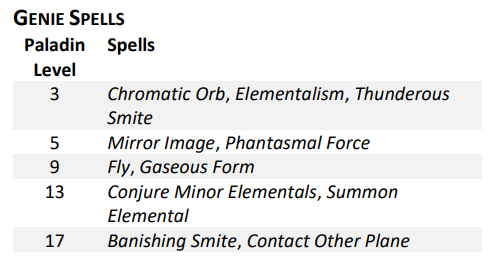
The standard additional spells for the archetype. As expected, mostly elemental spells, including summoning spells – also Fly, which is going to be tempting for sure for a Paladin.
Genie’s Splendor (Level 3)
When you aren’t wearing Medium or Heavy armor, you gain a bonus to your AC equal to your Charisma. I’m surprised with this new direction – and we’ll see a similar feature again later – but 5e was pretty strict about keeping the numbers tightly bounded, especially for AC.
A flat bonus to it can easily start becoming broken – yeah, it’s limited to light armor (or unarmored), but I’m sure people are already brainstorming on how to stack anything they can to get crazy ACs (and I’m sure they’re already found their combos, since this UA has been out for a couple of months already). I didn’t get to play 3e/3.5e, but I was under the impression that one of the reasons for the radical changes in 4e, and 5e too, was the inflation of numbers and stacking bonuses. Now that it starts creeping back, does that mean that WoTC has changed their design philosophy? Well, lots of people have already said they believe so, even outside the context of this particular feature – and I believe so as well, though this isn’t the post to write about it in depth.
All I’ll say on this feature anymore is – it might not be as bad because with Light Armor, or even with Unarmored Defense if you multiclass, because you’ll need to spread points in several abilities. Or it can turn you invincible with just a single level splash into Barbarian or Monk – if you’ve had any practical experience with this, let me know, I’m very curious about your thoughts on the whole thing.
Oh, you also get proficiency in one of Acrobatics, Intimidation, Performance, or Persuasion. A bit of an afterthought really when compared to the wall of text I had to write above… And those are some great skills to have too, if you don’t have proficiency in them already (except maybe performance).
Aura of Elemental Shielding (Level 7)
At the start of each of your turns, you choose a damage type: Acid, Cold, Fire, Lightning, or Thunder. All allies within your Aura of Protection gain resistance to that damage type.
A very nice feature, making the Paladin even more of a defensive powerhouse for everyone around – and with honestly a lot more flexibility than I was expecting, with the ability to choose every round.
Elemental Rebuke (Level 15)
When you’re hit by an attack roll, you can use your reaction to halve the damage taken and force the attacker to make a Charisma saving throw. If they fail, they take 4d10+CHA damage of an elemental type of your choice – aka Acid, Cold, Fire, Lightning, or ThunderThunder, or half of they succeed. You can use this a number of times equal to your Charisma Modifier per long rest. Sure, the damage is very nice, but – even more defensive tools. Halving damage is a fantastic ability, and on top of your Resistance you’re getting pretty hard to kill.
Noble Scion (Level 20)
As a bonus action you gain a number of benefits for 10 minutes. This can be used once per long rest, or you can spend a 5th+ level spell slot. And your bonuses are a flight speed of 60 feet (hover included), and when you or an ally in your Aura of Protection fails a d20 Test, you can use your reaction to make it succeed instead. Obviously a very strong feature, fitting for level 20 – I don’t have a complaint here. It also fits thematically, with the second bonus being called Minor Wish.
Overall, mechanically this looks pretty strong, with a lot of defense and support – though, as I said in the Genie’s Splendor feature, perhaps a bit too strong? As for the theme, I stated my reservations in the beginning.
Ranger – Winter Walker
Mostly hailing (ha ha, another pun I didn’t realize was there until I was editing) from Icewind Dale, and any other frigid wasteland, Winter Walkers are a new archetype.
Frigid Explorer (Level 3)
You have resistance to cold damage, and when you hit a creature with a weapon, it takes an additional 1d4 cold damage (increasing to 1d6 at level 11). This can only happen once per turn per creature, and more interestingly – it ignores cold resistance. I haven’t seen this sort of thing happening a lot – ignoring resistances, I mean. There are spells that remove resistance, and maybe some very special cases where resistance is ignored, but I don’t even remember what those are. Sure, it’s only for this feature, not all cold damage in general, but it’s still something noteworthy in my opinion, and I’m again not sure how to feel about it.
Hunter’s Rime (Level 3)
When you cast Hunter’s Mark, you gain Temporary HP equal to 1d10+your Ranger level. Also, creatures affected by Hunter’s Mark can’t take the Disengage action.
Hunter’s Mark is pretty central to the Ranger’s play style, so any upgrades to it are always welcome, and I like the niche but potentially very useful ability to block Disengage.
Winter Walker Spells (Level 3)
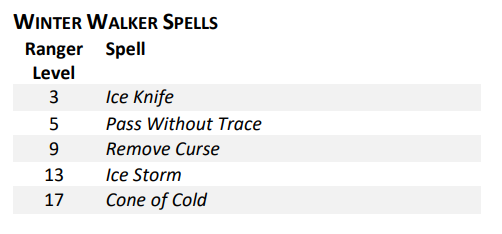
The usual extra spells for archetypes. Surprise surprise, mostly ice-focused.
Fortifying Soul (Level 7)
When you finish a short rest, a number of creatures up to your Wisdom modifier can regain 1d10+your Ranger level HP, and they have advantage against being frightened for an hour. You can use this once per long rest, though I don’t think many people take more short rests throughout the day.
It’s alright – around the same as a Cure Wounds for everyone at this level, so a good bit of healing, though everyone also has their Hit Dice to heal as well in a short rest. Unless you’ve got a very long day, it’s a decent bonus but nothing too remarkable. The advantage against frighten is also pretty good in certain situations, if you’re going against a dragon with Frightful Presence for example.
Chilling Retribution (Level 11)
When a creature hits you with an attack roll, you can use your reaction to force it to make a Wisdom saving throw or become frightened and have its speed reduced to 0. You can use this a number of times equal to your Wisdom modifier per long rest.
A nice way to disable some dangerous opponents, though it requires you to be the target of an attack (as opposed to taking damage in general like, say, failing against a Fireball) – so you’ll have to risk it a bit.
Frozen Haunt (Level 15)
Once per long rest (or by expending a 4th+ level spell slot) you assume a snowy, ghostly form when you cast Hunter’s Mark. This lasts as long as the spell does, and you gain immunity to cold damage, immunity to being grappled, prone, or restrained, you can move through objects and creatures, and finally each creature of your choice within 15 feet of you takes 2d4 cold damage at the start of your turn.
Just be careful with this – it lasts as long as Hunter’s Mark lasts, and that requires concentration, so you might find yourself out of it pretty quick if you’re in the middle of a lot of enemies. It’s pretty tempting to move in to maximize your cold damage, but… you can see where this is going. Although you get free casts as a Ranger regardless. I think it could be stronger though – the damage is a bit too low for this level.
Overall, this looks like a more defensive style of Ranger, with extra healing and THP, and a slow, attritional damage. I like this one, but i think it could do with some buffs – as it is, Rangers are not tanky enough to support this kind of playstyle, and I also think it might get a bit old to have the exact same gameplan every combat – revolving pretty much entirely around Hunter’s Mark. Although, I think that’s a common issue with martial classes in general… They don’t have much variety.
Rogue – Scion of the Three
A “Gruesome Agent of Malice”, this is a rogue connected to the Dead Three, aka the gods Bane, Bhaal, and Myrkul. These particular ones have been recently a bit more high profile with Baldur’s Gate 3 being released a while back, and especially if you’ve played as The Dark Urge, so it’s not unexpected for them to make an appearance here.
Bloodthirst (Level 3)
If your Sneak Attack hits a bloodied creature, you deal extra damage equal to half your Rogue level.
In addition, when an enemy you can see is reduced to 0 HP, you can use your reaction to teleport up to 30 feet. You can use this a number of times equal to your Intelligence modifier.
At level 3, that’s just 1 extra damage on your sneak attack, but I suppose any little bit helps, and it starts adding up. As for the teleport, rogues always appreciate extra mobility, either to set up another sneak attack next to an ally, or to slink back and hide away.
Dread Allegiance (Level 3)
When you finish a long rest, you choose between Bane, Bhaal or Myrkul. Depending on your choice you get resistance to psychic, poison, or necrotic damage, and you gain access to a cantrip: Minor Illusion, Blade Ward, or Chill Touch respectively.
It’s alright. Blade Ward certainly got a very vital improvement on 2024 over 5e, and it’s a nice extra thing you can spend your concentration on, but I don’t know if a rogue really goes for something defensive; this includes the resistances, which are a bit esoteric in terms of damage types. Minor Illusion is always nice for creative uses, and Chill Touch is also a decent cantrip, though I don’t think rogues would really go for that over a weapon attack. I think I would prefer something more aggressive in place of that, or, if you want to keep the different damage types, there are plenty of fun things you could do. For example, something that came to my mind (if you want to avoid stacking even more damage) you could have it so that your sneak attacks now deal that corresponding damage type instead of their normal one. Still, this is a secondary feature to Bloodthirst at level 3, so it’s better to keep it low-power.
Strike Fear (Level 6)
You gain a new option for your Cunning Strike which costs 1d6; your target makes a Wisdom saving throw, and is frightened for 1 minute if they fail. Not bad – as good as the Trip option I’d say, maybe better. Probably your new default option for Cunning Strike? Though it feels a bit late at level 9 – this could have another option as well to make it spicier, though the theme certainly fits.
Aura of Malevolence (Level 13)
At the start of your turns, each creature of your choice within 10 feet of you takes damage equal to your Intelligence modifier, with the same damage type you have chosen from Dread Allegiance. This damage ignores resistance.
Mixed feelings here. Assuming you have 20 INT, that’s 5 damage to each target. Sure, it’s always good to have, but… I can’t help but want something more. Something more flavorful, perhaps. Maybe extra damage against blooded creatures? Maybe something for frightened creatures? In addition, something I mentioned before as well in the Winter Walker, is that I’m not really very excited about the prospect of more things that ignore resistance. I get that it’s in very specific situations, but I think it’s a bad direction to go down.
Dread Incarnate (Level 17)
You gain advantage on all frightened creatures, and you treat any rolls of 1 or 2 for your sneak attack damage as a 3. This one is simple, but I do like it – it’s quite impactful but also very thematic in my opinion. You have a source of applying fear with Strike Fear, and with advantage you trigger sneak attack, which now deals increased damage. In fact, each sneak attack dice now has an average damage of 4 instead of 3.5. Well… I guess it seemed more impressive with the original wording, but it certainly feels a lot more impactful when you actually roll a bunch of 1s.
Overall, this archetype is quite promising, but it could do with some work. It also adds Intelligence as a secondary ability score, or perhaps a tertiary one since it only affects your cantrips and the damage of your Aura, so you might not really care about it.
Sorcerer – Spellfire Sorcery
Your power comes straight from the Weave. I thought all magic came from the Weave? Well, yours is more Weave-y and more raw. This could easily be a phoenix-type sorcerer too, I don’t think the “fire” part is that thematically fitting – or at least, not as fitting as it could be for something else.
Spellfire Burst (Level 3)
When you spend a sorcery point, you can choose between giving yourself or a creature within 30 feet of you 1d4+CHA temporary HP, or making a creature within 30 feet of you make a DEX saving throw or take 1d6 fire or radiant damage.
A nice feature early on, sorcerers are pretty squishy so getting some THP is nice – and extra damage is always good. And as you level up, you’re going to start using a lot more sorcery points, so you’ll trigger this more often.
Spellfire Spells (Level 3)
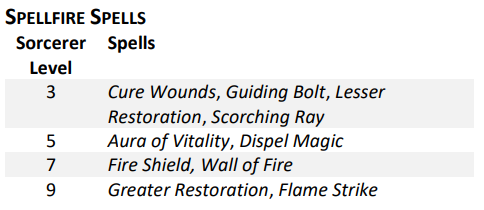
The obligatory extra prepared spells. Some fire, as well as healing – sorcerers with healing are certainly going to be interesting, especially combined with Metamagic. Distant Spell for Cure Wounds, Aura of Vitality with Extended Spell? Oh, and Guiding Bolt – this is a fun list.
Absorb Spells (Level 6)
You always have Counterspell prepared, and successfully countering a spell gives you 1d4 sorcery points back. Certainly a very good incentive for using Counterspell liberally, since you can also get back some spell slots (partially) by converting these sorcery points. This makes you a menace to spellcasters, and I’m all for it.
Honed Spellfire (Level 14)
An upgrade to your Spellfire Burst; you add your Sorcerer level to the THP, and the damage option increases to 3d6. Good to see, keeping it impactful as your levels increase. It’s pretty much a level 1 spell for free every time!
Crown of Spellfire (Level 18)
As a bonus action, you gain a number of bonuses for 1 minute once per long rest (or if you spend 7 sorcery points).
You gain a flight speed of 60 and can hover, you take no damage from succeeding on saving throws from spells or magical effects and half damage from failing, and once per turn when hit by an attack you can spend hit dice to reduce the damage taken by the roll plus your Sorcerer level.
An interesting feature; everyone seems to get flying nowadays, so that seems pretty standard, and the defensive effects are quite nice – though you probably want to roll your hit dice one by one to maximize their effectiveness by adding your level (by that I mean, even if you can block all the damage from one attack by using multiple hit dice, you let some through to let you use it more times – hit dice are a pretty limited resource too). I think it fits the archetype, and it’s nice to have an extra sink of sorcery points (though I don’t believe they would trigger Spellfire Burst).
Overall, another subclass I’m positive about – probably my favorite among the ones in this document.
Wizard – Bladesinger
And finally, we have the return of the Bladesinger.
Bladesong (Level 3)
As a bonus action, you activate Bladesong – as long as you don’t wear armor or carry a shield. It lasts for 1 minute, and ends if you wear armor, use a shield, or… make an attack with 2 hands? I mean, I can sort of see the theme, but let me use a longsword two-handed. This really forces you to play dual-wield, and i do not like that.
The bonuses you get are:
- You can use INT instead of STR or DEX for your weapon attack and damage rolls
- You add your INT modifier to concentration saving throws
- You gain AC equal to your INT modifier
Another “extra AC” feature. I guess it makes sense to have it, if you can’t have armor (which I’m not sure how to feel about in the first place – not too excited, I’ll admit) but I won’t get into it again, I already did in the Noble Genie. I will say though, with 5 INT and Mage Armor, that’s a base AC of 18+DEX – not bad. Certainly tankier than most other wizards, though your HP is still pretty bad.
You can use this a number of times equal to your INT modifier per long rest. I don’t think you’ll have an issue running out – 5 combats a day seem excessive even for hardcore dungeon delving, unless you’re using variant mechanics for what counts as a long rest.
Training in War and Song (Level 3)
You gain proficiency with all melee martial weapons that aren’t Two-Handed or Heavy, and you can use them as a spellcasting focus. Yeah, I’d say this is necessary for this class to even function. You also gain proficiency in one of Acrobatics, Athletics, Performance, or Persuasion. Probably start with the first two, wizards don’t get those easily.
Extra Attack (Level 6)
You get the standard extra attack, and you can also cast a Wizard cantrip instead of one attack. Could be any cantrip you know instead, I think some might be interesting in putting a level in Warlock for Eldritch Blast, but I guess it’s not that bad. You can go bladelock if you’re into that I suppose.
Song of Defense (Level 10)
When you take damage while Bladesong is active, you can use your reaction to spend a spell slot to reduce the damage taken by 5 times the slot’s level. Is this really worth it? It’s a far worse Armor of Agathys, so… probably not, unless you’re in a REALLY bad situation. I know wizards don’t get that spell, but they still have other tools – at level 10, you have 4th level spell slots, and that includes Greater Invisibility, not to mention stuff like Fly or Haste that probably let you zip in and out and avoid damage.
Song of Victory (Level 14)
When you cast a spell with an action, you can use your bonus action to make a weapon attack. Not bad, and not unexpected either.
Overall, i’m a mix of both positive and wary of the Bladesinger. Interestingly, for all the restrictions about two-handed weapons, the wording does allow you to use ranged weapons as well, as long as you have proficiency – both Bladesong and Song of Victory don’t restrict it, so you could use a hand crossbow if you really want that kind of janky build.
Final Thoughts
An interesting mix of things overall. I would say that most of the subclasses could use some more work – Purple Dragon Knight in particular more than the others, but I really like College of the Moon and Spellfire Sorcery. As this is an older UA, there time for feedback on the survey is long past, but do let me know what you think as well!
Join Our Mailing List
Do want…
- Extra content?
- Discounts?
- Updates about all our work?
 The Kind GM