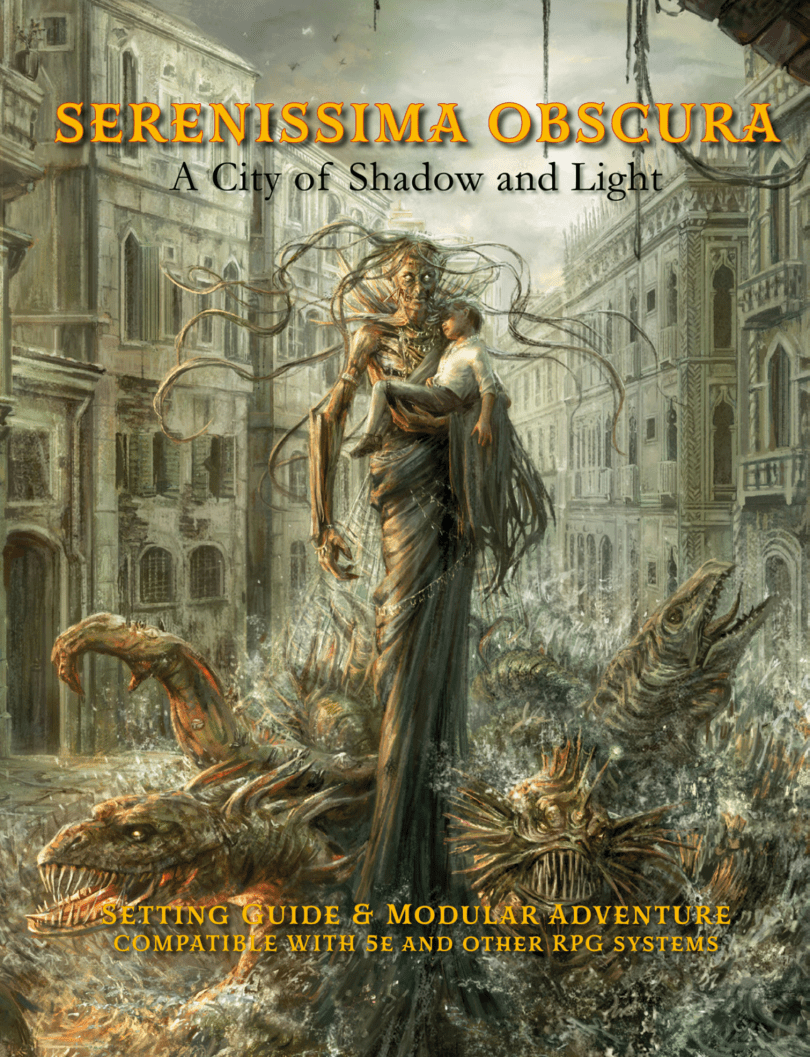
Serenissima Obscura is a 400+ page supplement by Vortex Verlag, and the sequel to The Straight Way Lost.
Disclaimer: We were provided with a free digital and physical copy of this product.
There’s going to be quite a bit we’ll be talking about, so let’s get right into it. The book is divided into 5 big chapters – well, 5 Books actually, but functionally we’ll call them chapters – and we’ll take a look in each one of them in order.
Setting Guide
Serenissima Obscura takes place during the end of the 15th century and the beginning of the 16th, during the “Magical Renaissance”. You can read The Straight Way Lost for more details, but the condensed version is this: In this Earth, catholicism is the “real” history – God created the world, Lucifer had his fall, etc etc, and specifically Dante’s Divine Comedy also happened, with a group of people travelling through Hell, Purgatory, and Paradise in order to stop the machinations of Girolamo Savonarola. There are, however, several extra things: magic is real and studied as an art and science, and so are various magical races, all with their own history.
While The Straight Way Lost placed us in Florence in 1492, Serenissima Obscura takes us to Venice after those events, in 1507. As a result of that whole story, magic, which used to be quite rare and weak, has been greatly empowered; and while it’s still not something the average person has access to, Venice is one of the most influential, powerful, and advanced cities in the world; more and more magicians, wizards, alchemists, and scientists congregate there to advance their art. In addition, magical races like the elves and dwarves (elfi and nani respectively, since we’re in Italy) are coming out of seclusion and mingling more openly with the human world – where they can afford to.
Venice specifically as a setting is a very rich and interesting location. As pretty much the center of trade not only in the Mediterranean but most of the world, you can find people, goods, and ideas from all corners of the earth. The book has a very extensive part dedicated to the city; from its wider territory (including regions of mainland Italy as well as further away colonies like Crete and Cyprus, as well as trading posts in distand lands), its society, political landscape, government, and military, to detailed information about the city’s layouts and different districs and islets (including of course the famous Arsenal) as well as minor and major factions. All in all, this is about 100 pages of rich lore and history that lets you plan and play around with the setting as you wish.
Character Creation
The second chapter/book includes new or altered rules for 5e classes and races. Note that I said 5e, and not 5.5/2024 edition. Again, there’s a lot more in The Straight Way Lost; the basics are reiterated here, but there is also The Magical Renaissance – Player’s Guide for 5e that combines the mechanical changes and additions from both books.
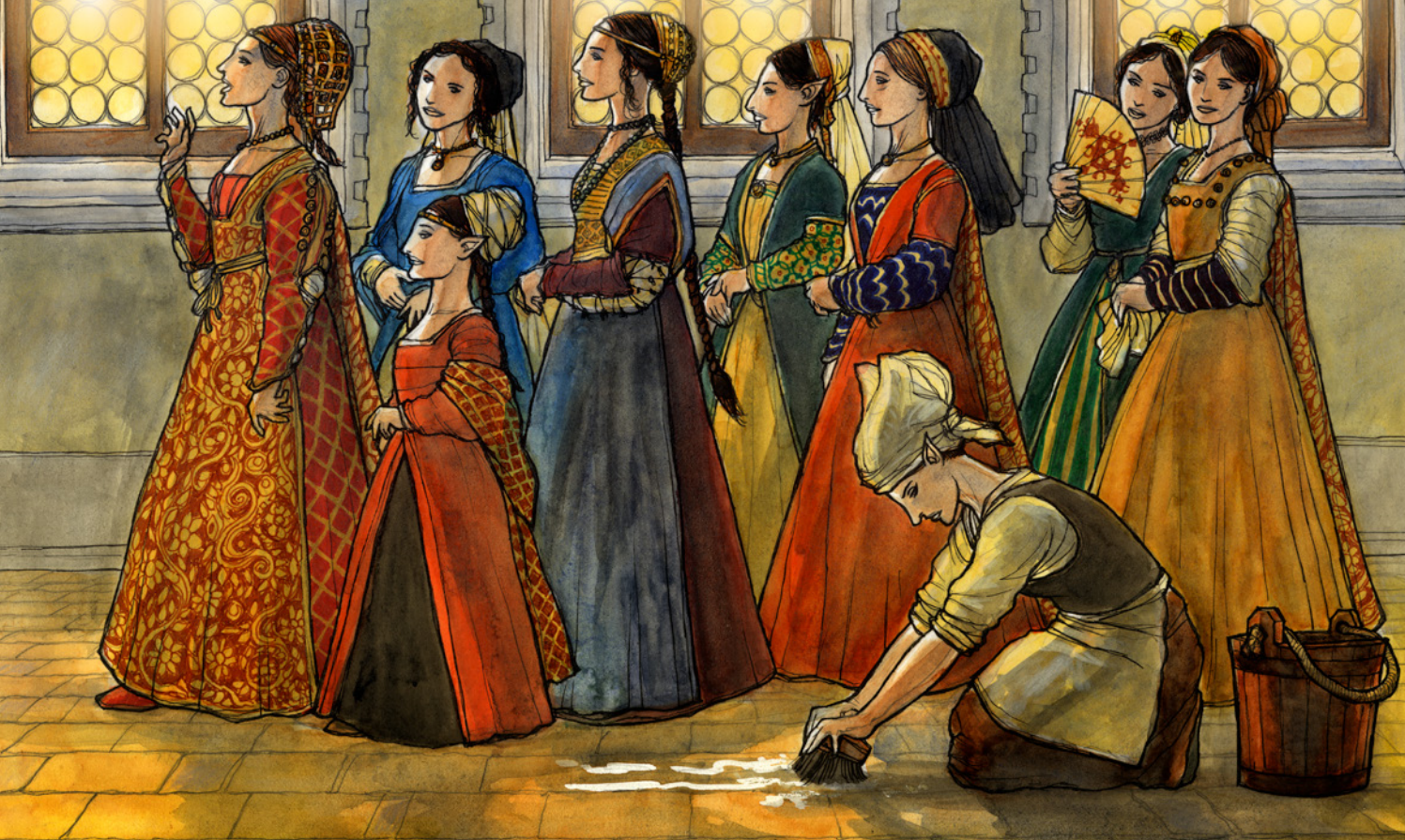
There are 5 sub-chapters to this. First, we have adaptations of known species to fit in this setting. Elves, Dwarves, and even Gnomes and Tieflings can be chosen for characters, but they need special… handling, since socially both magical species and magic in general are still contentious – especially tieflings since they will most likely not be tolerated even in the more progressive places like Venice. There is also a new option for species: The Children of the Lagoon, or Putei dea Laguna. This is a humanoid species living underwater and around the isles of Venice, connected to the ancient, hidden history of Venice’s founding and an ancient Fae Queen.
Then, we have suggestions and rules on how to play existing classes; some, like the Fighter or the Wizard, are pretty simple to incorporate, but Warlocks are going to have a tougher time and should probably not be too eager to advertise their pacts, Clerics, Paladins, and Sorcerers are more restricted on some of their choices, and Monks and Barbarians will be a tough sell. There is a new subclass for the Druid, the Circle of the City, and The Straight Way Lost also had 3 new subclasses for the bard that you can, of course, use here as well.
Finally, there are two whole new classes: The merchant has a list of powers they can use, focusing on social and political power: deals, contracts, debts, scheming, connections, and wealth. You know everyone worth knowing, you have investments and business deals across the world, and you use it all to your advantage. The Merchant has two subclasses: The Bright League, for respectable, lawful citizens who seek influence and wealth in the upper layers of society, and The Shadow Syndicate, for all the sneaky black market dealers, smugglers, traffickers, and criminals of all sorts. Then, we have the Gonneslinger; firearms are still quite early on in their development history, but they are common enough that – while not omnipresent, even in armies – you could conceivably find someone who uses one. You, however, take it to the next level by inscribing your firearm with magical glyphs to enhance its destructive powers. Again, you have 2 subclasses: The Scrapper, focusing on more close-ranged combat, mixing melee weapons and handguns for a brawling, close-range style of fight, and the Shootist, focusing more on long-range, methodical, sniping style of combat using long arms.
Game Master’s Guide
The third chapter/book is a bit of an introduction to the campaign and modules included in this book, as well as some more information and advice for the GM on how to prepare and run them. We’ll get more into it in the next parts, but there are two different sets of adventure modules, one for the “Bright Side World” and one for the “Dark Side World” – one takes place in the “mortal realm” while the other in the fey realm, but they can be played in any order. In fact, there are also three categories of modules if we look at them a different way: modules that are interconnected in the main overarching storyline, which constitute the main “campaign” – though even those are more of a sandbox without a definite order – modules that seem to be related to the main adventure but are more of sidestories that don’t really affect it besides getting the players to know more of Venice and build up their reputation, and modules that are completely unrelated and can be used as stand-alone plots. Of course, you can also just ignore the “main quest” and just have your players have adventures across Venice and the wider region, using the modules as inspiration or just not connecting them.
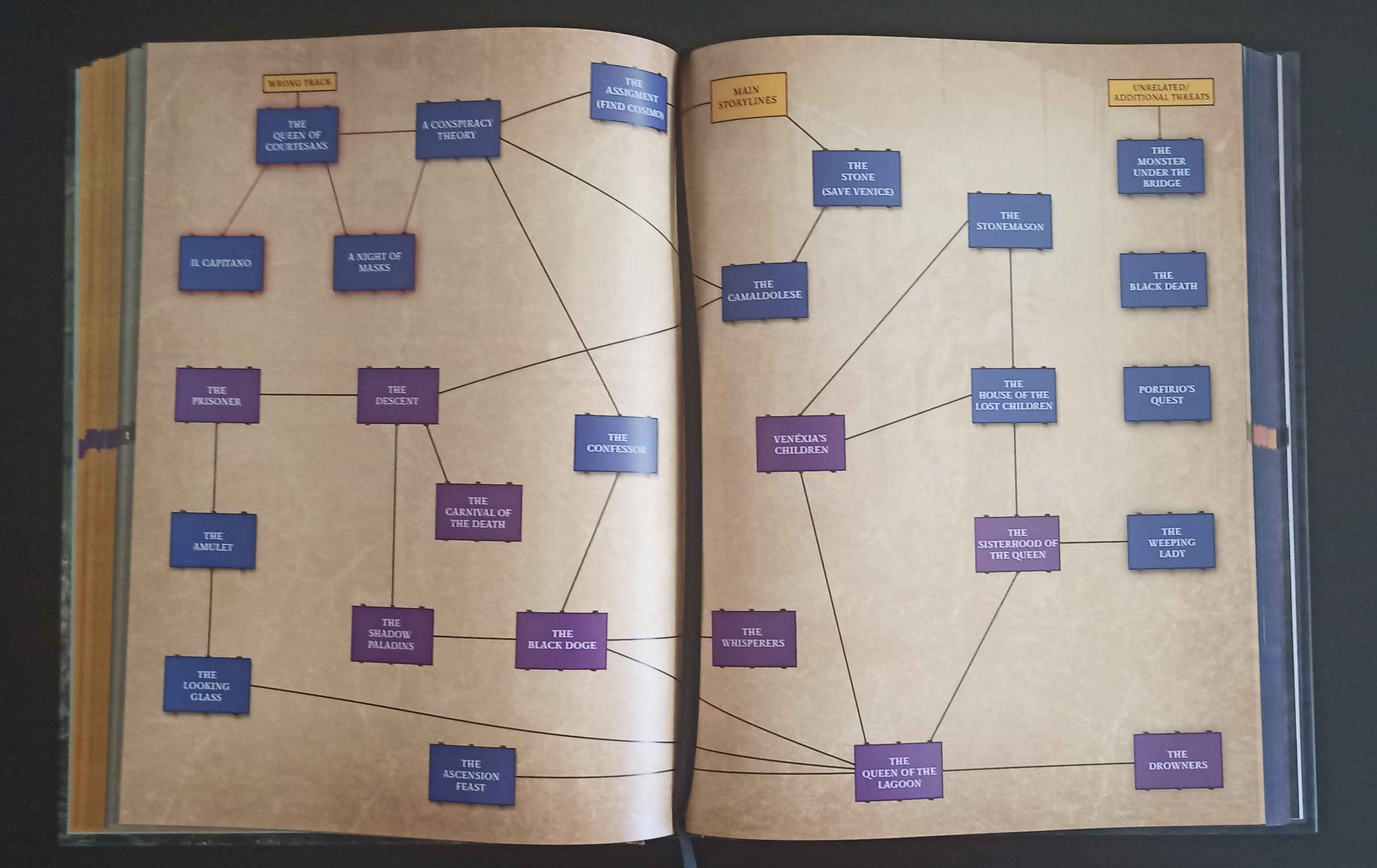
There is also here a small timeline, as well as a two-page spread showing a graph of how all the modules connect and interact, that I found extremely nice for letting you plan ahead. Finally, there are some additional information about money, climbing the social ladder, as well as a small part about building and outfitting a house with various extra things to use as a base of operations.
Adventure Modules
I’ll talk about the modules in both the Bright Side and the Shadow Side together – I won’t spoil much of the story, since it relies a lot on mystery and ancient lore, but there’s a lot of them as you can see in the image above. There are 17 modules for the Bright Side, and 10 modules in the Shadow Side, taking up around 200 pages all together.
There’s a lot of stuff to do, including combat but also a lot of exploring Venice, talking with people, investigating conspiracies and secrets, and so on. Like with The Straight Way Lost, you won’t get as much dungeon crawling and indistcriminate monster murdering as you usualy do in a more high fantasy world. However, something that is quite different from the previous instalment is that the more freeform aspect of the sandbox campaign will make it a lot more attractive to a much more diverse playerbase. Dante’s journey through the Divine Comedy might have been a very highly specific thing to play through, and while it was a fascinating adventure, it was in many aspects constraining. Now, you have a much wider world available to you, and one that is more accessible and customizable.
The Physical Book & Miscellaneous
I was really impressed with the physical book of The Straight Way Lost, and Serenissima Obscura is just as good, if not better. I’ve seen some comments that the glossy pages aren’t everyone’s preference, which makes sense, but they haven’t caused me any issues. Everything is in order: the hardcover, the binding, etc, and the colours are just as gorgeous – though they have been toned down a bit to more muted blues and yellows. I also like how every chaptes has its own page color (you can see it somewhat on the photo above), so if you’re looking for something specific you can often just open the book in a page very close to what you want and just flip to it. And if you’re worried you’ll still have difficulty reading it due to the colors, the digital files include a high contrast version. Finally, if D&D doesn’t feel like the right system, there is also a conversion guide for Ars Magica.
Final Thoughts
I remember when writing about The Straight Way Lost that, while incredible, wasn’t for everyone. I think that Serenissima Obscura has surpassed it by a lot; a vastly expanded world, a very detailed setting guide, and a highly customizeable sandbox adventure make it a lot more approachable while still maintaining the same charm and mystery of the Magical Renaissance.
This post contains affiliate links. By using them, you support the blog without any extra charge being applied to you.
Join Our Mailing List
Do want…
- Extra content?
- Discounts?
- Updates about all our work?
 The Kind GM
Very interesting. I love Venice, and setting a campaign in a magical version of it would be cool.
LikeLiked by 1 person