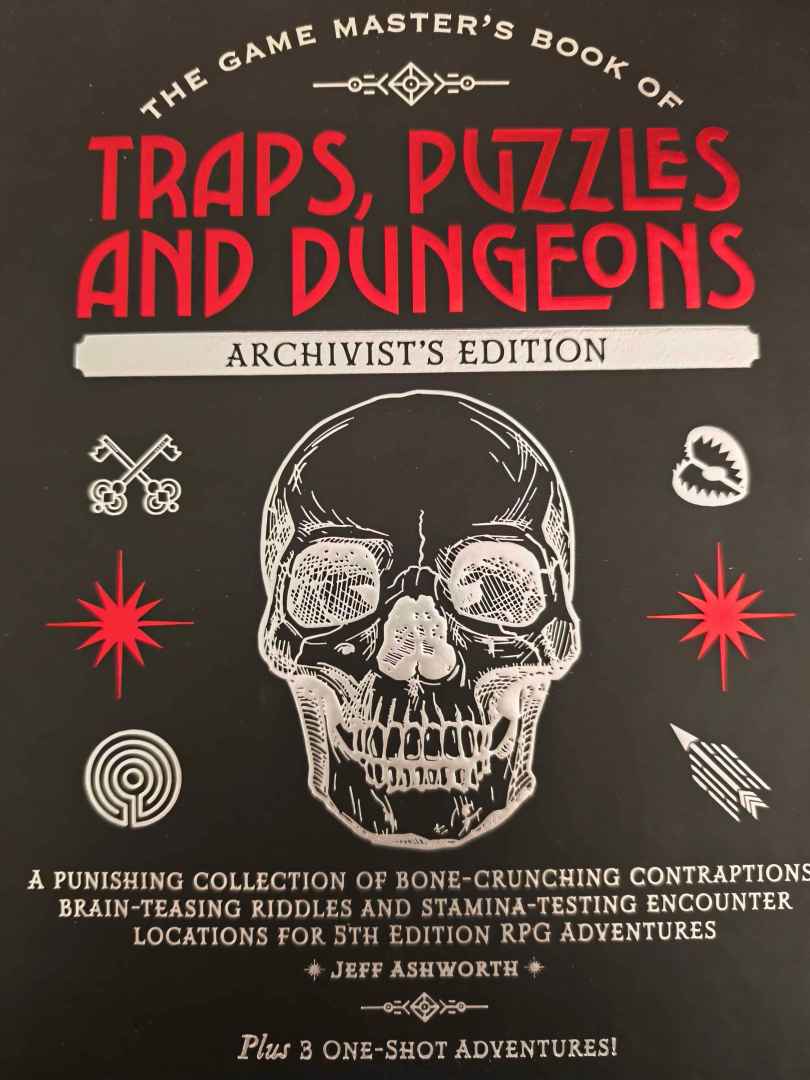
Bone-crushing? Yes! Brain-teasing? Also yes!
The Game Master’s Handbook of Traps, Puzzles and Dungeons – Archivist’s Edition is a collection of traps, puzzles and dungeons by Jeff Ashworth, and it offers plenty of inspiration for Game Masters looking to challenge their party in deadly ways. It is part of the Game Master Series, a library of 18 (so far) books, and we have already reviewed The Game Master’s Handbook of Patrons, Pacts & Pantheons, The Game Master’s Book of Magic and Mayhem for Kids, and The Game Master’s Deck of Fantastic Familiars & Animal Companions.
Disclaimer: We were provided with a review copy of this product.
Content chapter by chapter
The Game Master Series tends to include a foreword and introduction, where creators share their thoughts and offer advice in 3 subsections on what this book is, what it isn’t, and how to use it. The book is divided into 5 sections, beginning with One-shot adventures. This chapter presents 3 ready-to-use adventures, each presenting a different challenge. In The Spire and the Scab, an earthquake has disturbed the peace of a mountain town as an ancient evil could have been released. Pick of the Litter sends the party to the Plane of Heroes to help a young sphinx become a divine guardian through a series of gruesome traps and puzzles, while Skhalhammer Manor features disappearances, nightmares, and a dream dragon. These adventures offer a nice starting point for GMs that want to try the book’s contents, without building a dungeon from scratch. The best part? NPCS are at the end of every one-shot, so no need for extra page flipping.
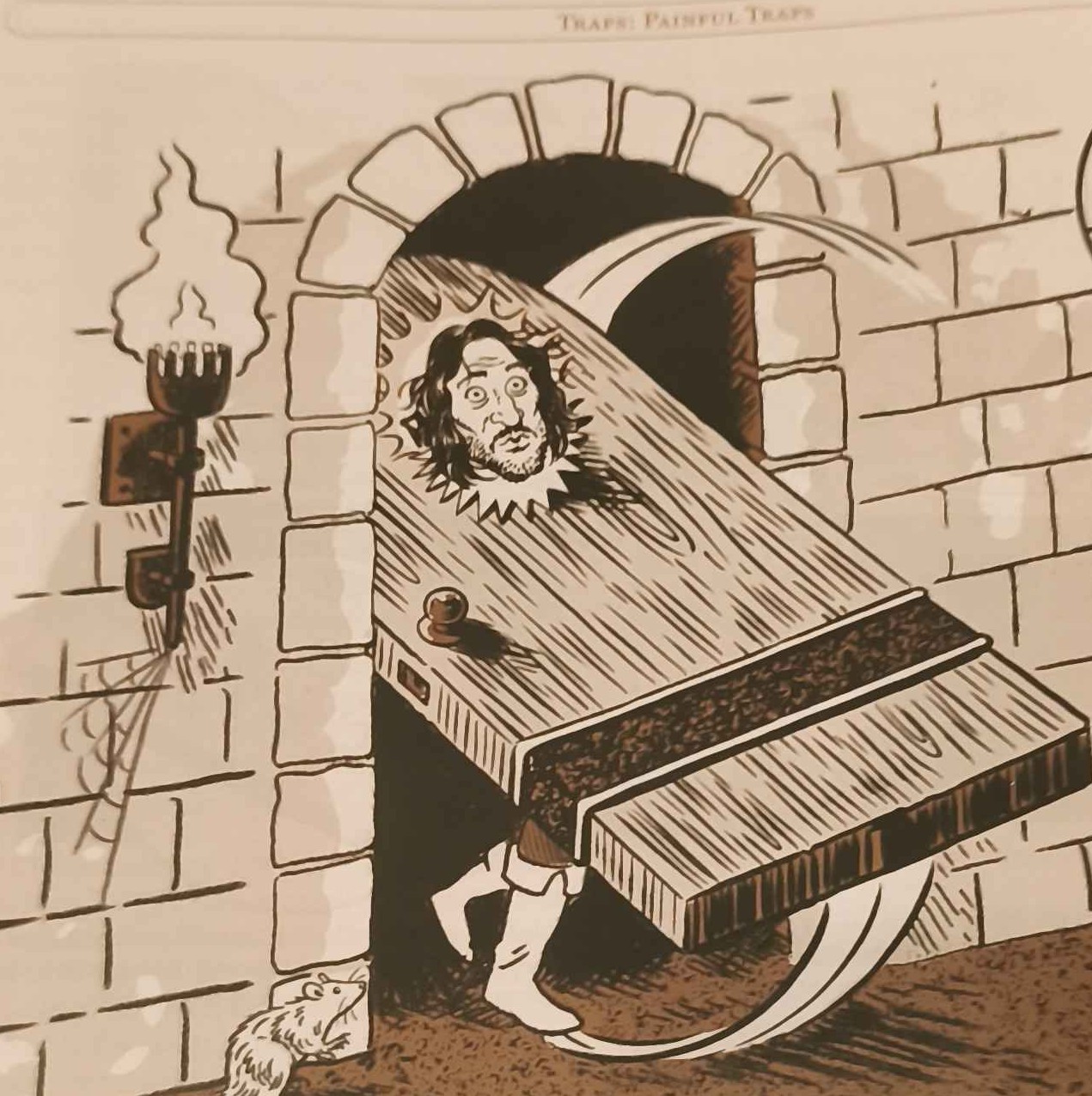
Up next, we have the Traps section. Traps are organized by their purpose and the kind of challenge they present, and are divided into four categories: painful traps, deadly traps, disruptive traps, and complex traps. This variety makes it easier to find what is appropriate for each party and situation, and not all of them are designed to be deadly. A personal favorite is the reverse knock, where turning a doorknob results in the unfortunate adventurer being trapped in the door. What a way to make players think twice before opening a door.
The Puzzles section comes with three categories. Rhymes & riddles challenge even the most perceptive players and are accompanied by a scenario to help the GM set the scene, but they can be presented however seems fitting. Ciphers are real-world puzzles that players need to solve to decipher hidden messages. Lastly, gateway puzzles, as the name implies, block access to something the party wants and require big brains instead of brute force. If I had to choose one, it would be the barbarian’s brilliance, but I won’t spoil it.
The fourth section, Dungeon Chambers, is the biggest chapter of the book, with 50 rooms that would put a smile on many DMs. The following sentence pretty much says all you need to know:
And, if your party gets lost or confused navigating these spaces, well, maybe they shouldn’t have entered your dungeon in the first place?
Each chamber offers a different location, ranging from the herbalist’s greenhouse to the monstrous closet. This section is quite useful, especially for anyone who wants to create and run a dungeon crawl but does not have time to design every room themselves.
Last but not least, random selectors are roll tables for those times when fate better decide what happens next. Rather than flipping through the entire book to find something suitable, GMs could roll their dice and introduce a new obstacle when improvisation is needed throughout a campaign. It might seem like a simple addition, but it makes the book even more practical at gaming tables.
Layout & Art
They say don’t judge a book by its cover, but I couldn’t possibly resist giving it bonus points for such an amazing design. The book comes in two editions, Original and Archivist’s, respectively. The Original Edition features a skull design with geometric symbols, decorative borders, and blood-looking splatters, suitable for a dark atmosphere. The Archivist’s Edition features a bolder look, with black imitation leather decorated with silver and crimson foil stamping. and crimson lettering. The metallic crimson page edges are the perfect finishing touch. We have it, and it’s an absolute treat to look at.
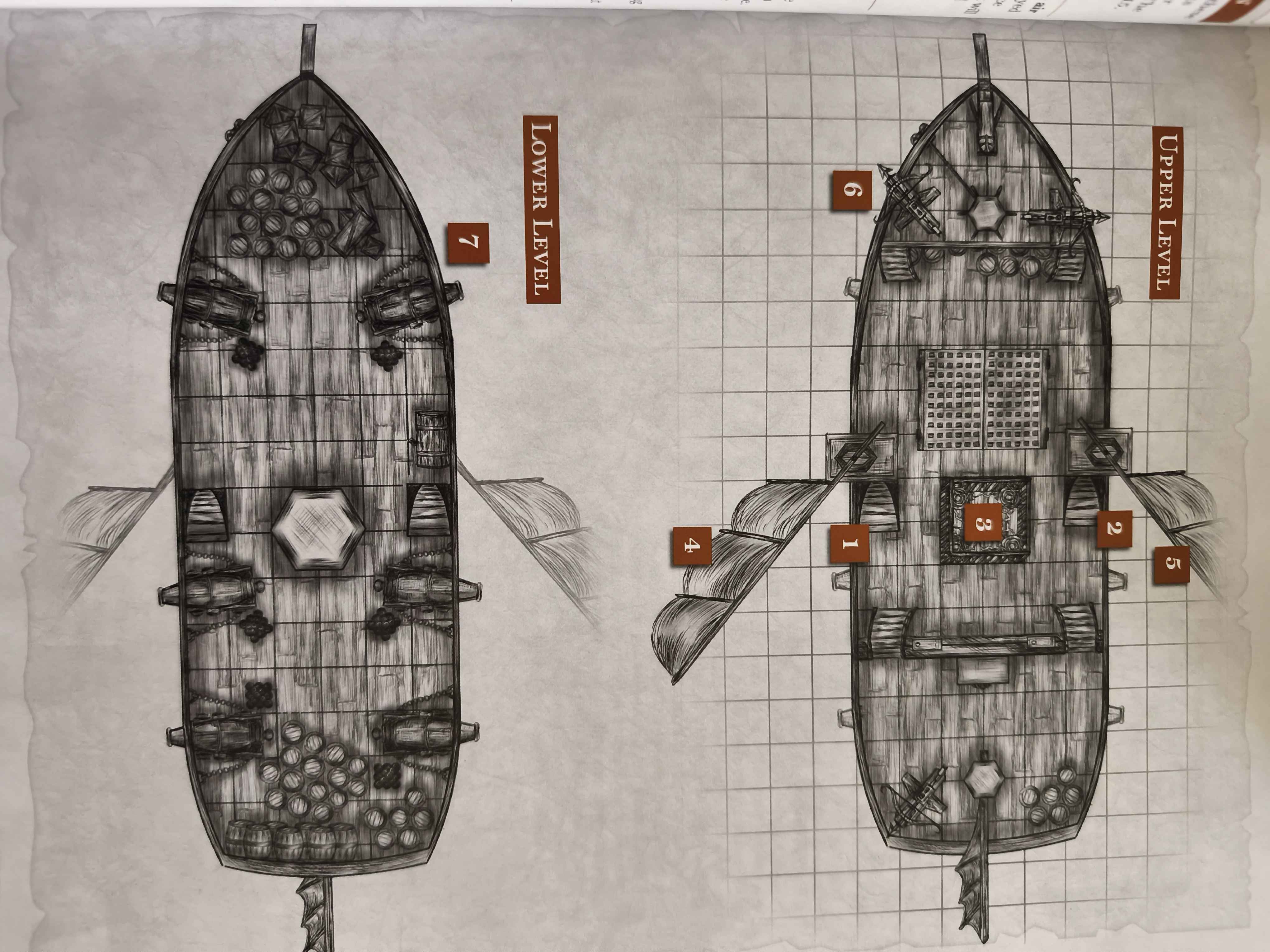
The book has 253 pages presented in a polished layout. A table of contents is present, and each section has a dedicated two-page cover. The book’s elements such as titles, text boxes, and map markers follow a red-hue coloring pattern, which I find very fitting to the overall theme. Maps are placed wherever needed, numbered and referenced, too. The illustrations follow a striking comic-book style, with black, white, and brown-red tones that give off an old-school fantasy vibe. I particularly enjoy this expressive and dynamic artwork, as you can picture the unfortunate adventurers suffering through all manner of unfortunate situations. – hehehe, evil laugh. Each art piece adds character and atmosphere without feeling distracting. A solid 10/10 from me!
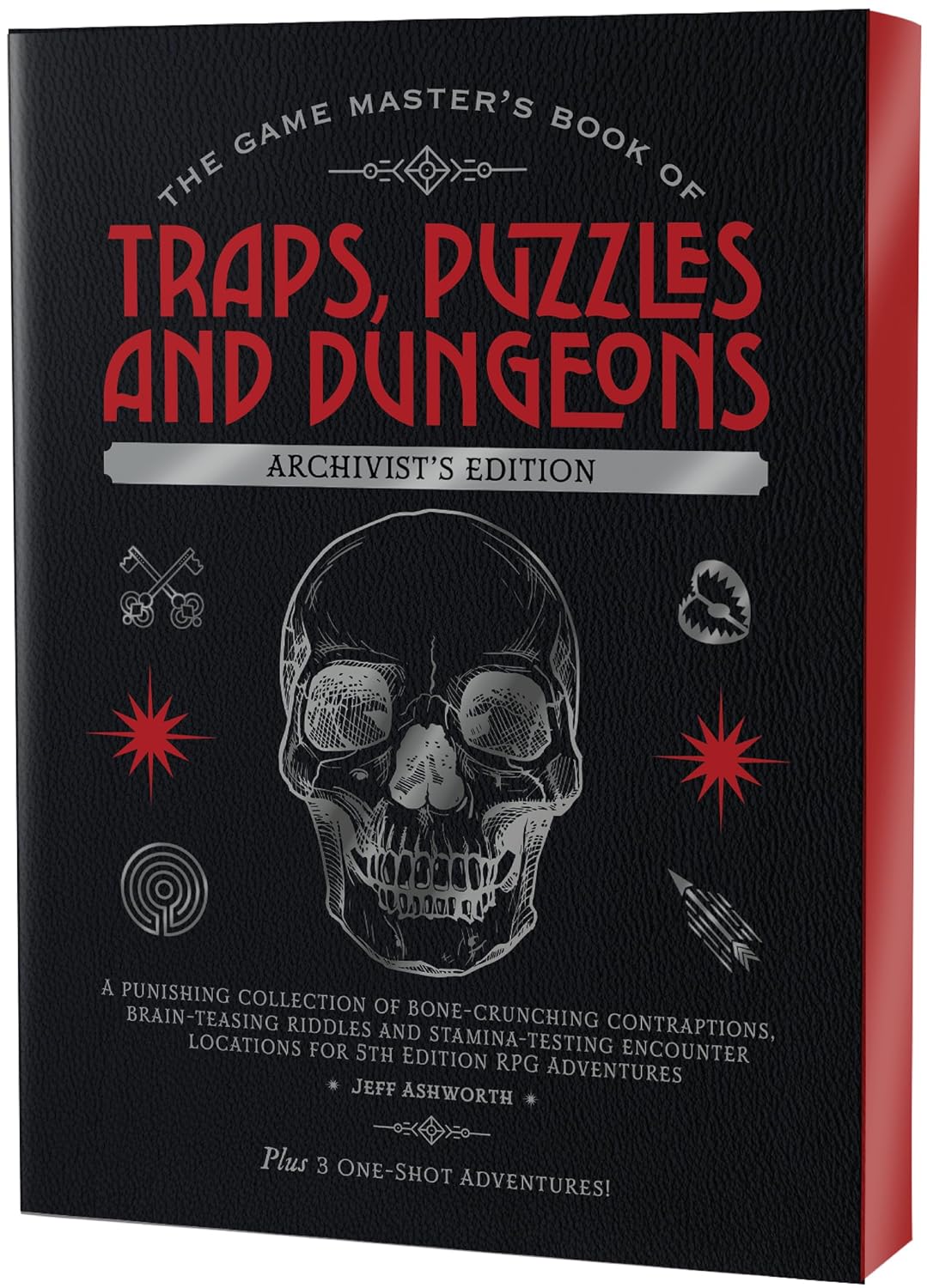
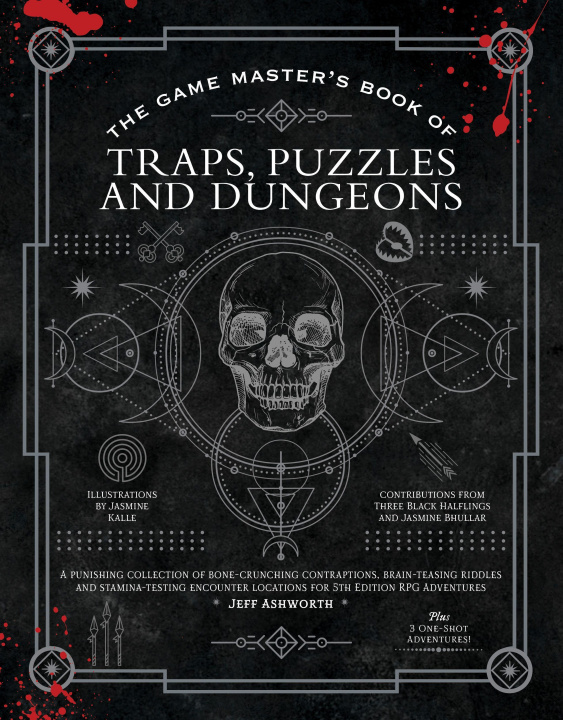
Archivist’s Edition vs Original Edition side by side.
Final Thoughts
I believe that The Game Master’s Handbook of Traps, Puzzles and Dungeons – Archivist’s Edition is a handy resource for every table that wants to spice up their games. There is plenty to borrow and adapt: ready-to-run adventures, a wide variety of traps and puzzles, and dungeon chambers. I appreciate the plethora of options as it supports inspiration rather than dictates it. And if you are a collector like us, the Archivist’s Edition is a lovely addition to your shelf.
#NicoleRecommends ? I definitely do!
Stay crafty and embrace chaos,
Your new favourite author.
Join Our Mailing List
Do want…
- Extra content?
- Discounts?
- Updates about all our work?

