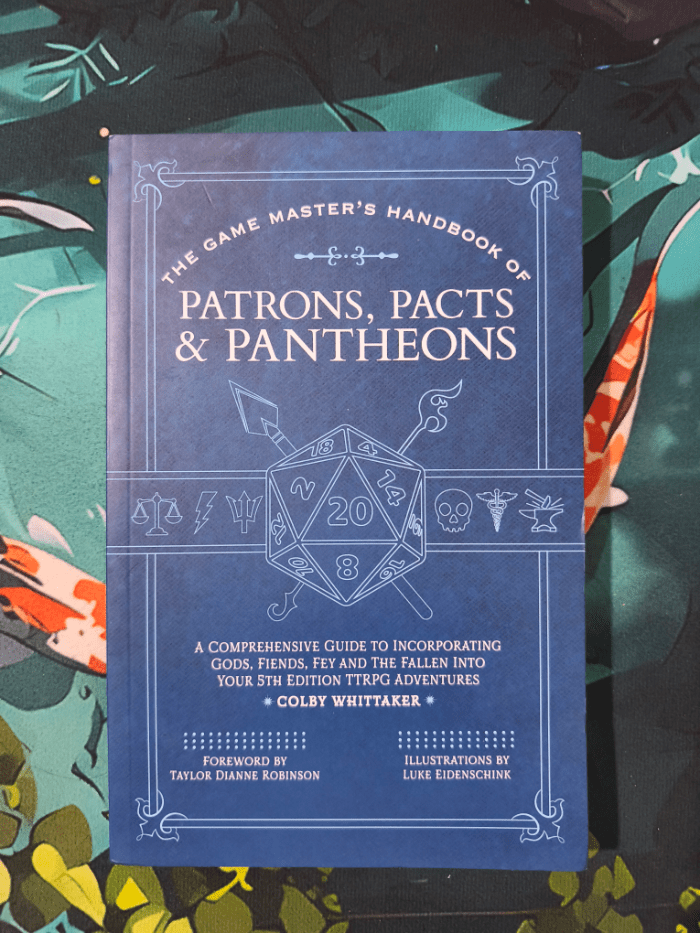
Guess what arrived in our mail!
The Game Master’s Handbook of Patrons, Pacts & Pantheons is a book of more than 300 pages by Colby Whittaker, also known as Hagiologist, and illustrated by Luke Eidenschink, and is all about gods and pantheons. Religion is something that often just exists in the background of a campaign, so it is nice to see these supernatural entities becoming an active part of the world and shaping adventures.
Disclaimer: We were provided with a review copy of this product.
Content chapter by chapter
The book is organised in 5 chapters, starting with Chapter 1 – Religion. Rather than simply explaining religion as a concept, the author explores how religions function within a world. They present different approaches to religious settings such as polytheism, dualism and even eldritch horror. Practical guidance is also provided for omnipotence. If gods are all-powerful, why would they rely on low-level adventurers to accomplish heroic deeds? The book offers answers to this question while avoiding situations where divine intervention would make the adventurers’ choices feel meaningless.
Another thing worth mentioning is religious practitioners. Here religion extends beyond adventurers and clerics or monks, introducing laypeople, institutional leaders, scholars, clergy and academics with examples that demonstrate how these ideas can be infused in a campaign.
Finally, the chapter introduces Favor and Gifts. Game Masters and players can track a character’s relationship with a deity, supernatural patron or force through a favor score, which begins at zero and increases by objectives accomplished by said character. The book includes an extended list of objectives and the rewards they grant. As favor grows, characters receive gifts ranging from new cantrips and spells to languages and ability score improvements. However, maintaining that relationship is as important as building it, as favor can decline and cause the bestowed gifts to vanish.
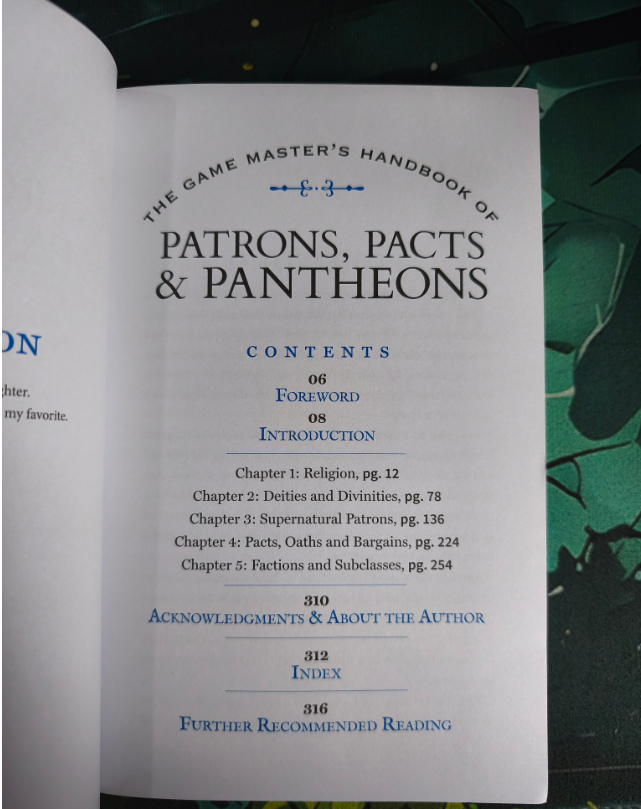
Chapter 2 – Deities and Divinities is dedicated to building memorable gods and divine beings. In total, 17 entities are presented, distinct enough to inspire every GM as they craft their adventure. Each entry includes the deity’s name, other epithets they may use, portfolio (the areas over which they hold authority and influence), precepts and defining characteristics.
Then the chapter shifts from worldbuilding to practical advice in a section called Roleplaying Deities. It includes how gods communicate, the tone of their speech and how they convey their overwhelming majesty. Divine encounters are encouraged to feel extraordinary, accompanying divine visions with supernatural phenomena to remind players that they stand before something far beyond their understanding.
The To Stat or not to Stat section discusses whether deities should have stat blocks. Instead of encouraging direct confrontations with divine beings, the author recommends using avatars when interaction or combat is necessary. That way, the god’s unreachable nature is effectively preserved while allowing meaningful encounters. It is suggested to give deities appropriate skill modifiers so that they can participate in social interactions without being reduced to ordinary NPCs. – and help the GM avoid their wrath!
The final section of this chapter is a collection of random religion tables to aid Game Masters when creating their religions. History, beliefs, daily rites and rituals can be generated or expanded, making religions feel active parts of the setting.
Chapter 3 – Supernatural Patrons is all about powerful entities that exist beyond traditional gods. These patrons can become the source of a character’s magical abilities, provide ancient knowledge, or even serve as sponsors for quests and long-term arcs. Unlike deities that are usually established during worldbuilding, patrons can be introduced at any point in a campaign to fulfil a specific role, whether as an antagonist, a guide or a guardian.
I want to highlight the Demands and Desires section, which explains that every patron has their own expectations of those they seek their aid. If they are good in nature, they may ask for noble deeds, while others can be manipulative and exploit their followers for their own gains. This creates many opportunities for roleplaying, making moral dilemmas naturally play a role in adventures.
Similar to Chapter One’s omnipotence, there is the concept of Phenomenal Cosmic Power. The book explains that despite their supernatural abilities, patrons are under the limitations imposed by the world. The chapter is concluded by a variety of patron types and ready-to-use examples. Each entry begins with advice on how to roleplay the broad category of the patron, followed by their desires, favor objectives and gifts. In the individual entries, their appearance is described, along with motivations, possible relationships with both PCs and NPCs and the precepts of those who follow them. The author doesn’t stop at premade examples, and provides enough guidance on modifying existing patrons or creating new ones, reinforcing one of the book’s biggest strengths: it teaches you to create your own content and not just use what is already written. To make this process easier, a patron roll table is also included.
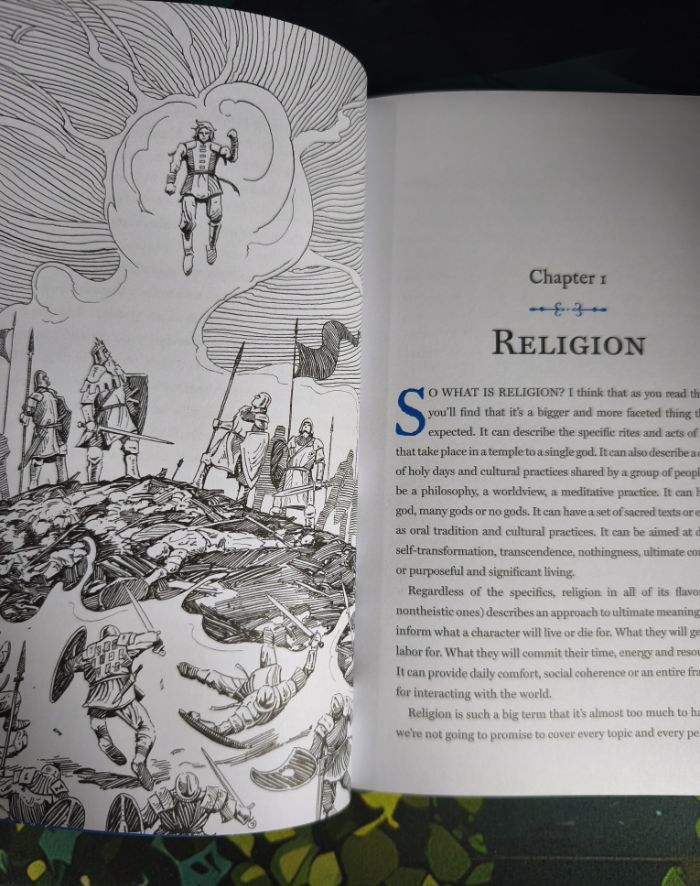
Moving on to Chapter 4 – Pacts, Oaths and Bargains. This chapter explores the possible agreements a character can forge with supernatural entities. It is made clear that these agreements are not meant only for warlocks, as anyone could have a reason to enter such a contract. Formal declarations help in defining the bond between a character and their patron, often challenging them or placing meaningful limits on their actions.
Timing plays an important role here. The chapter presents the moments when these agreements are most impactful, such as times of great need, moments of panic, or emotional crisis, presenting pacts as opportunities for character development and memorable tales. It distinguishes contracts, oaths and bargains. Contracts are formal agreements with clearly defined clauses and expectations, often conflicting but very tempting for characters. Oaths represent promises whose fulfilment depends on whether the relevant parties believe that the oath is honoured. On the other hand, bargains are much less formal, and often verbal, while they may conceal hidden meanings, encouraging their participants to choose their words carefully.
Then, in Carrots and Incentives, we find practical suggestions for encouraging players to embrace these pacts. Boons and Banes section includes narrative rewards and drawbacks that reflect a patron’s or deity’s influence upon a character and range from beneficial to mixed and negative effects. One of my favourites is the Hour of the Hunted, a boon that transforms the character into a small beast of their contractor’s choice at every dusk, leaving them in that form until dawn. But if their hit points are reduced to 0 while in beast form, they return to their normal form unconscious and unstable.
The final chapter, Chapter 5 – Factions and Subclasses, ties everything together by introducing organisations that are devoted to deities, patrons and supernatural powers. These factions could serve various roles in a campaign, such as quest givers, sources of knowledge, trusted allies or antagonists. Several examples are provided and include the faction’s motivations, notable members, tactics and stat blocks.
Last but not least, there is a selection of thematic subclasses designed to complement the theme of the book. New options are presented for the paladin, the warlock, the druid, the cleric and the monk, allowing players to take a deeper step into faith, devotion and supernatural powers.
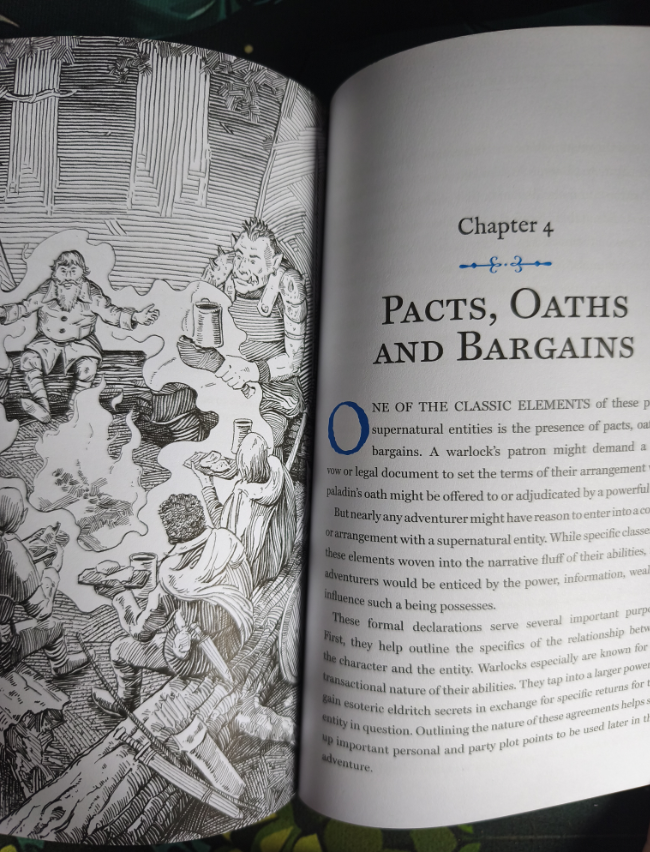
Layout & Art
The book features a clean and polished layout that makes reading and navigating its 300+ pages surprisingly easy. The table of contents at the beginning, clear chapter divisions, bold headings and well-organised tables allow readers to locate specific topics with ease. Distinctive blue titles give the book a visual identity, while GM tips are also provided in blue boxes throughout the book. The illustrations that introduce each chapter complement the book beautifully, with black and white scenes that capture the themes of faith and divinity.
Final Thoughts
Overall, The Game Master’s Handbook of Patrons, Pacts & Pantheons succeeds in making religion, divine beings and supernatural forces an active part of every campaign, rather than background lore. I believe that it effectively teaches GMs how to build rich worlds with pantheons and religions. Now it is time to hand the book back to Chris and let him seek divine enlightenment as well!
At the time of writing this review, the book is available for preorder and will be released on August 18, 2026.
Stay crafty and may your patrons favour you,
Your new favourite author.
Join Our Mailing List
Do want…
- Extra content?
- Discounts?
- Updates about all our work?
This post contains affiliate links. By using them, you support the blog without any extra charge being applied to you.


Looks amazing! I will definitely pick it up, as I have enjoyed the other books in this series quite a bit – the Dragon book being a particular favorite!
LikeLike
We’re glad you enjoy the series. Legendary Dragons are on our wishlist ( We can’t wait to review it). We hope that you enjoy this one as well, and we’d love to hear your thoughts once you get the chance to read it.
LikeLike