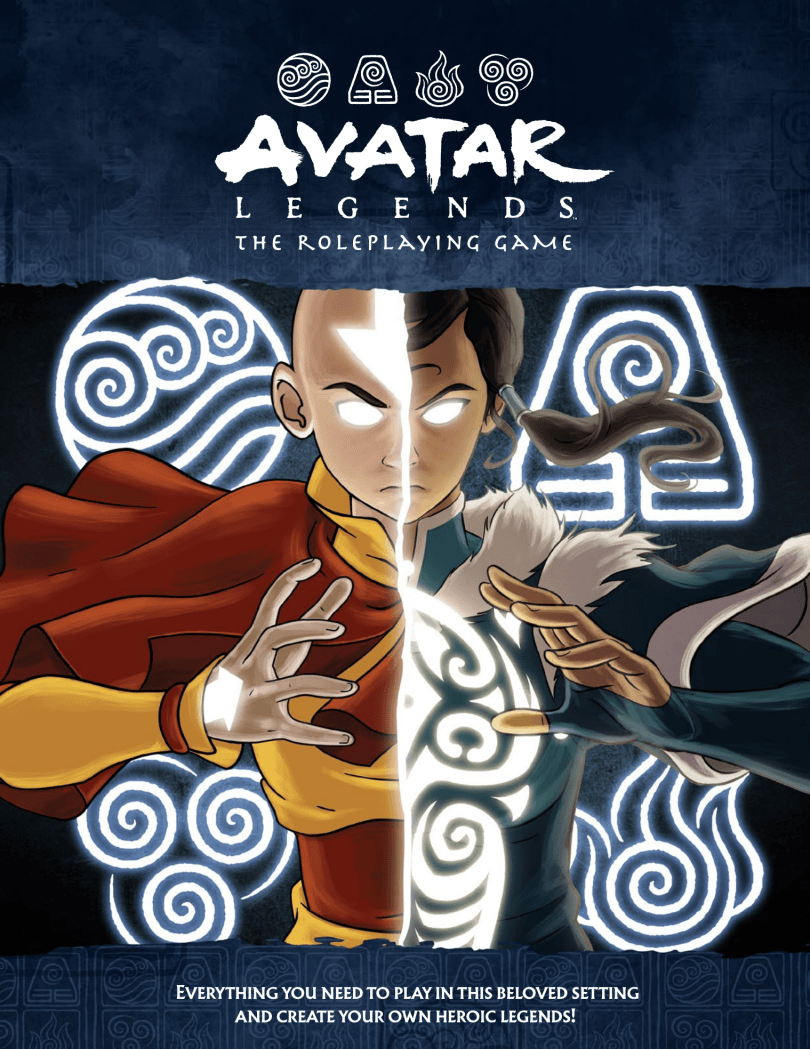
Avatar Legends: The Roleplaying Game is a TTRPG developed by Magpie Games for playing in the world of Avatar: The Last Airbender.
Setting
The setting is, well, the world of Avatar. The Core Book has a chapter dedicated to explaining the setting, though you’ll need to have already watched the shows or read the novels if you want to get the full scoop; this is more of a primer/reminder with some additional information than a full setting guide. However, you can play in various different eras: the Kyoshi Era, the Roku Era, the Hundred Year War, the Aang Era, and the Korra Era, each with their own challenges and troubles. For each era, you get an overview of major events, important figures, and threats and challenges for each of the four nations.
I’m not going to get much more into the setting; you’re most likely already familiar with it, and if you’re not, there are better, more comprehensive sources to find out more.
System
Avatar Legends is based on Powered by the Apocalypse. I guess the better way to say it is just “Avatar Legends is Powered by the Apocalypse”? Anyway, we’ve seen some other systems using PbtA before, but this is a bit more… mainstream, I guess. The system is pretty simple; you roll 2d6, 7+ is a partial success – or a “weak hit”- 10+ is full success or a “strong hit”, anything below that is a miss. The GM doesn’t roll dice, just describes the scenes and results of the players’ actions. Those actions are called Moves – there are several Basic Moves that everyone has access to, like Assess, Guide, Trick, et cetera. There are also Balance Moves that everyone can do – we’ll talk about Balance later. There are also Exchanges; in cases where there is reason to run a more extended combat that the Basic Moves can’t resolve, the combatants start Exchanges. They each choose an Approach – Defend and Manoeuvre, Advance and Attack, or Evade and Observe – and roll accordingly. Each approach also has basic and advanced techniques for more custom and engaged fighting. However, using Exchanges is meant to be more cinematic than technical; each player is paired up with their own target (or they just gang up on someone), but it’s not meant to have some sort of highly tactical, synergistic combat.
As for the characters themselves, they have 4 stats: Creativity, Focus, Harmony, and Passion. Each of those can go to a maximum of +2, or a +3 by choosing a special Advancement Move. You also choose a Playbook – essentially an archetype that gives you a starting point spread, usually +1 to two stats and -1 to another, as well as access to specialised Moves. The Core Book includes 10 Playbooks. Each character also has Fatigue; you can get up to 5 Fatigue before starting to get some negative effects, and there are plenty of ways to accumulate it; but it’s also not that hard to clear it as well.
Finally, there’s Balance, a pretty core part of the system. When you create your character, you choose two somewhat antithetical ideas; the example given is Self-Reliance and Trust. You have a 5-point track, with each idea at either side – on that track, you mark your current balance and your centre. During the game, you (or others) can take Balance Moves that shift your balance towards or away one of the ideas. Reaching past the edge of the track gets you to Lose your Balance, with its own negative effects; throughout a longer campaign, you can also slowly shift your Centre towards one or the other side. If you reach the edge with your Centre, it means you are fully committed to that idea. It’s an interesting mechanic that actually fits a lot with the way the system appears to be envisioned; a more thoughtful, exploratory system about the characters and their beliefs, rather than a grand world-shaking story (though that can obviously also happen).
Final Thoughts
I really liked Avatar: Legends as a system, and found it really fitting for the setting it was designed for. I will admit that I usually prefer mechanical settings over the more open-ended, roleplay-focused ones, but this had some quite nice ideas – the Balance track especially is quite inspired, though not everyone will enjoy such heavy integration of their character’s personality into the actual game mechanics.
This post contains affiliate links. By using them, you support the blog without any extra charge being applied to you.
Join Our Mailing List
Do want…
- Extra content?
- Discounts?
- Updates about all our work?


My experience with this game varied based on whether I had already consumed the animated series. Some people find the world easier to grasp without prior viewing.
LikeLiked by 1 person
I should probably check this out, since I’m a big fan of both AtLA and PbtA. I think I’m just a little unenthusiastic about games based on shows or series where there is a definite Most Important Person In The World – it’s not that you can’t stage smaller stories in the shadow of the greater ones, or anything, it’s just that you’re always going to be reminded that you’re not where the REAL action is, and that feels demoralising.
LikeLiked by 1 person
I agree, and think this one is going to struggle the same way everything He-Man, or Conan does. Do you want to be that awesome guy, or his far less inspiring sidekick?
LikeLiked by 2 people
Both very valid issues; I considered mentioning something similar while writing the review, but then I thought again about it. You could say something similar about D&D after all – a level 1, or 5, or even 10 character is practically inconsequential when there are level 20 wizards flying around fighting liches inhabiting the body of tarrasques or whatever crazy stuff people get up to at those levels, but there’s still value in playing a low-level adventurer. I admit it’s a bit harder to do that here since the world is… smaller, i guess, in the sense that the Avatar is usually the central character and has a lot more visible impact, but on the other hand that’s because the Avatar is usually the PoV character of the relevant media. You could easily make some characters during the original show’s time that never meet Aang or Zuko or any of the characters but still have impact on the war and the wider world.
But as I said, I fully inderstand the hesitation.
LikeLiked by 1 person