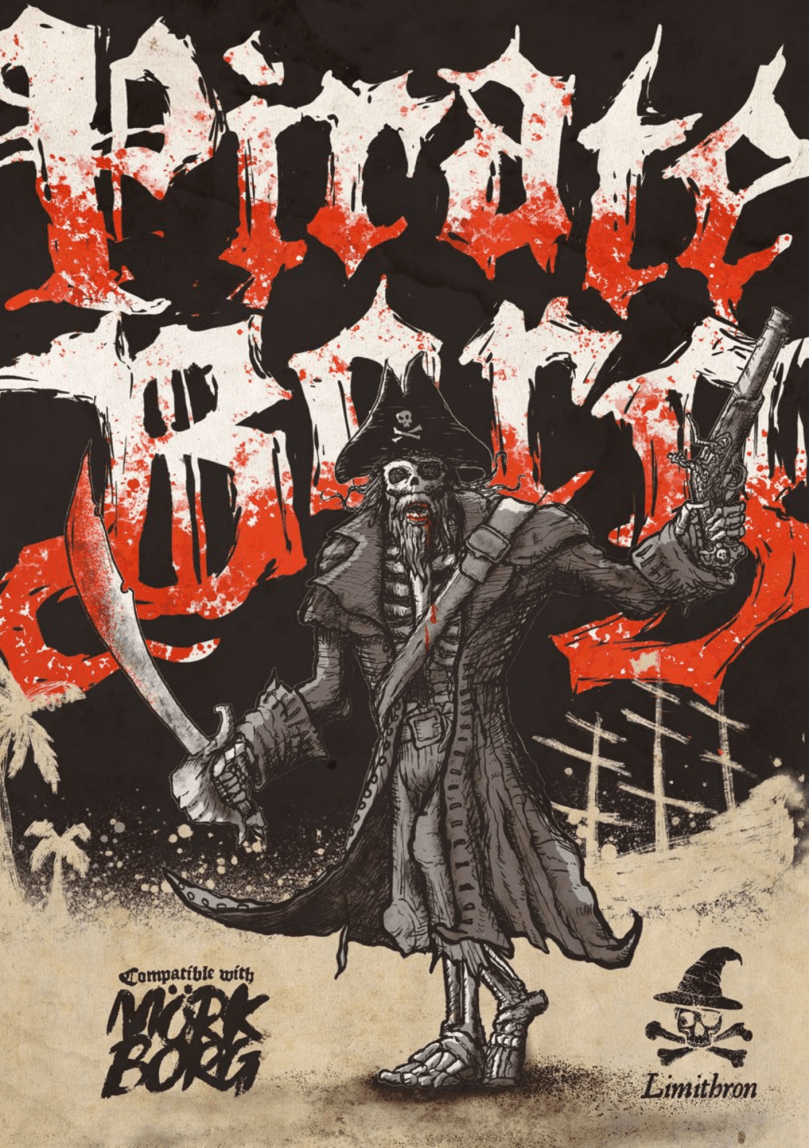
Pirate Borg is a dark fantasy piratical TTRPG system by Limithron, based on Mörk Borg.
Disclaimer: We were provided with a free digital copy of this product.
You might be familiar with the dark and gritty aesthetics of Mörk Borg, and Pirate Borg follows in those footsteps; you are a pirate, but not a very jolly one. The world sucks, and it’s about to suck a whole lot more for everyone – especially you. If you’re not familiar with it, however, I guess a rough approximation would be “Darkest Dungeon, but with Pirates of the Caribbean”.
We’re taking a look at the Core Rulebook today; there are some additional supplements out, but we’ll keep them for another time.
The Setting
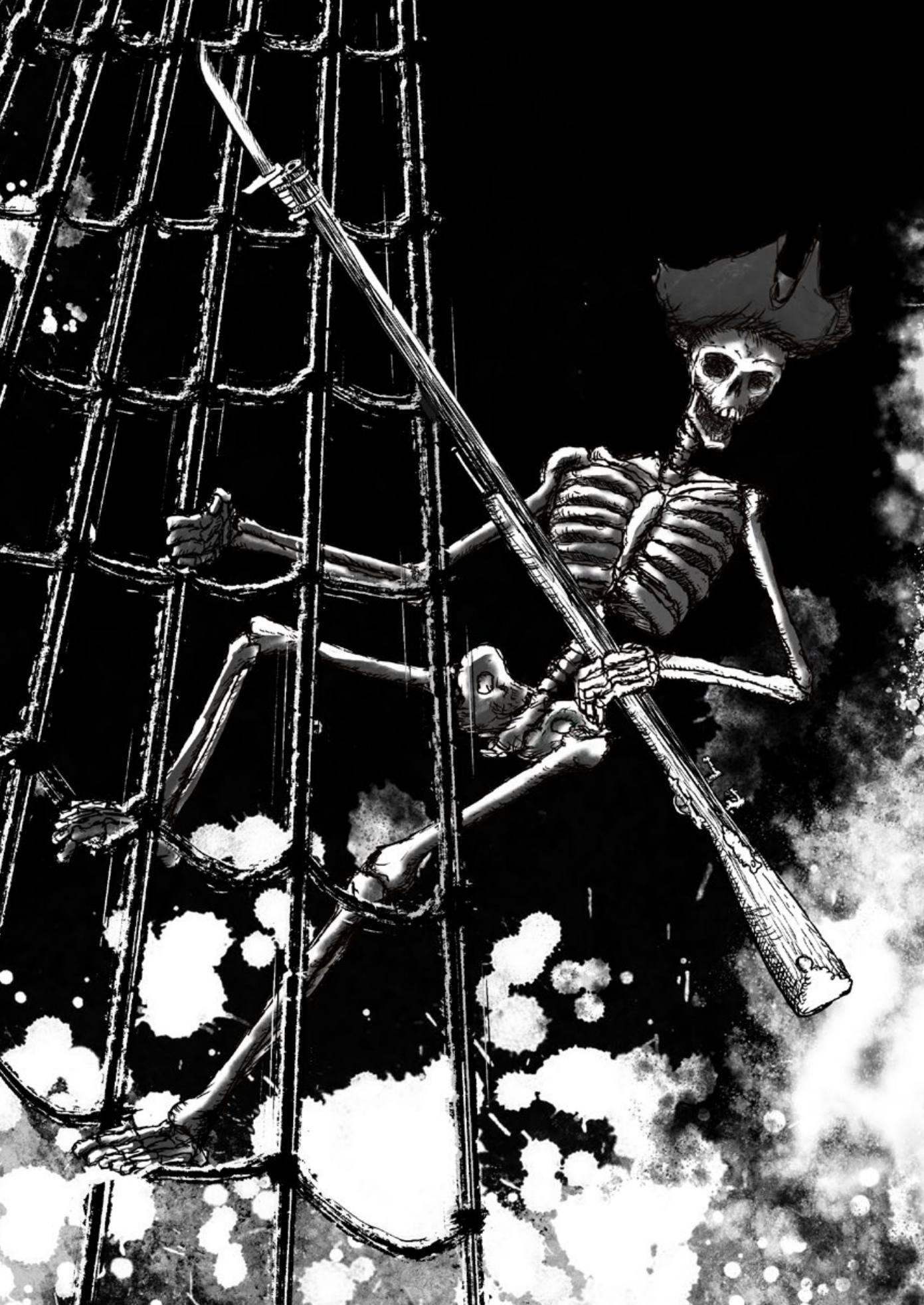
Mörk Borg takes place in an original dark fantasy world, with lots of inspiration from black/doom metal and a mostly Nordic theme. In contrast, Pirate Borg takes place on Earth – a bit different than ours, but still Earth nonetheless. But just like Mörk Borg, it is an apocalyptic setting – not a post-apocalyptic, keep in mind, but full-on apocalyptic: the end is not there yet, but it’s coming very, very soon, and you won’t see past it.
With that out of the way, the main area that the setting inhabits is the Caribbean in the golden age of piracy, the century roughly from 1650 to 1750. The Spanish, English, and French are in a constant state of war in the New World, pirates are everywhere, and then the beginning of the end arrives. Undead start to rise from the depths, ravaging entire cities with their increasing assaults. Cultists and warlocks spread terror with their black magic. Ships made of flesh and bone, enormous krakens and otherworldly monstrosities, fishmen and sirens and mutants claim the seas, and nothing stays dead for long. In the end, Armageddon arrives to destroy the world – and following in the footsteps of Mörk Borg, you are instructed to toss the book into the sea when you get to that point (well, Mörk Borg originally told you to set the book on fire, but we’re also on a nautical theme here).
There’s a lot more to talk about – for example, a big part of the world is Ash, the dusty remnants of “killed” undead that people snort, smoke, inject, and inhale for magical boosts, a hallucinogenic high, or to straight-up die if they’re unlucky. There are hidden temples with ancient mysteries in the jungles of Yucatán. There’s the Necronomicon, there’s the Scourge (this entire city must be purged!), the Inquisition is making its way around, and so is Blackbeard – a lot of stuff, as I said, all very much in line with the story and the theme, but I’ll let you explore them on your own pace.
The System
Pirate Borg is rules-light, focusing on quick resolution of pretty much any action. It also has a lot of rolling for your character creation – in the sense that most of your choices are made randomly, not on your own, though of course you can disregard that. It’s also pretty lethal – characters are fragile, there are ways that you can die instantly from a bad roll, and in general, you’re in a constant struggle to survive, a struggle that you’re destined to lose. So it’s certainly not for everyone, but you can have a lot of fun if you let go and embrace the chaos.
Characters are pretty simple. You have 5 Abilities: Strength, Agility, Presence, Toughness, and Spirit. For each, you roll 3d6 – the total you get corresponds to a modifier, starting from -3 for 3-4 and getting up to +3 for 17-18. The sum isn’t used after character creation – you just keep the modifiers. To make a Test, you roll a d20 and add the appropriate modifier, and check against a Difficulty Rating. Melee attacks use Strength and ranged attacks use Agility, and you hit on a 12. Defense is also a DR12 Agility test to avoid getting hit. Armor reduces damage taken, up to a d6. That’s pretty much it for mechanics – there’s also criticals on a ant 20 and fumbles on a nat 1. The next step for your character is to roll or choose a class; there are 6 main classes in the Core Rulebook, the Brute, Rapscallion, Swashbuckler, Zealot, and Sorcerer, with 2 extras that are special classes, the Haunted Soul and the Tall Tale (undead or other species respctively – and by other species it means Merfolk, Aquatic Mutant, or Sentient Animal – yes, you can be a jaguar, a crocodile, or even a rat or a chicken). Each class is about a page long – it gives you a bonus and a penalty to some abilities, your starting HP (a die for your starting HP, really, you also roll for that), some starting equipment that you also roll for, and a list of abilities you roll for when you gain experience. Yes, even levelling up is randomised.
Alternatively, you can choose to be a Landlubber and have no class, instead getting the upside of rolling 4d6 and dropping the lowest result for your abilities. Finally, there’s one more mechanic before you’re done – the Devil’s Luck. Most classes start with a d2 for it, except the Sorcerer and Zealot, which start with a d4. When you’ve used up all your Luck Points, you roll your d2 (or d4) after resting and regain that many. You can use Luck Points to reroll any die roll, reduce damage taken by d6, neutralise a crit or a fumble, lower one test’s DR by 4, or deal max damage with one attack, so it’s one small extra bonus you get to stay alive just a bit longer. Very powerful, obviously, but also very limited, so use it properly.
There’s some additional small systems in place for things like arcane rituals, alchemy, naval combat (which is a bit more involved, as you can expect to see plenty of it), and there are also a lot of random tables for you to roll and generate anything you might need; treasures, rumors, jobs and quests, ships, uncharted islands, and of course other pirates. There’s also a Bestiary – not a very big one, but it covers all the important parts: pirates, sailors, undead, beasts, and monsters are all there, along with a quick page for you to roll and create your own.
Finally, there’s also a small module included, The Curse of Skeleton Point. I wouldn’t call it an introductory adventure, and neither do the authors – it’s more of a sandbox mini-setting, with info on some important NPCs and a dungeon crawl attached. I think it does a pretty good job getting you into the spirit of things, though I’d suggest you have some experience as a GM before trying to run it – but I will also say that your players don’t need to be experts. Since it’s a very lightweight system, you can have first-timers to introduce it, though I will repeat again that you should make sure they’re alright with the dark, despairing, gritty and gory theme.
The Art
I can’t not mention the art, of course. Mörk Borg is a bit famous for having a very… particular style of book, and Pirate Borg also delivers in the same vein. There’s amazing art plastered all over the book, and a lot of pages are very stylyzed, with very dark and even black background with red or white text, and sometimes the text is a bit jumbled up and with changing sizes and fonts – but admittedly while it’s very cool optically, it can often be hard to read, especially on smaller screens if you have the digital version.
Final Thoughts
Pirate Borg is a worthy addition to the Mörk Borg… universe, let’s call it. But even independent of that, it’s super easy and lightweight as a system, extremely flavorful and interesting as a setting, and a beautiful book. You can get the PDF version in DriveThruRPG, but if you want the hardcover physical book, you can get it through Free League Publishing or Limithron themselves.
This post contains affiliate links. By using them, you support the blog without any extra charge being applied to you.
Join Our Mailing List
Do want…
- Extra content?
- Discounts?
- Updates about all our work?
 The Kind GM
… I will admit to being intrigued by the possibility of playing a pirate chicken… 0_o
LikeLike